
IndiGo’s Blackmailing a Warning: Tomorrow Private Defence Manufacturers May Blackmail the Nation – Veteran Trade Union Leader C. Srikumar
Srikumar himself is stranded in Pune due to cancellations for four days now!
OPINION PIECE
The unprecedented chaos in India’s aviation sector has “shaken the entire country,” said veteran trade union leader C. Srikumar, warning that the ongoing crisis involving IndiGo is not just a failure of operations but a “collapse of the entire Civil Aviation system.”
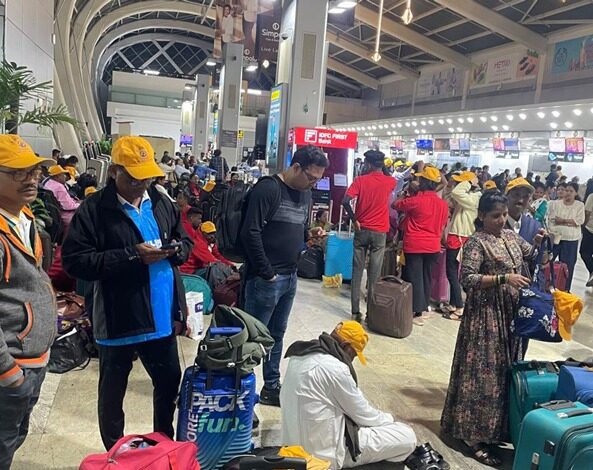
For five consecutive days, passengers across the country have faced mass flight cancellations, lack of information, and no emergency response teams at airports. According to Srikumar, “Passengers were treated worse than animals,” with young, newly recruited IndiGo staff left helpless and exposed to public anger.
‘DGCA bowed down to IndiGo’s blackmail’
Srikumar said the aviation regulator’s decisions worsened the crisis.
“IndiGo’s blackmailing resulted in DGCA bowing down and relaxing safety norms. Despite knowing that IndiGo did not have enough pilots to operate their approved routes, new routes were cleared and tickets were sold indiscriminately,” he said.
Passengers came to know of cancellations only after reaching the airport. People travelling for funerals, job interviews, medical emergencies, pregnant women, senior citizens, and children were left stranded without support. Many waited for hours without food, guidance, or updates.
As IndiGo flights were grounded, other airlines reportedly hiked their fares by up to ten times, worsening the crisis. The government later imposed fare caps, but “the damage was already done,” Srikumar noted.
A personal ordeal: ‘I am stuck in Pune for four days’
Srikumar himself is stranded in Pune due to cancellations. He narrated the ordeal of a friend’s sister who arrived from Nairobi on IndiGo Flight 6E 1854, scheduled to connect to Bhubaneswar.
Her connecting flight was cancelled at the last minute. IndiGo staff rerouted her via Hyderabad, issued a boarding pass, and then failed to operate that flight as well.
“Her flight was cancelled at 11 am. She got her baggage only at 5 pm. ‘Please wait’ was the only answer she received for hours,” he said.
She has since filed a complaint with DGCA.
‘Excessive privatization and monopoly-friendly policies are to blame’
Srikumar linked the aviation meltdown to deeper policy failures.
“This crisis is the result of long-term policies of excessive privatization, monopolistic market power, outsourcing, and weakening labour protections.”
He argued that large private players like IndiGo were allowed to gain a dominant market share, forcing smaller airlines out. Lean staffing, fixed-term employment, and stretching pilots’ duty hours close to 12 hours have become normalized, he said, despite being unsafe.
Drawing a sharp parallel with defence production, Srikumar warned: “Today one private airline has blackmailed the entire nation. Tomorrow private defence manufacturers may do the same.”
He said growing reliance on private companies for arms and ammunition may allow them to “dictate terms to the Government” if public sector units like the Ordnance Factories continue to be weakened.
Warnings for Railways, Defence, Power, and Public Transport
Similar risks exist across strategic sectors—Railways, Electricity, Public Transport—where corporatization and outsourcing have increased stress, job insecurity, and risk of accidents, he said.
The abolition of the Old Pension Scheme (OPS) and the uncertainty among Central Government employees add to systemic stress.
‘Government must strengthen PSUs and review anti-worker policies’
Srikumar made a strong appeal:
- Review privatization and outsourcing in aviation, defence, railways, and other strategic sectors
- Strengthen Government institutions and PSUs
- Revisit the four Labour Codes and FDTL norms in consultation with employee unions
- Ensure humane working conditions, guaranteed social security, and old-age pensions
- Regularize contract, casual, and fixed-term workers in Government and PSUs
He welcomed the recent Madras High Court judgment directing regularization of hundreds of contract workers at BHEL, calling it a model for all public sector employers.