
SAIL: Chairmen Come and Go, Steel Marches On -Indian Steel Sector Stands Strong Beyond Thousands of Amarendu Prakash
Why India Can Look Beyond Conventional Pathways—and Find Another Vikas Kaushal for SAIL
OPINION PIECE
Speculation in certain quarters regarding the possible exit of SAIL Chairman Amarendu Prakash from the public sector steel major to explore opportunities in the private sector continues to surface from time to time. These unverified discussions have, in turn, prompted questions within sections of the Steel Ministry ecosystem and among policy observers.
Just while surfing the news, I came across a comment from a delusionist suggesting that India’s steel sector would be at the receiving end if this so-called transformation were to take place. I couldn’t stop myself from etching these words down.
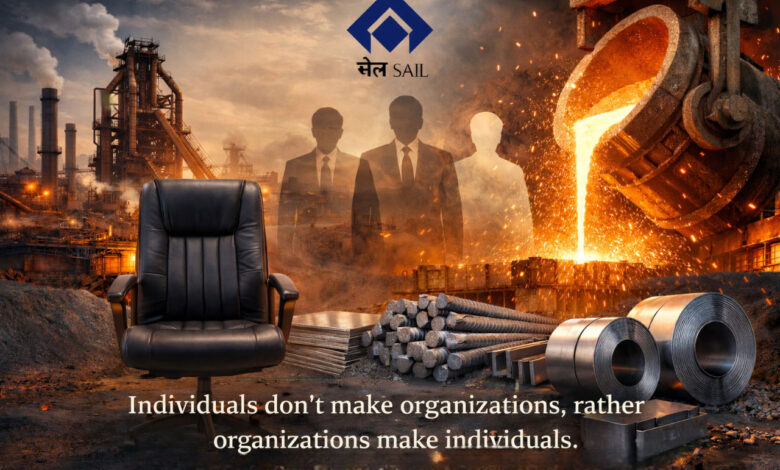
My Take – India’s steel sector will not tremble because someone may leave; it trembles only when institutions are weakened—and gossip, however loud, has never melted steel. India’s steel sector is not a personality cult that collapses with a chair being vacated. It has endured policy somersaults, global dumping, raw material shocks and bureaucratic drift. To imagine it would “be at the receiving end” because of one individual’s hypothetical exit is not analysis—it is delusion.
STEEL IS FORGED IN BLAST FURNACES, NOT IN GOSSIP COLUMNS, AND INSTITUTIONS OUTLAST EGOS EVERY SINGLE TIME.
Against this backdrop, www.indianpsu.com has examined potential scenarios that could arise should any such leadership transition occur, and what implications—if any—it might have for the broader steel sector. However, the perspective presented here differs from more conventional or linear assessments that tend to view individual leadership changes in isolation.
This analysis seeks to place the discussion within a wider institutional and sectoral context, focusing on structural depth, governance mechanisms, and leadership availability rather than on any single individual or speculative outcome.
As the saying goes, one person’s loss can often turn out to be another’s gain. So, if Amarendu Prakash were to move on from the top post of Steel Authority of India Limited (SAIL) to explore an opportunity within the private sector — would it amount to a grave loss for India’s steel sector?
The unequivocal answer is a resounding NO.
It is being said that he may not be making this transition alone and that another Director or two from SAIL—person or persons with reasonable experience in handling steel plants—could also be moving alongside him.
Even if that were to be the case, the answer remains unchanged: NO.
India does not suffer from a shortage of bright minds or capable professionals. The narrative of “brain drain” simply does not fit this situation. The country’s steel ecosystem, like several other strategic sectors, has developed a deep and resilient leadership pipeline over the decades.
Editor’s Note: I will anytime say – Bye-Bye, SAIL can prosper and perhaps do better without you, Sir!
Lessons to be learnt from recent past – glaring example of the appointment of Vikas Kaushal as CMD, Hindustan Petroleum Corporation Limited (HPCL)
A recent and telling example comes from the petroleum sector. Some months ago, the Ministry of Petroleum and Natural Gas, under the able leadership of Union Minister Hardeep Singh Puri, sent out a strong message that India has no dearth of professional leadership. Defying conventional expectations—and surprising many in the corridors of power and among those in the PSU leadership queue—the government chose Vikas Kaushal, a hardcore industry professional with not a single day of PSU experience, to head Hindustan Petroleum Corporation Limited (HPCL).
Vikas Kaushal assumed charge as Chairman & Managing Director of HPCL on March 17, 2025. A seasoned global energy leader with over three decades of experience, he is a Chemical Engineering graduate from DCET, Panjab University, and an MBA from IIM Ahmedabad.
He began his career with ICICI Limited before joining A.T. Kearney in 2000, where he spent more than two decades, including 17 years as a Partner. During his tenure, he served as Global Leader for Energy & Process Industries, Managing Director and Country Head of A.T. Kearney India, and Chairman of India Business. A two-time elected member of the firm’s Global Board, Kaushal also chaired its Finance & Audit and Governance Committees.
With deep expertise spanning oil & gas, power, renewables, and new energies, he has advised leading Indian PSUs—HPCL, Indian Oil, BPCL, and GAIL—along with global energy majors, on large-scale transformations and strategic initiatives.
Today, HPCL is undergoing a visible metamorphosis. The PSU has entered a decisive growth phase, driven by the commissioning of a major technology upgrade at its Vizag refinery and the imminent start-up of the Barmer refinery in Rajasthan—two projects poised to significantly enhance refining margins, expand capacity, and strengthen earnings, among several other developments.
Interestingly, Kaushal reportedly took an almost 80 per cent pay cut to assume the leadership role at HPCL. In sum, it has turned out to be a win-win situation for India’s petroleum sector as well as the Ministry of Petroleum and Natural Gas.
The bottom line is clear: Leadership transitions may fuel speculation, but the depth of professional talent and institutional strength ensures uninterrupted momentum for India’s steel industry. Ultimately, no one is indispensable, and no individual is bigger than the organisation they serve. Whether in steel or petroleum, India’s PSUs demonstrate that institutional strength, governance frameworks, and the availability of capable professionals ensure continuity, even as leadership transitions occur. The lessons from appointments like HPCL CMD Vikas Kaushal further reinforce the point: the sector’s momentum rests on collective capability, not any single career move.
AFTER ALL, WE ARE THE VISHWA GURU, JUST WAIT FOR 2047 – FOR THE VIKSIT BHARAT, OUR VIKSIT BHARAT
Disclaimer: This article is an opinion-based analysis. The views expressed herein are personal and are based on publicly observable institutional patterns, industry practices, and general governance frameworks. They do not constitute statements of fact regarding any individual, organisation, or appointment, nor should they be construed as confirmation of any reported or unreported development.