
EU–Mercosur Free Trade Deal Signed, Signals Strategic Independence
The deal will create one of the world’s largest free trade zones, covering nearly 785 million people and accounting for around 20 per cent of global GDP
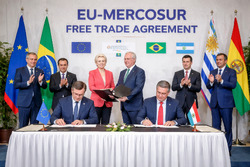
The European Union and the Mercosur bloc of South American nations have signed a landmark Free Trade Agreement (FTA), concluding negotiations that began more than 25 years ago. The agreement was signed in Asunción, Paraguay, and is being seen as a major geopolitical signal of the EU’s intent to diversify trade ties beyond the US and China.
The deal will create one of the world’s largest free trade zones, covering nearly 785 million people and accounting for around 20 per cent of global GDP. The agreement brings together the EU and five Mercosur countries — Argentina, Bolivia, Brazil, Paraguay and Uruguay — and proposes the elimination of tariffs on over 90 per cent of goods, subject to ratification by member states.
Once implemented, the pact is expected to strengthen supply chains, improve access to critical raw materials and enhance trade resilience at a time of rising protectionism globally. The EU’s share of Mercosur imports has declined sharply over the years, with China now holding a significantly larger share, making the deal strategically important for Europe.
However, the agreement has triggered opposition within the EU. France voted against the deal, with Italy backing French concerns, particularly over the impact on European agriculture. Farmers in France and Greece have staged protests, arguing that imports from Latin America may not meet the EU’s strict production and environmental standards.
Negotiations for the EU–Mercosur trade deal began in 1999, with an agreement in principle reached in 2019, but environmental and political concerns delayed the final signing.
Despite opposition, the deal is being viewed as a crucial step toward reviving large multilateral trade agreements and reinforcing the EU’s strategic autonomy in an increasingly fragmented global trade order.
The writer of this article is Dr. Seema Javed, an environmentalist & a communications professional in the field of climate and energy