
Urban Heat Emerging as Major Economic and Public Health Risk for India: Experts Warn of 2.5% GDP Impact
Need for Localised Data and Heat-Resilient Urban Planning
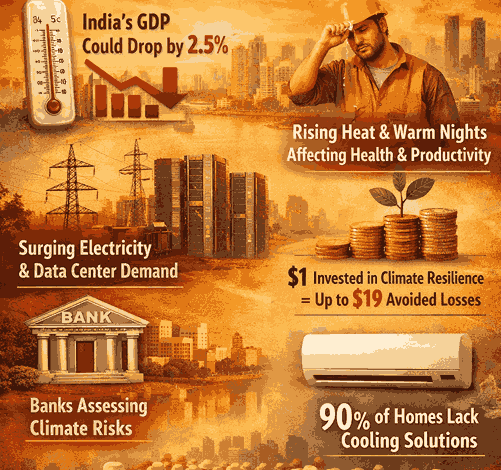
Urban heat is fast emerging as one of India’s most significant — yet under-addressed — economic and public health risks, with experts warning that unchecked temperature rise could reduce the country’s GDP by up to 2.5%.
The concerns were highlighted during the ‘Urban Heat in India: Economic and Public Health Impacts’ roundtable co-hosted by Climate Trends and World Trade Center Mumbai ahead of Mumbai Climate Week 2026, bringing together leaders from energy, MSMEs, textiles, finance, insurance, and sustainable investment sectors.
Rising Heat Reshaping Economy and Cities
Opening the discussion, Vijay Kalantari, Chairman of World Trade Center Mumbai, cautioned that rising heat poses a systemic threat not only to Mumbai but to the entire country.
He stressed that urban planning must undergo a fundamental shift, noting that unchecked construction and dense urbanisation have intensified heat stress across cities.
Experts at the roundtable highlighted that warm nights are increasing faster than hot days, worsening health outcomes and reducing worker productivity. Rising humidity levels are also amplifying “feel-like” temperatures, making heat exposure more dangerous.
Climate Resilience Investments Offer High Returns
Aarti Khosla, Founder and Director of Climate Trends, emphasised the urgent need for financial mechanisms and inclusive solutions reaching the last mile of India’s economy.
According to discussions, every $1 invested in climate resilience can generate up to $19 in avoided losses, underlining the economic case for early adaptation through climate-resilient infrastructure rather than costly emergency responses later.
Majority of India at High Heat Risk
Vishwas Chitale, Fellow at the Council on Energy, Environment and Water (CEEW), noted that nearly 60% of India’s districts face high to very high extreme-heat risk, affecting almost 70% of the population.
He warned that increasing warm nights represent a dangerous emerging trend and called for deeper research into affordable and scalable solutions.
Electricity Demand Patterns Rapidly Changing
Heat stress is also reshaping India’s electricity demand profile. Shashank Jewalikar, Executive Director at Maharashtra State Load Despatch Centre, said cooling demand is driving new evening peak loads while energy-intensive data centres are adding concentrated pressure on power infrastructure.
Localised heat effects, he noted, are making grid planning increasingly complex.
Industry Supply Chains Under Stress
Companies with extensive supply chains are already witnessing operational challenges. Ankit Gupta, General Manager at ITC, said the conglomerate is identifying high-risk locations and building controlled work environments using traditional and in-house adaptation techniques due to limited publicly available heat-risk data.
In the textile sector, Manish Daga, Founder CEO & President of Cotton FPO Association, highlighted severe workplace risks, particularly for labour-intensive operations.
He warned that extreme heat directly affects worker safety and disproportionately impacts women workers, making stronger compliance and workplace standards essential.
Financial Sector Treating Heat as Material Climate Risk
Financial institutions are increasingly recognising heat as a systemic climate risk.
Smitha Hari, President of AuctusESG, emphasised that heat exposure varies significantly across sectors and must influence capital allocation decisions.
Deepak Kumar, DGM at Union Bank of India, said the bank now treats heat — alongside biodiversity and nature risks — as one of 13 climate hazards and is developing a comprehensive climate risk assessment framework, aligned with broader initiatives by the Reserve Bank of India.
Investment, Insurance and Cooling Solutions Critical
Meraj Inamdar of the National Institute of Securities Markets pointed out that India’s Business Responsibility and Sustainability Reporting (BRSR) framework does not yet explicitly capture heat exposure risks, despite rising worker fatalities in heat-exposed sectors.
Hardik Shah of DSP Asset Managers said investors are beginning to quantify climate risks, though most still prioritise carbon mitigation over adaptation. He stressed the growing importance of parametric insurance as climate events intensify.
Labanya Prakash Jena, Director at Climate and Sustainability Initiative (CSI), highlighted that nearly 90% of Indian homes lack air-conditioning, making affordable cooling solutions a development priority rather than a luxury.
Need for Localised, Data-Driven Solutions
Participants unanimously agreed that lack of granular heat data, weak risk modelling, and limited financing mechanisms are major barriers to adaptation.
Experts called for localised planning, sector-specific risk assessments, improved workplace standards, and targeted capital allocation to manage what is increasingly being recognised as one of the biggest risks facing India’s economy and public health systems.
The writer of this article is Dr. Seema Javed, an environmentalist & a communications professional in the field of climate and energy