
Government Reviews West Asia Situation; Energy Supplies Secure, LPG Production Rises 25%
About 9,000 Indian nationals are currently in Iran, and Indian students and pilgrims have been relocated from Tehran to safer cities
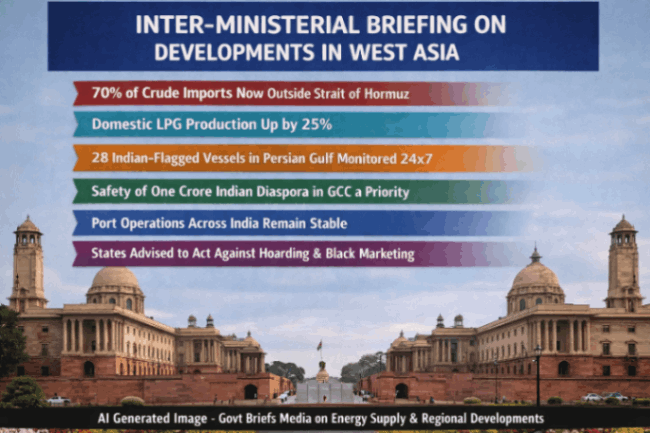
The Government of India on Wednesday held an inter-ministerial briefing at the National Media Centre to review the evolving situation in West Asia and assess its impact on energy supplies, maritime operations, and the safety of Indian nationals in the region.
Senior officials from the Ministry of Petroleum and Natural Gas, Ministry of External Affairs, Ministry of Ports, Shipping and Waterways, and Ministry of Information and Broadcasting briefed the media on preparedness measures being taken by the government.
The briefing highlighted that India’s energy supplies remain secure despite disruptions in the Strait of Hormuz, with the government implementing several contingency measures to ensure uninterrupted fuel availability and safeguard national interests.
Crude Oil Supplies Remain Stable
Officials said India’s crude oil supply position remains stable due to diversified sourcing.
India currently consumes about 55 lakh barrels of crude oil per day, and procurement from around 40 countries has ensured adequate supply. As a result of diversification, about 70 percent of India’s crude imports are now routed through alternatives outside the Strait of Hormuz, compared with about 55 percent earlier.
Two additional crude cargoes are already en route to India and will further strengthen supply. Refineries across the country are operating at very high utilisation levels, in some cases exceeding 100 percent capacity.
Natural Gas Supplies Adjusted to Protect Priority Sectors
India’s total natural gas consumption stands at about 189 MMSCMD, of which 97.5 MMSCMD is produced domestically. Around 47.4 MMSCMD of gas supply has been affected due to force majeure conditions, officials said.
To manage the situation, the government issued a Natural Gas Control Order on March 9, 2026, under the Essential Commodities Act to prioritise supply to essential sectors.
Under the revised allocation framework:
- Domestic PNG supply and CNG for vehicles will receive 100% supply
- Tea industries and manufacturing units will receive about 80% of their previous six-month average supply
- Fertiliser plants will receive about 70% supply
- Refineries and petrochemical units will face around a 35% reduction
Meanwhile, gas companies have secured LNG cargoes from alternative sources, with two shipments already on their way to India.
Domestic LPG Production Increased by 25%
India imports about 60 percent of its LPG consumption, with nearly 90 percent of these imports passing through the Strait of Hormuz, which has been affected by recent developments.
To address potential disruptions, the government issued directions on March 8, 2026, asking refineries and petrochemical complexes to maximise LPG output by diverting propane, butane, propylene and butenes streams to the LPG pool.
As a result, domestic LPG production has increased by about 25 percent, and the entire domestic production is now being directed toward household consumption.
For non-domestic LPG, priority is being given to essential sectors such as hospitals and educational institutions.
A three-member committee comprising Executive Directors of Indian Oil Corporation, Hindustan Petroleum Corporation and Bharat Petroleum Corporation has been formed to review LPG allocations to restaurants, hotels and other commercial users to ensure fair distribution.
LPG Prices and Supply Monitoring
The price of a domestic LPG cylinder in Delhi currently stands at ₹913, following a recent increase of ₹60. However, for PM Ujjwala Yojana beneficiaries, the price remains ₹613 per cylinder.
Officials noted that despite a 41 percent increase in Saudi Contract Prices since July 2023, the price for PMUY consumers has fallen by around 32 percent due to government support.
The government has also approved ₹30,000 crore compensation to oil marketing companies to cover LPG under-recoveries.
Authorities have observed some panic booking and hoarding, but said the normal delivery cycle remains about 2.5 days. Consumers have been advised not to rush bookings.
To curb diversion and misuse, the Delivery Authentication Code (DAC) system is being expanded to cover about 90 percent of consumers. As a temporary demand management measure, the minimum gap between LPG bookings has been increased from 21 days to 25 days.
Maritime Safety Measures in Persian Gulf
The Ministry of Ports, Shipping and Waterways said 28 Indian-flagged vessels are currently operating in the Persian Gulf region.
Of these:
- 24 vessels are located west of the Strait of Hormuz, carrying 677 Indian seafarers
- 4 vessels are east of the Strait, with 101 Indian seafarers on board
A 24-hour control room has been operational since February 28, 2026, to monitor developments and coordinate assistance.
The Directorate General of Shipping has also issued advisories directing vessels and seafarers to adopt enhanced security protocols and submit crew details for monitoring.
Port Operations and Trade Continue Normally
Officials said port operations across India remain stable, with authorities monitoring vessel movements and cargo flows to ensure continuity of export-import trade.
Major ports have been instructed to extend necessary assistance to exporters and maintain real-time monitoring of developments in the region.
Safety of Indian Diaspora in the Region
The Ministry of External Affairs said the welfare of about one crore Indian nationals living in Gulf Cooperation Council countries remains a priority.
The Prime Minister has spoken with leaders of several countries including UAE, Qatar, Saudi Arabia, Oman, Bahrain, Kuwait, Jordan and Israel.
The External Affairs Minister has also been in regular contact with counterparts in the region, including Iran.
Officials confirmed that two Indian nationals have died and one remains missing following attacks on merchant vessels, while some injured Indians are receiving treatment.
About 9,000 Indian nationals are currently in Iran, and Indian students and pilgrims have been relocated from Tehran to safer cities. The government is also assisting individuals seeking to return to India via land routes through Armenia and Azerbaijan.
States Asked to Prevent Hoarding
The Union Home Secretary has held a meeting with Chief Secretaries and Directors General of Police of all States and Union Territories, advising them to prevent hoarding and black marketing of essential commodities.
States and UTs have also been asked to nominate official spokespersons to provide regular public updates and ensure verified information is disseminated through official channels.
The government said it continues to closely monitor developments in West Asia and remains committed to ensuring energy security, maritime safety, protection of Indian nationals abroad, and uninterrupted availability of essential supplies.