

Urea Self-Sufficiency or Hidden Dependence on Imported Gas? India’s Fertiliser Subsidy Puzzle
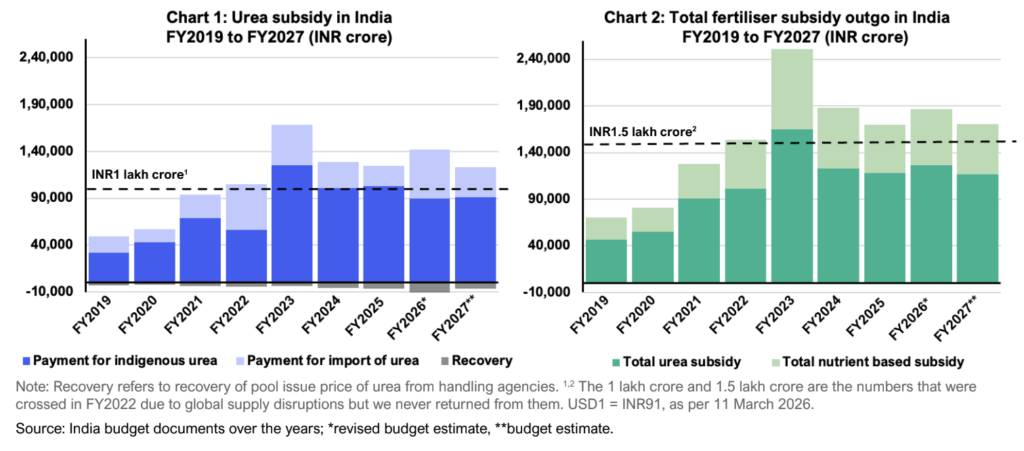
The urea subsidy, which constitutes the largest component of the fertiliser subsidy, has exceeded ₹1 trillion (USD 10.9 billion) annually for the past six years
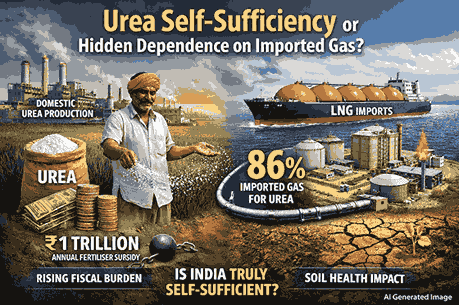
India’s fertiliser subsidy continues to be one of the largest recurring expenditures in the Union Budget, driven primarily by regulated urea prices and volatility in global input costs. While the subsidy mechanism ensures affordable fertilisers for farmers, it is increasingly placing a heavy burden on public finances and limiting fiscal space for long-term agricultural investments.
The urea subsidy, which constitutes the largest component of the fertiliser subsidy, has exceeded ₹1 trillion (USD 10.9 billion) annually for the past six years. In the current financial year, the government has budgeted ₹1.17 trillion (USD 12.7 billion) for urea subsidies alone.
Domestic Production Push
In recent years, the government has focused on increasing domestic urea production to reduce import dependence. As part of this strategy, six new urea plants have been commissioned over the past six years, leading to a record level of domestic production in FY2023-24.
However, this achievement masks a deeper challenge. The same year that witnessed record domestic output also saw a sharp rise in the use of imported natural gas in urea production.
Limited Impact of DBT Component
The fertiliser subsidy framework includes a Direct Benefit Transfer (DBT) mechanism under which fertiliser companies receive 100% of the subsidy based on actual sales recorded through Aadhaar-enabled Point-of-Sale (POS) devices at retail outlets.
Despite the technological push, the DBT component has remained extremely small:
- Less than ₹10 crore annually until FY2024 (except ₹12 crore in FY2022)
- ₹19 crore in FY2025
- ₹32 crore in FY2026
Surprisingly, no allocation has been made for this component in the FY2026 Budget, raising questions about the government’s long-term DBT strategy in fertiliser distribution.
Rising Fertiliser Imbalance and Soil Health Concerns
The heavy subsidy on urea has also distorted fertiliser usage patterns in India. According to the Economic Survey 2026, the Nitrogen : Phosphorus : Potassium (N:P:K) ratio has deteriorated significantly.
- FY2010: 4 : 3.2 : 1 (close to the recommended balance)
- FY2020: 7 : 2.8 : 1
- FY2024: 10.9 : 4.1 : 1.68
This imbalance indicates excessive nitrogen usage, which is damaging soil health and reducing long-term agricultural productivity.
The Economic Survey recommends restructuring the subsidy system by modestly increasing urea prices while transferring equivalent support directly to farmers on a per-acre basis. Such a system could preserve farmers’ purchasing power while aligning fertiliser prices closer to their actual agronomic costs.
Fertiliser Subsidy Crossing ₹1.5 Trillion
To encourage balanced fertilisation, India introduced a Nutrient-Based Subsidy (NBS) for phosphatic and potassic (P&K) fertilisers over a decade ago. Despite this reform, the total fertiliser subsidy has remained extremely high.
For the past five years, the annual fertiliser subsidy bill has exceeded ₹1.5 trillion, and it is projected to reach ₹1.7 trillion (USD 18.5 billion) in FY2027.
Hidden Dependence on Imported LNG
Another structural challenge is emerging from the fertiliser sector’s growing dependence on natural gas.
Affordable domestic natural gas supplies are limited and are prioritised for sectors such as city gas distribution and industries, which can pass higher costs to consumers.
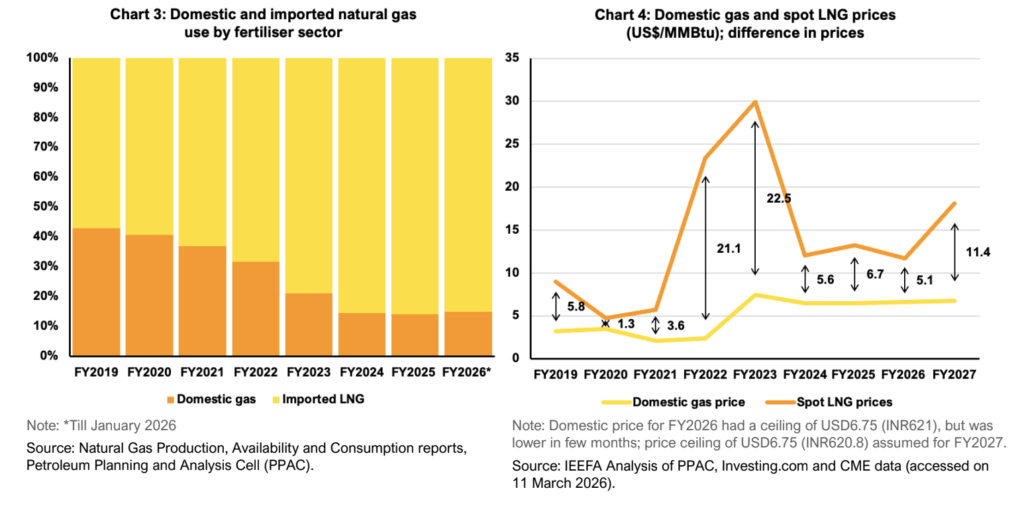
However, urea prices are government-controlled, preventing fertiliser producers from passing on higher input costs. As a result, fertiliser plants increasingly rely on imported natural gas or liquefied natural gas (LNG).
Currently, around 86% of the natural gas used in domestic urea production comes from LNG imports, raising concerns about the sustainability of India’s push for “self-sufficiency” in urea production.
Need for Structural Reform
The Economic Survey 2026 emphasises that India must recalibrate its fertiliser subsidy policy to ensure balanced fertiliser use, improve soil health, and enhance agricultural productivity.
Reforms that encourage judicious fertiliser application, better soil management, and rational pricing could reduce the subsidy burden while strengthening the long-term sustainability of Indian agriculture.
Without such structural changes, India’s apparent progress toward urea self-sufficiency may remain heavily dependent on imported energy, shifting the country’s vulnerability from fertiliser imports to natural gas imports.
The writer of this article is Dr. Seema Javed, an environmentalist & a communications professional in the field of climate and energy