

SAIL Revises Compassionate Transfer Policy; CTC Meetings to Be Held Every Two Years
The move is likely to raise concerns among employees awaiting transfers on compassionate grounds
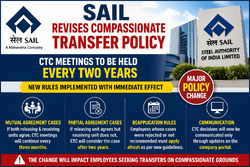
In a significant policy shift, Steel Authority of India Limited (SAIL) has revised its compassionate transfer policy for officers and employees, extending the interval for Compassionate Transfer Committee (CTC) meetings from once every three months to once every two years in specific cases.
The revised guidelines, issued by SAIL headquarters and implemented with immediate effect, are expected to have a substantial impact on employees seeking transfers on compassionate grounds such as family health concerns, education needs, and other personal exigencies.
Key Changes in Policy
Under the updated framework, SAIL has introduced differentiated provisions based on the level of agreement between the releasing and receiving units:
- Mutual Agreement Cases:
Where both the releasing and receiving units agree on a transfer request, the existing provision remains unchanged. Such cases will continue to be reviewed in CTC meetings held every three months. - Partial Agreement Cases:
In situations where the releasing unit agrees but the receiving unit does not, the review timeline has been significantly extended. These cases will now be taken up by the CTC only after a gap of two years, replacing the earlier three-month review cycle.
Changes in Reapplication Rules
SAIL has also revised the reapplication process:
- Previously, employees whose applications were rejected or kept pending by the CTC could reapply after one year.
- Under the new rules, employees whose cases were not recommended by the CTC will need to submit a fresh application in accordance with the revised guidelines.
Communication of Decisions
Another notable change is in how decisions are communicated. Going forward, outcomes of CTC meetings will be shared exclusively through updates on the company’s internal portal, eliminating other forms of direct communication.
Employee Concerns
The move is likely to raise concerns among employees awaiting transfers on compassionate grounds, as the extended review cycle in non-consensual cases could delay relief for those dealing with urgent personal circumstances.