

In Jharia’s Troubled Landscape, Beyond Coal Output, a Different Test of Leadership Is Unfolding at BCCL
The administrative approach of BCCL CMD Manoj Kumar Agarwal has begun to draw quiet attention
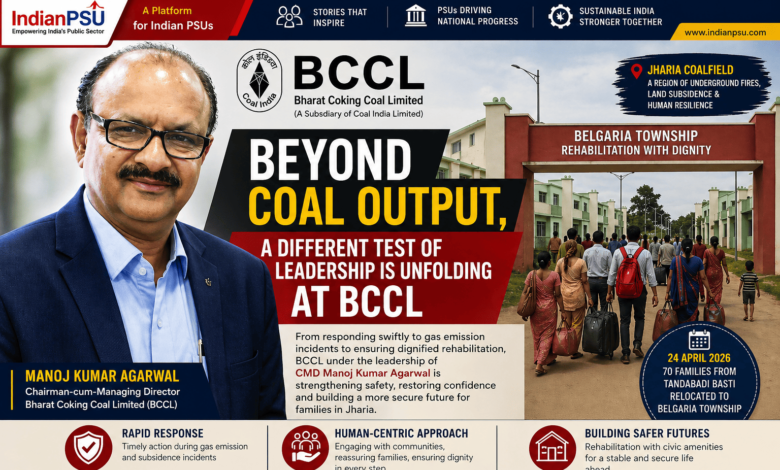
In Jharia, the challenge before Bharat Coking Coal Limited is not measured only in tonnes of coal.
In a region marked by gas emissions, subsidence and displacement, BCCL’s response under CMD Manoj Kumar Agarwal is increasingly being judged by administrative presence, rehabilitation and human sensitivity.
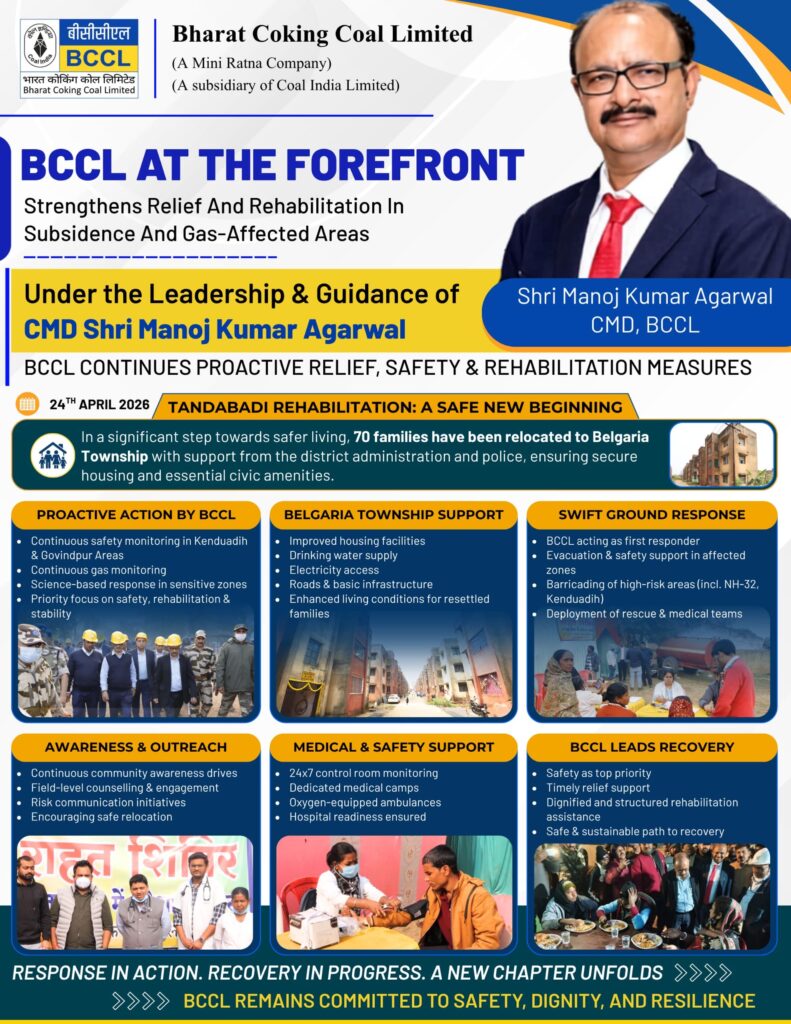
It is measured equally in unstable ground, sudden gas emissions, anxious settlements and the difficult task of moving vulnerable families toward safety.
That is why, in this disturbed mining belt, BCCL’s effectiveness is judged not merely by production targets but by how quickly and credibly it responds when distress reaches the doorstep of local communities.
It is in this more demanding test that the administrative approach of BCCL CMD Manoj Kumar Agarwal has begun to draw quiet attention.
Recent months have shown a visible pattern: whenever incidents involving gas seepage, subsidence threats or habitation distress emerge in vulnerable BCCL zones, the response has been quicker, more coordinated and more field-oriented.
The gas emission incident reported on December 3, 2025, at Rajput Basti in Kenduadih once again exposed the fragile conditions in which many families continue to live.
In such locations, even a limited technical disturbance quickly translates into public anxiety.
What has stood out in BCCL’s handling is that the response has not remained confined to technical inspection alone. Safety teams, local coordination and rehabilitation follow-up have increasingly moved together, giving affected residents a stronger sense that the institution is present on the ground when needed.
That administrative presence matters in Jharia
Communities living over unstable land do not judge institutions by circulars or notices. They judge them by how quickly help arrives, how officials engage, and whether relocation is handled with seriousness and dignity.
This became visible again on April 24, 2026, when 70 families from Tandabadi Basti were shifted to Belgaria Township with support from the district administration and police authorities. Belgaria remains central to the Jharia rehabilitation framework and each successful relocation carries significance beyond numbers.
Every family moved is one household taken out of immediate environmental risk
More importantly, every successful shift builds confidence among other hesitant residents that rehabilitation is becoming both credible and humane.
- No single PSU head can solve Jharia’s century-old problems overnight.
- Yet leadership often reveals itself in the pace of response and the seriousness of institutional follow-up.
- In BCCL’s case, Manoj Kumar Agarwal appears to be placing emphasis on exactly that — reducing the distance between corporate administration and field distress.
- For a coal company, output will always remain important.
- But in Jharia, credibility is increasingly being measured by something else as well: how responsibly the institution stands with the people living around its mines.
Editor's One Liner Conclusion
“Public confidence in vulnerable mining zones is built less by advisories and more by visible response.”
We Report – You Decide…