Amarendu Prakash – The “modern-day scientist” who innovated the art of flying SAIL Steel!
A whopping, over 6,50,000 tonnes of steel flew away to 40 unscrupulous firms now under Lokpal/CBI scanner
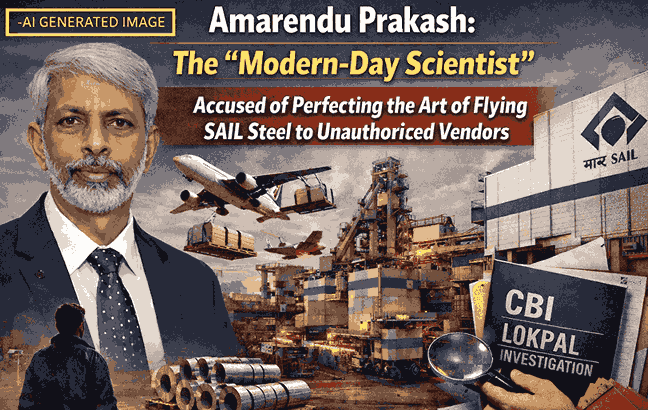
When Steel Became the Story…
Amarendu Prakash, the outgoing Chairman of Steel Authority of India Limited is no less than the biggest magician in the Steel Sector of the country and can easily be termed as the “modern scientist” who innovated the art of flying SAIL Steel!
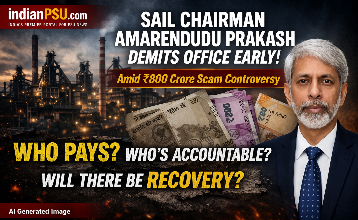
The steel behemoth PSU will be witnessing the unceremonious exit of Amarendu Prakash on April 1, 2026, as his replacement, if shortlisted by the Public Enterprises Selection Board (PESB) and cleared by the Appointments Committee of the Cabinet (ACC), would be occupying the top chair on April 02, 2026. It is indeed a crude reality that Prakash, who was to officially relinquish office in 2028, has been shown the exit gate, with his stint cut off by over two years but there would not be perhaps, a single person in SAIL, who would be shedding a tear on his dismissive retreat.
The unfolding developments inside Steel Authority of India Limited (SAIL) have opened one of the most debated chapters in the recent history of India’s steel sector. What was once portrayed as aggressive commercial outreach is now facing intense scrutiny, with investigative agencies examining transactions involving an estimated 6,50,000 tonnes of steel allegedly diverted to nearly 40 firms.
At the centre of the controversy stands Amarendu Prakash, the outgoing Chairman of SAIL, whose tenure is ending amid circumstances that many insiders describe as anything but routine. Investigations reportedly being examined by the Lokpal and the Central Bureau of Investigation have raised serious questions regarding commercial decisions taken during the period. While no final conclusions have yet emerged and due process remains underway, the scale of the alleged irregularities has sparked widespread concern across policy and industry circles. An Exit Before Time Prakash, whose tenure was officially expected to continue until 2028, is now set to demit office on April 1, 2026. The early exit — over two years ahead of schedule — has fueled speculation that the leadership change reflects deeper institutional unease rather than a routine administrative transition.
Within SAIL, several officials privately describe the moment as a reset phase for the organisation. The absence of visible resistance to the transition has itself become a talking point, signalling internal fatigue over controversies that had begun overshadowing operational achievements. The System Steps In The appointment of the next chairman will follow the established institutional process through the Public Enterprises Selection Board, with final approval resting with the Appointments Committee of the Cabinet. The incoming leadership will face a dual challenge — stabilising business operations while restoring confidence in governance mechanisms.
Industry observers note that India’s public sector enterprises are increasingly being judged not only on production numbers and profitability but also on transparency, compliance, and ethical commercial conduct. A Turning Point for SAIL?
For SAIL, the issue now transcends individuals. The larger question is whether the episode will lead to structural reforms in commercial oversight and accountability systems. If investigations substantiate wrongdoing, the case could emerge as a landmark example of institutional checks asserting themselves within India’s PSU ecosystem. If not, it will still serve as a reminder of how perception, governance, and public trust remain inseparable in large state-owned enterprises. Either way, the narrative surrounding SAIL has changed — from production targets and expansion plans to scrutiny, accountability, and the urgent need to rebuild credibility.
And here comes the change of narrative… The controversy surrounding Steel Authority of India Limited (SAIL) did not unfold in isolation; it evolved alongside shifting political equations in New Delhi. During the second term of the Narendra Modi government, when Jyotiraditya Scindia helmed the Steel Ministry, sources within policy circles recall a growing unease over complaints emerging from within the PSU. Those familiar with the developments claim that the minister was inclined toward decisive administrative action and a broader clean-up exercise aimed at restoring confidence in the system. But before any long-term institutional course correction could fully take shape, electoral politics intervened.
The transition to Modi 3.0 brought a change of guard in the Steel Ministry — a development that, according to insiders, altered the internal power dynamics surrounding SAIL’s leadership. Within certain quarters of the organisation, the reshuffle was perceived as a temporary easing of pressure for then Chairman Amarendu Prakash, who reportedly recalibrated his approach to navigate the new administrative environment.
That respite, however, proved short-lived. Sources indicate that friction soon surfaced between Prakash and senior ministry functionaries, signalling that concerns had not entirely dissipated. Around the same period, proceedings linked to the Lokpal gathered pace, prompting the Central Bureau of Investigation to begin examining additional complaints connected to the matter.
Officials familiar with the broader developments suggest that the evolving situation began attracting attention at the highest levels of governance, particularly in light of the Prime Minister’s repeatedly articulated stance of zero-tolerance toward corruption.
As institutional scrutiny tightened and investigative threads expanded, the space for manoeuvre reportedly narrowed, leaving the SAIL leadership confronting mounting administrative and reputational pressures. In retrospect, insiders say, the episode illustrates how swiftly fortunes can change in India’s PSU ecosystem — where political transitions may reshape equations, but investigative processes often continue on their own momentum.
“The furnaces of SAIL will continue to run, but the questions surrounding this chapter are unlikely to cool anytime soon.”