Centre Offers Additional 10% Commercial LPG Allocation to States to Push PNG Transition
CGD entities such as IGL, MGL, GAIL Gas, and BPCL have been directed to expedite household and commercial PNG connections
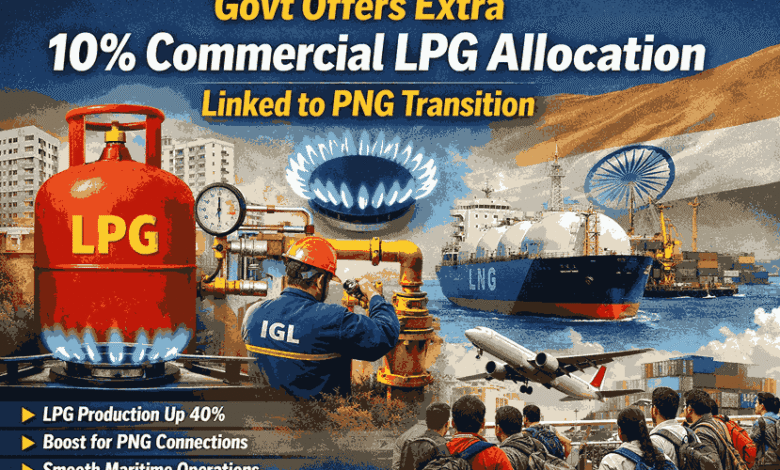
The Centre has announced an additional 10% allocation of commercial LPG to States and Union Territories, linking it to key reforms aimed at accelerating the transition towards Piped Natural Gas (PNG), amid evolving geopolitical challenges in West Asia.
The announcement was made during a high-level media briefing at the National Media Centre, Delhi, where officials from the Ministries of Petroleum and Natural Gas, External Affairs, and Ports, Shipping and Waterways shared updates on fuel availability, maritime safety, and assistance to Indian nationals abroad.
Push for PNG Adoption Gains Momentum
The government has urged States and UTs to implement reforms that support rapid expansion of the City Gas Distribution (CGD) network.
Under the new framework, additional LPG allocation will be linked to:
- Formation of State and district-level CGD committees (1%)
- Granting deemed permissions for CGD projects (2%)
- Introduction of “dig and restore” mechanisms (3%)
- Reduction in lease/rental charges (4%)
CGD entities such as IGL, MGL, GAIL Gas, and BPCL have been directed to expedite household and commercial PNG connections and clearly communicate timelines to consumers.
Fuel Supply Remains Stable Despite Global Tensions
Despite the closure of the Strait of Hormuz, the government reassured citizens that:
- All refineries are operating at high capacity
- No petrol or diesel shortages have been reported
- Domestic LPG production has increased by 40%
- No fuel dry-outs at retail outlets
Citizens have been advised not to panic buy, as adequate stocks are available across the country.
Priority Sectors Fully Protected
The government confirmed uninterrupted fuel supply to critical sectors:
- 100% gas supply to domestic PNG and CNG transport
- Around 80% supply maintained for industrial and commercial consumers
- Priority support for hospitals, cold storage units, and seed processing facilities
LPG Monitoring and Digital Expansion
Key improvements in LPG distribution include:
- Online LPG bookings increased from 83% to 93%
- Delivery Authentication Code coverage expanded to 81%
- Over 2,300 surprise inspections conducted to curb hoarding and black marketing
Additionally, 48,000 KL of kerosene has been allocated to States as an alternative fuel to ease LPG demand.
Maritime Operations Remain Smooth
India’s maritime sector continues to function without disruption:
- No congestion at major ports
- 22 Indian-flagged vessels operating safely in the Persian Gulf
- Over 472 Indian seafarers repatriated
- Ports like Visakhapatnam Port Authority have added storage capacity
Container congestion at Jawaharlal Nehru Port Authority (JNPA) has also reduced significantly.
Support for Indians in Gulf and Iran Intensified
The Ministry of External Affairs confirmed that:
- Over 2.6 lakh passengers have returned to India since February 28
- Indian Missions are operating 24×7 support systems
- Students in Iran have been relocated to safer areas
- Assistance is being provided for transit through Armenia and Azerbaijan
Flight connectivity is steadily improving:
- 70–75 flights daily from the UAE to India
- Additional services from Saudi Arabia, Oman, and Qatar
Government Advisory to Citizens
The government has urged citizens to:
- Avoid panic buying and rely on official information
- Use digital LPG booking platforms
- Consider switching to PNG or electric cooking alternatives
- Conserve energy wherever possible
Conclusion
The Centre’s strategy combines enhanced fuel production, strict monitoring, and structural reforms to ensure uninterrupted energy supply while promoting cleaner fuel alternatives like PNG. The additional LPG allocation linked to reforms is expected to accelerate India’s transition towards a more sustainable and resilient energy ecosystem.