Defence Procurement Needs Urgent Reform, Says AIDEF Leader C. Srikumar
After Industry Concerns, Warnings from AIDEF & OFB on Procurement Issues Were Ignored
OPINION PIECE
Defence procurement in India has long been criticised for procedural complexity and prolonged timelines that delay the induction of critical equipment into the Armed Forces. The issue has once again come into focus following recent remarks by industrialist Baba Kalyani, Chairman and Managing Director of Bharat Forge, who called for urgent reforms in the defence acquisition process.
Speaking at the Asia Economic Dialogue, Kalyani urged the Ministry of Defence (MoD) to simplify procurement procedures to enable faster industrial participation and improve ease of doing business in the defence sector. He stated that he had raised these concerns with senior officials, including the Defence Secretary and the Union Defence Minister.
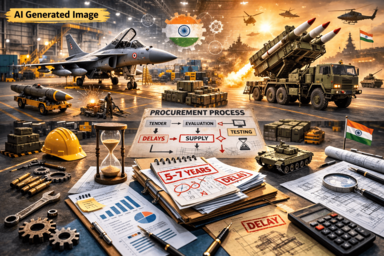
According to Kalyani, the procurement cycle for defence equipment in India is excessively long. The tendering process itself can take nearly a year, followed by the selection of the lowest bidder. Even after the contract is awarded, companies are required to supply a single prototype unit for repeated testing by the Indian Army’s quality wing — a process that may take another year. Additionally, manufacturers are not permitted to procure materials before approval of the First of Production Model (FOPM).
He observed that the complete procurement timeline often stretches between five and seven years — a duration he described as incompatible with today’s rapidly evolving technological environment. In contrast, defence exports are processed much faster, as overseas buyers mainly seek confirmation of approval by the Government of India.
Trade Union Leader Says Concerns Were Raised Earlier
Reacting to these developments, C. Srikumar, General Secretary of the All India Defence Employees Federation (AIDEF), told www.indianpsu.com that similar concerns had been repeatedly flagged earlier by the erstwhile Ordnance Factory Board (OFB) and employee unions.
He alleged that the Ministry of Defence failed to take these warnings seriously at the time, and that operational shortcomings arising from policy and procedural bottlenecks were instead attributed to Ordnance Factories and their workforce.
According to Srikumar, corporatisation of the Ordnance Factories was presented as a solution to improve accountability and efficiency. However, he claimed that many structural issues originated within policy design and procurement mechanisms rather than manufacturing entities themselves.
Challenges After Corporatisation
Srikumar further stated that despite assurances of financial and non-financial handholding after corporatisation, the newly formed defence public sector companies are now compelled to seek orders from non-defence sectors such as Railways, state police forces and paramilitary organisations. He alleged that intense competition has led to pressure on labour estimates and wage conditions for workers.
He argued that procurement challenges stem from fragmented authority and what he described as an overly rigid, transaction-based procurement culture within the MoD.
Call for Long-Term Procurement Framework
Advocating reforms, Srikumar suggested a shift from transactional procurement towards long-term, relationship-based acquisition models. He emphasised that Ordnance Factories and Defence Public Sector Undertakings (DPSUs) were originally established primarily for national security rather than profit.
He maintained that critical design, development and manufacturing capabilities should remain under government control and cautioned against excessive dependence on private industry. According to him, weakening public defence manufacturing institutions could eventually create monopolistic conditions that may adversely affect the Armed Forces.
Srikumar also alleged that several alternative proposals submitted by AIDEF prior to corporatisation were ignored without detailed examination by the Ministry.
Need for Balanced Reform
Concluding his remarks, Srikumar urged the government to adopt a more balanced procurement policy that ensures continuity, promotes innovation, and gives priority to DRDO, Ordnance Factories and Defence PSUs while maintaining industry participation.
He warned that excessive competition among private players without structural reforms could ultimately affect timely delivery and quality standards, thereby impacting operational preparedness of the Armed Forces.
Views expressed here are those of C. Srikumar, veteran Trade Unionist & General Secretary of AIDEF