
India’s Climate Disclosure Reporting Needs to Be More Robust
This shift is being driven by global sustainable finance markets and the demand for decision-useful disclosures aligned with international standards
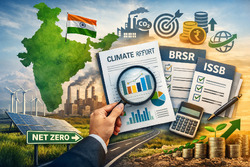
As climate transition planning moves to the centre of global sustainability reporting, Indian companies face growing pressure to strengthen the quality and credibility of their climate disclosures. Investors, lenders and insurers are increasingly seeking clear, forward-looking transition plans that explain how companies will shift to a low-carbon future—supported by measurable targets, defined actions, financing strategies and risk analysis.
This shift is being driven by global sustainable finance markets and the demand for decision-useful disclosures aligned with international standards. Against this backdrop, India’s current reporting framework needs significant strengthening if it is to support effective climate-related decision-making and maintain the country’s attractiveness to global capital.
A new assessment by the Institute for Energy Economics and Financial Analysis (IEEFA) compares India’s Business Responsibility and Sustainability Reporting (BRSR) framework with the International Sustainability Standards Board (ISSB) standards, highlighting both strengths and critical gaps in India’s approach to climate transition planning.
Risk of Capital Exclusion
IEEFA’s analysis underscores a clear warning: as global sustainable finance markets increasingly demand credible transition plans and forward-looking metrics, Indian corporates risk losing access to capital if disclosures remain high-level, fragmented and unstandardised.
While India has made progress in mandating ESG disclosures through BRSR, the framework does not yet provide the depth required for investors to assess transition risk, capital allocation plans and long-term climate resilience.
BRSR vs ISSB: Strengths and Shortcomings
The study finds that neither BRSR nor ISSB alone offers a fully comprehensive picture of a company’s climate transition plan.
BRSR stands out for its stronger emphasis on social and community engagement, offering measurable indicators for stakeholder interaction. However, climate-specific stakeholder dependencies—such as supplier alignment, customer transition risks and workforce reskilling—remain underdeveloped and require significant enhancement.
In contrast, ISSB’s S2 standard provides robust, climate-specific guidance, including detailed requirements on greenhouse gas emissions, climate resilience targets and transition plan disclosures. However, ISSB relies more on narrative disclosures and offers less granularity on social and community dimensions compared to BRSR.
IEEFA’s mapping analysis positions climate transition planning as a unified corporate exercise and highlights ways in which existing sustainability standards can be made more consistent and complementary.
Missing Elements in India’s Climate Transition Reporting
One of the most significant findings of the assessment is that BRSR omits several critical components of credible climate transition planning. These include:
- Clear linkages between greenhouse gas reduction targets and specific transition levers
- Mandatory climate scenario analysis to test resilience against climate risks
- Granular governance disclosures, such as climate-linked remuneration and accountability
- Transparent funding strategies to support transition plans
- These gaps limit the usefulness of disclosures for investors and undermine confidence in corporate net-zero commitments.
Insights from IEEFA’s Climate Transition Framework
The analysis is based on IEEFA’s climate transition plan framework, which draws from a review of 18 international frameworks and consultations with regulators, companies, investors and research institutions. The framework is grounded in the Transition Plan Taskforce (TPT) framework, identified by IEEFA as a robust global reference for transition plan disclosures.
“The framework aims to evaluate the quality of climate-related disclosures, the essential elements of transition plans, and how that translates into real progress by corporates on climate transition outcomes,” says Shantanu Srivastava, Research Lead, Sustainable Finance and Climate Risk at IEEFA, and the report’s author.
“The assessment focuses on whether disclosures are decision-useful for investors seeking to assess transition risk, capital allocation plans and long-term resilience,” adds Tanya Rana, Energy Analyst at IEEFA and co-author of the report.
Four Pillars of Transition Planning
IEEFA’s framework comprises five major categories—Foundation, Governance, Implementation Strategy, Engagement Strategy and Transparency. The current analysis focuses on the first four, as Transparency reflects outcomes of corporate actions, while the study examines disclosure regulations governing the transition planning process.
- Foundation: ISSB requires detailed disclosure of emissions targets, transition plans and scenario analysis. BRSR, however, covers targets and responses at a broader level and does not mandate scenario analysis.
- Governance: ISSB provides clear guidance on climate-specific governance and oversight mechanisms, while BRSR remains anchored in broader ESG principles.
- Engagement Strategy: ISSB focuses on narrative disclosures of stakeholder engagement. BRSR offers more structured indicators, particularly for social and community impact.
- Implementation Strategy: ISSB’s climate-specific guidance offers greater clarity on how companies plan to execute their transition pathways.
A key differentiator is the ISSB’s 2025 guidance on climate transition planning, based on the TPT framework, which enables companies to report transition-specific information within existing ISSB standards. No comparable guidance currently exists under BRSR.
From Ambition to Action
As Indian companies set net-zero targets and climate commitments, the credibility and clarity of their transition strategies are becoming critical. Strengthening BRSR to align more closely with global climate standards—while retaining its strong social focus—can play a pivotal role in translating climate ambition from aspiration into implementation.
Robust, standardised and decision-useful climate disclosures are no longer optional. They are essential for safeguarding India’s access to global capital and supporting a credible, economy-wide transition to a low-carbon future.
The writer of this article is Dr. Seema Javed, an environmentalist & a communications professional in the field of climate and energy