
Iran–Israel Conflict: What Rising Geopolitical Tensions Mean for Petroleum Prices in India
India is relatively better positioned today compared to earlier crises due to diversification of crude sourcing, including higher imports from Russia, the United States, and African producer
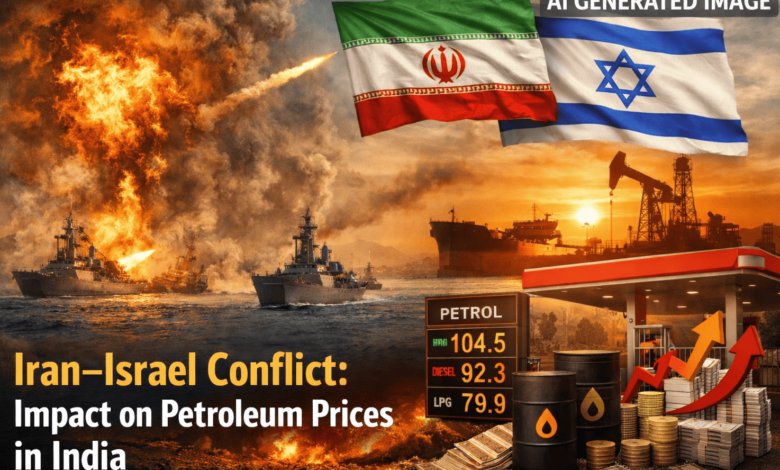
The escalating conflict between Iran and Israel has emerged as a major geopolitical flashpoint with significant implications for global energy markets. While the confrontation is geographically distant from India, its economic impact is likely to be felt directly through petroleum product prices, inflationary pressures, and the country’s overall energy security.
As one of the world’s largest crude oil importers, India remains highly sensitive to volatility in international oil markets, particularly developments in the Middle East — the source of a substantial share of its energy supplies.
Strategic Importance of the Middle East Oil Corridor
The primary concern arising from the Iran–Israel tensions is the potential disruption of shipping routes in the Strait of Hormuz, one of the world’s most critical oil transit chokepoints. Nearly one-fifth of global crude oil trade passes through this narrow maritime corridor.
For India, the stakes are particularly high. A significant portion of crude oil and liquefied natural gas imports travels through this route. Any escalation threatening tanker movement, maritime security, or insurance costs immediately triggers uncertainty in global markets, pushing crude prices upward even without an actual supply disruption.
Energy traders typically add a “geopolitical risk premium” during such crises, leading to sharp price volatility.
How Global Conflict Translates into Higher Fuel Costs in India
The transmission mechanism from war to domestic fuel prices follows a predictable chain:
- Rising geopolitical tensions increase crude oil futures prices
- India’s import bill rises due to higher benchmark crude rates
- Public sector Oil Marketing Companies face margin pressure
- Government intervention delays immediate retail price revisions
- Eventually, petrol, diesel, LPG and aviation fuel prices come under upward pressure
India imports nearly 85 percent of its crude oil requirement, making domestic fuel economics closely tied to global benchmarks.
Short-Term Impact: Why Pump Prices May Not Rise Immediately
Despite fluctuations in global crude prices, Indian consumers may not see an immediate increase in petrol and diesel prices.
Retail fuel pricing in India is influenced by policy considerations, including inflation control and economic stability. Oil Marketing Companies often absorb temporary losses, while the government may adjust excise duties or rely on pricing buffers to prevent sudden consumer shocks.
However, prolonged high crude prices reduce marketing margins and create fiscal pressure.
Medium-Term Risks: Inflation and Sectoral Impact
If tensions persist or escalate into a wider regional conflict, the economic consequences could become more pronounced.
Higher crude prices typically lead to:
- Increased transportation and logistics costs
- Rising aviation turbine fuel prices impacting airlines
- Higher LPG subsidy burden
- Cost escalation across manufacturing and FMCG sectors
Such developments can push retail inflation upward and widen India’s current account deficit due to a larger energy import bill.
Worst-Case Scenario: Strait of Hormuz Disruption
Energy analysts warn that the most serious risk would arise if hostilities disrupt shipping through the Strait of Hormuz. In such a scenario, global crude prices could surge sharply, potentially crossing the $100-per-barrel mark.
This would significantly raise freight and insurance costs while forcing importing nations, including India, to source oil from more distant and expensive suppliers.
India’s Preparedness and Strategic Cushion
India is relatively better positioned today compared to earlier crises due to diversification of crude sourcing, including higher imports from Russia, the United States, and African producers. Strategic petroleum reserves also provide a temporary buffer against supply shocks.
Nevertheless, sustained geopolitical instability remains a structural risk for an import-dependent energy economy.
The Road Ahead
The Iran–Israel conflict underscores a long-standing reality: energy security remains deeply intertwined with geopolitics. For India, the immediate challenge lies in balancing inflation management with the financial health of oil marketing companies while ensuring uninterrupted energy supplies.
Much will depend on whether tensions remain contained or evolve into a broader regional crisis. Until clarity emerges, volatility in global oil markets — and uncertainty over future petroleum prices — is likely to persist.