RINL Circular Linking Salary to Targets Draws Sharp Criticism from Unions
Even Steel Ministry sits tight-lipped and non-committal towards problems of RINL staff

A recent circular issued by Rashtriya Ispat Nigam Limited (RINL), the corporate entity of Vizag Steel Plant, has triggered strong criticism from employees’ unions and officers’ associations, who allege that the move violates established labour practices and wage norms in India.
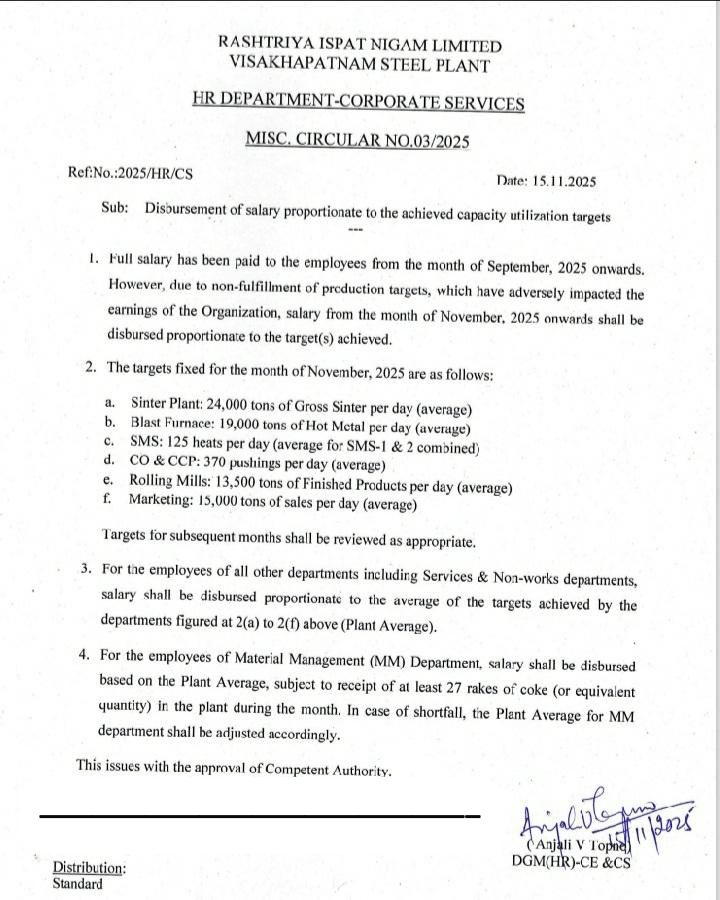
Circular No. 2025/HR/CS dated November 15, 2025, issued by the management, states that salaries from November 2025 onward will be paid in proportion to the targets achieved by employees or departments. Employee representatives argue that this decision contradicts the terms of employment and established wage practices.
According to Katam S. S. Chandra Rao, Deputy Secretary General of National Confederation of Officers Associations (NCOA), salary payments have traditionally been based on duty performed rather than production targets.
“Salary has always been paid for work performed during duty hours. Targets were meant to motivate employees and improve productivity, but salary has never been reduced based on departmental or organisational performance in either government or private organisations,” he said.
Chandra Rao further argued that linking salary to group or departmental performance is “manifestly wrong and bad in law.” He explained that performance targets historically served as benchmarks for incentives, profit-linked benefits, or promotions, but not as a basis for reducing fixed salary.
Employee unions have also raised concerns that the circular is neither labour-friendly nor compliant with established employment norms. Once the salary structure is fixed under the terms of employment, they argue, it cannot be altered to the detriment of employees without due process.
Padi Thrinadha Rao, General Secretary of the Visakha Steel Employees Union, demanded that the management withdraw the circular immediately, describing it as unlawful.
He pointed out several concerns in the circular:
- Lack of payment assurance: The circular does not guarantee that the proposed salary payments will always be made, especially if the company cites financial constraints or prioritises statutory dues and essential expenditures.
- Ambiguity in target linkage: It remains unclear whether employees in the Works division will be paid based on their own departmental performance or on the overall plant performance. If departmental targets apply, employees performing similar work in different departments may receive unequal salaries, which unions argue is legally questionable and could disrupt industrial harmony.
- Cross-department linkage issues: Linking salaries of Services and Non-Works departments to the performance of Works departments is considered irrational because these departments perform standard operational roles regardless of production targets.
- Operational inconsistencies: As an example, the union cited the Materials Management (MM) department. Even if the department exceeds its operational targets—such as handling more than 40 rakes—it would still receive salary based on the plant’s average performance, which unions say is illogical and demoralising.
Employee representatives argue that the circular creates uncertainty and could severely impact workforce morale at the steelmaker.
They have urged the management of Rashtriya Ispat Nigam Limited to immediately withdraw the circular and adhere to established labour laws and wage principles.