SAIL Under Fire: Steel Ministry Elevates Officer Amid Scam Shadow
Under Union Minister H. D. Kumaraswamy, the Ministry now finds itself at a crossroads—between stated policy and actual practice
The expectation was clear – following the early exit of Amarendu Prakash as Chairman of Steel Authority of India Limited (SAIL), the Ministry of Steel would initiate a deep institutional cleanse to restore credibility and reinforce governance standards.
That expectation, however, appears to have fallen short.
Even after Prakash’s departure, concerns persist that the legacy of questionable decision-making continues to cast a shadow over India’s steel behemoth.
A Controversial Appointment Raises Eyebrows
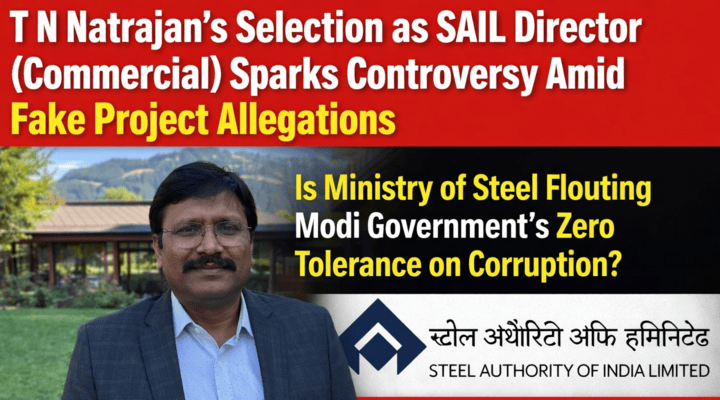
The recent appointment of T. N. Natarajan as Director (Commercial) of SAIL has come under intense scrutiny amid serious allegations linked to his previous tenure as Regional Manager – Western Region (RM-WR).
Sources and complaint documents suggest that nearly 1,00,000 tonnes of steel were supplied to allegedly dubious or “fake project” entities during his tenure. What raises further concern is that around 40,000 tonnes of these supplies reportedly occurred even after a Lokpal order dated January 10, 2024, which had flagged irregularities and triggered wider investigations.
These developments raise uncomfortable questions about internal controls, due diligence mechanisms, and compliance culture within SAIL.
Alleged Network Transactions and Due Diligence Failures
According to sources, several of the recipient entities may be linked through common promoters or trading platforms, hinting at possible network-based transactions. If true, this could indicate systemic gaps in SAIL’s verification processes and oversight mechanisms.
Adding to the gravity of the situation, the CBI has reportedly issued a questionnaire to Natarajan, seeking clarification on his role and decisions during the period in question.
Despite Red Flags, Appointment Moves Forward
What has surprised many observers is that despite these developments, Natarajan’s elevation was not stalled.
Sources indicate that a senior official within the Ministry of Steel strongly backed his appointment, arguing that:
- Natarajan was neither suspended nor chargesheeted
- A questionnaire from an investigating agency does not constitute grounds for denial of promotion
This line of reasoning ultimately prevailed.
Yet, the larger question remains—should individuals under investigative scrutiny be elevated to key leadership roles in strategic public sector enterprises?
Career Snapshot
T. N. Natarajan joined SAIL in 1993 at Bhilai Steel Plant and moved to the Central Marketing Organisation in 2003. He was posted as Regional Business Manager (Western Region) in Mumbai in January 2022 and later took additional charge as RM-WR in July 2023 before formal appointment.
Following his selection by the Search-cum-Selection Committee (SCSC), he has now assumed office in Delhi as Director (Commercial).
Key Questions That Demand Answers
The episode has triggered several critical questions:
- Why were supplies allegedly continued despite a Lokpal order and ongoing investigations?
- Were due diligence norms bypassed—or simply ignored?
- Did internal red flags fail, or were they overridden?
- Should senior-level appointments proceed while probes are underway?
The Larger Governance Question
At the heart of the issue lies a fundamental concern:
Is the Ministry of Steel aligning with the Government’s stated policy of zero tolerance towards corruption?
Prime Minister Narendra Modi has consistently emphasized probity and accountability in public life. However, the optics in this case present a troubling contrast:
- A senior official faces serious allegations
- Investigations are reportedly ongoing
- Yet, elevation to a top post proceeds unhindered
If substantiated, this is no longer about an individual case—it points toward a deeper systemic concern, or possibly selective inaction.
Silence Amid Questions
In an interesting development, multiple queries sent to T. N. Natarajan by www.indianpsu.com simply went unanswered.
This silence only adds to the growing unease.
Conclusion
There is an old analogy—when confronted by danger, a pigeon closes its eyes, hoping the threat disappears. But reality does not change by ignoring it.
The same principle applies here.
The credibility of institutions like SAIL—and by extension, public sector governance—depends not just on policy declarations, but on the consistency of their implementation.
We Report – You Decide…
To be continued….