
EV Boom Reduces Global Oil Dependence, Saves Billions: Ember Study
EV adoption emerges as a powerful tool to cut global oil dependence and reduce import bills
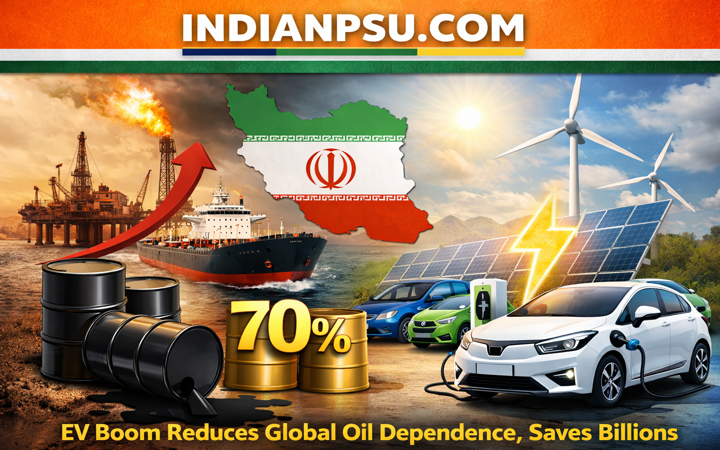
Electric vehicles (EVs) helped avoid the consumption of 1.7 million barrels of oil per day globally in 2025, nearly equivalent to 70% of Iran’s oil exports (2.4 million barrels/day) via the Strait of Hormuz, according to a new analysis by global energy think tank Ember.
The findings underline the growing role of EVs in reshaping global energy security and reducing dependence on volatile fossil fuel markets.
Oil Remains the World’s Biggest Economic Vulnerability
“Oil is the Achilles’ heel of the global economy,” said Daan Walter, Principal at Ember. “Asia’s oil vulnerability has been starkly exposed by the current crisis.”
Despite advancements in clean energy, oil dependence remains widespread:
- 79% of the global population lives in oil-importing countries
- Every $10 per barrel increase raises the global import bill by $160 billion annually
The Strait of Hormuz, a critical chokepoint, carries 20% of global oil exports, while the Gulf region supplies 29% of global oil—making it highly sensitive to geopolitical disruptions.
Asia remains particularly exposed, with 40% of its oil imports passing through the strait.
Walter described the situation as “Asia’s Ukraine moment,” emphasizing that even oil-producing economies are not immune to price shocks, as global oil prices are interconnected.
EVs Offer a Strategic Alternative
Ember’s analysis highlights that replacing oil-based transport with EVs could:
- Cut global fossil fuel imports by one-third
- Save approximately $600 billion annually
“Unlike the oil crises of the 1970s, we now have a viable alternative,” Walter noted. “Electric vehicles are increasingly cost-competitive and offer a practical solution to shield economies from oil price volatility.”
Electrification technologies are already available for over 75% of global energy demand, and all countries have the renewable potential to meet this demand through wind and solar energy.
EV Adoption Accelerating Worldwide
EV penetration is rising rapidly across global markets:
- 39 countries now have EV sales above 10%, up from just four in 2019
- China crossed 50% EV sales share in 2025
- Vietnam (38%), Thailand (21%), and Indonesia (15%) outperformed the US (10%)
- India (4%) surpassed Japan (3%), while Brazil reached 9%
Significant Economic Gains Already Visible
The shift to EVs is already generating major savings:
- China: Saves over $28 billion annually
- Europe: Around $8 billion
- India: Approximately $0.6 billion per year
At an oil price of $80 per barrel, these savings are expected to grow significantly as EV adoption scales.
Oil Demand Peak May Arrive Sooner
The International Energy Agency (IEA) projects global oil demand will peak by 2029, but current geopolitical and market disruptions could accelerate this timeline.
Conclusion
The rapid growth of EVs and renewable energy is not just an environmental shift—it is becoming a strategic economic necessity. As oil markets grow increasingly volatile, electrification offers countries a pathway to energy independence, lower import bills, and greater resilience.
The writer of this article is Dr. Seema Javed, an environmentalist & a communications professional in the field of climate and energy