
The Missing Link in Noida’s Labour Protests: Heat Stress
The question is simple - did extreme heat also shape this unrest? The answer may not be straightforward, but the signals are hard to ignore!
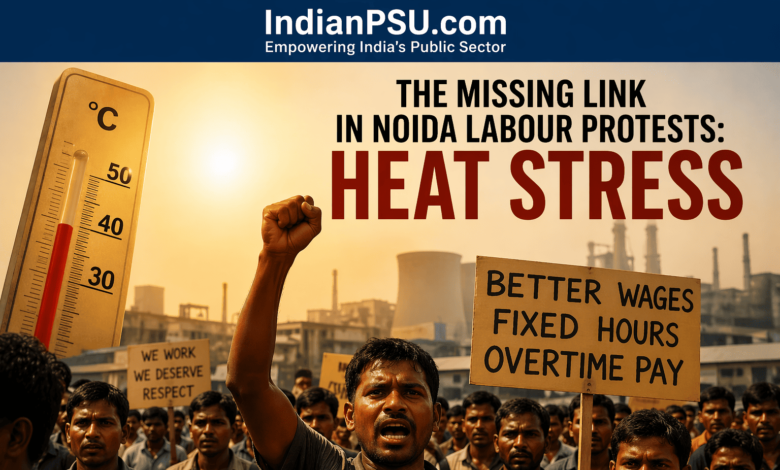
In the second week of April 2026, temperatures in Noida were already soaring between 36°C and 39°C, with forecasts touching 42°C. On April 13, an estimated 40,000–45,000 factory workers flooded the city’s industrial belt—Phase II, Sectors 60, 62, and 84—demanding wage hikes, fixed working hours, and overtime pay.
Most coverage focused on wages and the rising cost of living. But a critical dimension was largely absent: heat.
The question is simple—did extreme heat also shape this unrest?
The answer may not be straightforward, but the signals are hard to ignore.
A Workforce Under Thermal Stress
The protesters were largely contract workers from the garment and hosiery sectors—industries increasingly identified as bearing some of the highest “heat burdens.”
A February 2026 study, Breaking Point: Heat and the Garment Floor, covering factories across Delhi-NCR, Tamil Nadu, and Gujarat, revealed:
- 87% of workers reported heat-related symptoms—headaches, dizziness, cramps, fatigue
- 69% experienced reduced efficiency
- 78% skipped breaks to meet production targets
This is not just discomfort—it is physiological strain accumulating day after day.
Inside factories, the situation is worse. Jet dyeing machines operate at 125–130°C, while boilers and presses run continuously, adding intense radiant heat. Most units lack climate control, turning workplaces into heat traps.
When Heat Becomes Economic Pressure
Heat is not just a health issue—it is an economic one.
A 2025 study (Springer Nature) surveying 3,000 informal workers found that:
- 91.2% reported productivity loss due to heat
- Garment workers recorded an alarming 98.5% heat-induced productivity loss rate
- Dehydration emerged as the strongest predictor
Another study in Earth’s Future found that between 1980 and 2021, rising heat stress reduced labour capacity by nearly 10% in major Indian cities like Delhi, Kolkata, Hyderabad, and Mumbai.
In Delhi specifically, research shows that a 1°C rise in temperature leads to a 16% drop in daily earnings, alongside a 14% increase in medical expenses.
For workers already earning ₹11,000–13,500 per month, this dual squeeze—lower income, higher costs—can be destabilising.
No Escape After Work
The heat burden does not end at factory gates.
Most workers are migrants from Bihar and eastern Uttar Pradesh, living in overcrowded rental housing with poor ventilation and no cooling. After 12-hour shifts, they return to rooms that remain hot through the night.
According to Council for Energy, Environment and Water fellow Vishwas Chitale: “Nearly 60% of India’s districts face high to very high heat risk, affecting close to 70% of the population.”
Even more concerning is the rise in “warm nights.” Between 2012 and 2022, nearly 70% of Indian districts experienced at least five additional very warm nights per summer. Urban heat island effects trap heat, preventing nighttime cooling—especially in dense industrial cities.
Mahesh Palawat of Skymet Weather explains: “Heat doesn’t end when the sun sets anymore. The body depends on cooler nights to recover. Without that, risks multiply—physically and mentally.”
A systematic review on heat and sleep found:
- 64% of workers struggled to fall asleep
- 54% reported non-restorative sleep
- 45% experienced reduced total sleep
The most affected: shift workers, low-income urban residents, and those in poorly ventilated housing—the exact profile of Noida’s migrant workforce.
A Trigger, Not Just a Background Condition
Extreme heat rarely appears in protest headlines. But it quietly intensifies every existing stress—fatigue, declining wages, rising expenses, and deteriorating health.
By April, workers were already operating at physical limits. Add prolonged heat exposure, sleep deprivation, and financial strain, and the threshold for collective action lowers.
As Apekshita Varshney of Heat Watch puts it: “We are in a polycrisis. Workers have faced difficult conditions for years, and now extreme heat has compounded those vulnerabilities.”
The Missing Link in Policy and Reporting
India’s informal sector employs over 85% of the workforce. Yet occupational heat stress remains largely invisible in labour policy, industrial regulation, and media narratives.
The Noida protests may have been framed around wages—but the conditions in which those wages are earned are inseparable from climate.
Heat is not just weather anymore. It is a workplace hazard. And increasingly, it may also be a catalyst for unrest.
The writer of this article is Dr. Seema Javed, an environmentalist & a communications professional in the field of climate and energy