

Hormuz Crisis Reinforces Urgency of Clean Energy Transition: Report
Geopolitical shock exposes vulnerabilities of fossil fuel dependence; renewables seen as long-term solution for energy security
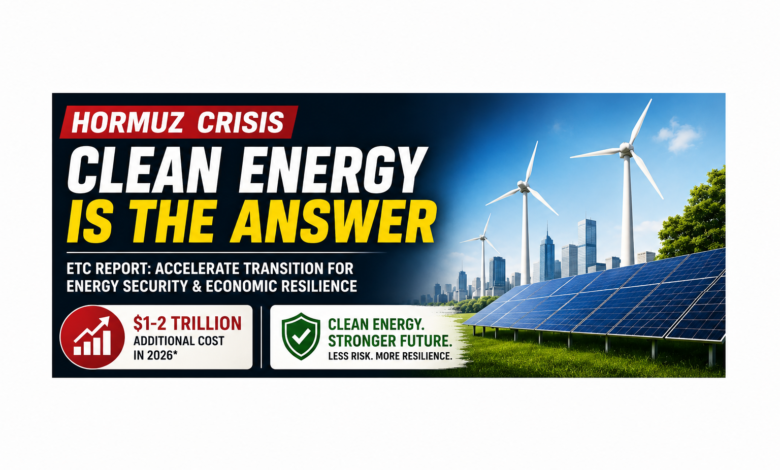
The recent disruption in the Strait of Hormuz has triggered the largest global energy supply shock on record, strengthening the case for accelerating the transition to clean energy, according to a new report by the Energy Transitions Commission.
Titled “Lessons on Energy Security after the Hormuz Crisis,” the report warns that reactive investments in fossil fuel infrastructure could deepen long-term vulnerabilities rather than resolve them.
Historic Supply Shock Hits Global Energy Markets
The closure of the Strait disrupted 18.4 million barrels per day (mb/d) of oil supply, surpassing even the scale of the 1973 Arab Oil Embargo. In addition, nearly 20% of global LNG trade and one-third of fertiliser flows were impacted.
The shock has disproportionately affected Asia, with over 80% of LNG and 84% of crude oil shipments through Hormuz destined for Asian markets, exposing the region’s heavy import dependence.
Clean Energy vs Fossil Fuels: A Structural Divide
The Commission highlights a fundamental difference between fossil fuel and clean energy systems:
- Fossil fuels transmit shocks instantly due to reliance on continuous supply chains and chokepoints.
- Clean energy absorbs shocks, with 70–90% of costs incurred upfront, allowing long-term insulation from market volatility.
Technologies such as solar, wind, batteries, and grid infrastructure continue to deliver energy regardless of geopolitical disruptions once deployed.
Rising Costs: A Global Economic Strain
The crisis has sharply increased energy prices:
- Oil surged from $70 to $90–120 per barrel
- LNG prices jumped from $10–12 to over $25 per MMBtu
The resulting inflationary pressure is hitting transport, food, and industrial sectors, with lower-income households and MSMEs bearing the brunt.
Europe alone is incurring losses of nearly €500 million per day, while damage to Qatar’s Ras Laffan LNG facility could take 3–5 years to repair, potentially reshaping global gas markets.
$1–2 Trillion Economic Impact Projected
The report estimates that sustained high fossil fuel prices could add $1–2 trillion in global energy expenditure in 2026 alone—without increasing energy supply, only raising costs.
Notably, this figure is comparable to the $1.5 trillion annual clean energy investment gap, highlighting a critical opportunity for reallocation.
Three Key Findings from the ETC Report
- Fossil fuel systems amplify crises, while clean energy systems provide resilience.
- High fossil fuel prices could equal the clean energy funding gap, underlining the economic case for transition.
- New fossil infrastructure risks locking in future shocks, given long project timelines versus rapid scalability of renewables.
Clean Energy Can Replace Hormuz Flows
The Commission notes that:
- Electric vehicles alone could reduce oil demand by 5 mb/d by 2030 and up to 10 mb/d by 2035
- A coordinated clean energy push could cut 20% of global oil demand and over 30% of gas demand by 2035
This would significantly reduce exposure to geopolitical disruptions.
Case Study: Spain vs Singapore
The report contrasts two energy systems:
- Spain, with 57% renewable electricity, saw power prices around $50/MWh
- Singapore, heavily reliant on gas (95%), faced prices exceeding $200/MWh
The divergence highlights that energy system design—not geography—determines resilience.
Leadership View
Adair Turner, Co-Chair of the Energy Transitions Commission, stated: “The current crisis shows that fossil fuel dependence is not only a climate risk but also an economic and strategic vulnerability. Clean energy systems are more distributed, more efficient and less exposed to price shocks.”
Conclusion: A Strategic Inflection Point
The Hormuz crisis marks the first major fossil fuel shock where scalable alternatives exist across all major energy sectors. The ETC argues that governments must resist short-term fossil expansion and instead prioritise clean energy deployment to ensure long-term energy security, economic resilience, and price stability.
The writer of this article is Dr. Seema Javed, an environmentalist & a communications professional in the field of climate and energy