
As Long as Fossil Fuels Rule, Power Will Shadow Energy
Clean energy independence is a shield against global turmoil
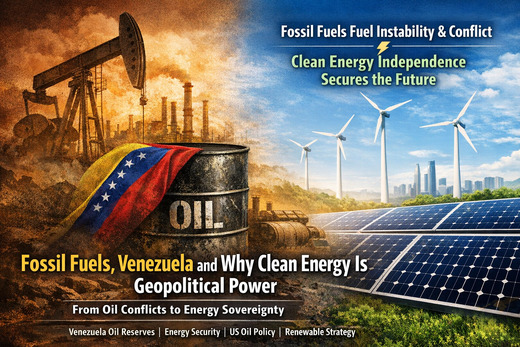
Until fossil fuels remain the backbone of the global economy, power will always shadow energy. Control over oil and gas is never just about markets—it is about leverage, coercion, and conflict. Instability is not an accident of the fossil-fuel system; it is built into it.
Venezuela is the clearest contemporary example. Sitting atop an estimated 303 billion barrels of crude—nearly one-fifth of global reserves, according to the U.S. Energy Information Administration, the country’s oil wealth has long been more curse than blessing. Today, it has once again become a chessboard in the global energy power struggle.
The United States’ renewed interest in Venezuela is less about humanitarian concern or democratic revival and more about reasserting its role as gatekeeper of a world still addicted to oil—just as parts of the globe are trying to break free. President Donald Trump’s reported push for $100 billion in investment by U.S. oil companies was met with cold realism. ExxonMobil CEO Darren Woods summed it up bluntly: Venezuela is currently “uninvestable.”
Yet the strategic intent is unmistakable. A U.S.-led revamp of Venezuela’s oil sector could eventually turn the country into a major supplier again, creating opportunities for Western oil companies and adding new barrels to global markets. That could help keep prices in check—but at a cost. Lower prices would also undercut higher-cost producers, including some in the U.S., revealing the contradictions of energy geopolitics driven by oil.
The deeper problem is structural. Oil and gas reserves are overwhelmingly concentrated in politically unstable regions, turning energy supply into a permanent flashpoint. From Russia’s invasion of Ukraine to renewed tensions involving Venezuela—and potentially Iran—control over fossil resources continues to trigger violence, retaliation, and economic shockwaves. As long as fossil fuels dominate, geopolitics will remain combustible.
That is why, in 2026, clean energy independence is no longer viewed merely as climate policy. It is increasingly recognized as a strategic shield—a form of national insurance against global turmoil.
By shifting from imported fossil fuels to domestic renewable energy, nations can insulate themselves from price volatility, supply disruptions, and geopolitical blackmail. Clean energy is about strategic autonomy, not just emissions reduction.
Europe’s predicament is instructive. The EU imports 95% of its crude oil and 86% of its natural gas, leaving its energy security exposed to external powers—from Moscow to Washington. Renewable energy, electrification, and storage are not ideological choices; they are tools of sovereignty. Every wind farm and solar park reduces the likelihood that a crisis thousands of kilometres away will trigger economic pain at home.
Even the United States, despite its shale boom, still imports around 40% of its crude oil—a vulnerability that exporting nations can exploit as political leverage. Events unfolding in Venezuela underline why remaining hooked to volatile fossil suppliers is a strategic risk no serious power can ignore.
Trump has met leading figures from the oil world, including ConocoPhillips CEO Ryan Lance, oil magnate Harold Hamm, and European commodity traders. But skepticism remains widespread.
Antonio Hill of the Natural Resource Governance Institute captured the reality succinctly: “Venezuela’s most pressing priority is to establish a stable, inclusive, and democratic government capable of heading off a looming humanitarian crisis and charting a path to economic recovery that delivers for its people. We’ve seen no indication that the US is ready to support that goal—and expecting any serious shift in foreign investment flows without it would be highly unrealistic.”
Others are more scathing. Frances Colón of the Center for American Progress argued: “President Trump’s meeting with Big Oil executives exposes what the Venezuela invasion was always about: corporate plunder at taxpayer expense.”
Economics, too, works against the fossil fantasy. Venezuelan crude is notoriously heavy and sour, making it expensive to process. As Professor Rockford Weitz of Tufts University notes, it is barely profitable unless oil prices exceed $80 per barrel—a level incompatible with long-term energy transition goals. This is precisely why major U.S. oil companies are hesitant.
China has already drawn its conclusions. With no intention of importing crude oil two decades from now, Beijing is going big on solar, offshore wind, and advanced nuclear power—not out of environmental idealism, but cold strategic calculation.
The lesson is unavoidable: fossil fuels entangle nations in cycles of dependency, coercion, and conflict. Clean energy, by contrast, decentralizes power—literally and geopolitically.
As long as oil and gas dominate, energy will remain a weapon. The faster nations unhook themselves from that system, the closer they move to genuine stability, sovereignty, and peace.
The writer of this article is Dr. Seema Javed, an environmentalist & a communications professional in the field of climate and energy