Japan Most Exposed to Oil & Gas Supply Disruption via Strait of Hormuz: Report
The Strait of Hormuz—located between Iran and Oman—is one of the world’s most critical energy chokepoints
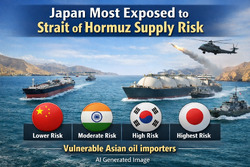
Asian economies remain highly vulnerable to disruptions in global energy supply routes, with Japan facing the highest risk from potential disruptions in the Strait of Hormuz, according to a new analysis by Zero Carbon Analytics.
The Strait of Hormuz—located between Iran and Oman—is one of the world’s most critical energy chokepoints. The narrow shipping corridor, only about two miles wide in each direction, carries around 20% of global oil and liquefied natural gas (LNG) shipments.
Asia Accounts for Majority of Hormuz Energy Flows
According to the report, Asian economies dominate the energy flows through the Strait:
- China, India, Japan and South Korea account for 75% of oil shipments
- The same four countries account for 59% of LNG flows through the route
However, vulnerability to supply shocks varies widely depending on energy import dependence and reliance on fossil fuels.
Japan Tops Risk Index
Zero Carbon Analytics developed a risk score to measure countries’ exposure to disruptions based on their share of imports via the Strait and dependence on fossil fuels.
The findings show:
| Country | Risk Score | Key Risk Factors |
|---|---|---|
| Japan | 6.4 | High reliance on imported oil and gas |
| South Korea | 5.3 | Heavy fossil fuel import dependence |
| India | 4.9 | Large volumes imported through Hormuz |
| China | 4.4 | Diversified supply routes including pipelines |
| United States | Low | Net exporter of oil and gas |
Japan and South Korea face the greatest vulnerability because of their heavy reliance on imported fossil fuels, which supply:
- 87% of Japan’s energy
- 81% of South Korea’s energy
By contrast, fossil fuel imports account for:
- 35% of India’s energy
- 20% of China’s energy
Hormuz: Lifeline for Middle East Energy Exports
The Strait serves as the primary export route for Middle Eastern oil producers such as Saudi Arabia, Iraq and Iran. It is also the only maritime route for LNG exports from Qatar and the UAE to global markets.
According to estimates by the US Energy Information Administration (EIA):
- 84% of oil shipments via the Strait in 2024 went to Asia
- 83% of LNG exports through the route were also destined for Asian markets
Rising Geopolitical Risks
Energy markets have already reacted to rising geopolitical tensions in the region. Iran temporarily restricted shipping movements in the Strait during military exercises in February 2026, highlighting the strategic leverage the route offers.
Analysts warn that a full blockade of the Strait of Hormuz could push oil prices to around USD 130 per barrel, matching the peak levels during the 2007–2008 oil shock. Iraq’s Deputy Prime Minister has even suggested prices could spike to USD 300 per barrel under extreme disruption scenarios.
Recent attacks on shipping by Iran-backed Houthi rebels in the Red Sea have demonstrated how relatively small military actions can disrupt global maritime trade. By April 2025, such attacks had reduced shipping traffic to the Gulf of Aden by around 70% compared with 2023 levels.
Energy Transition Seen as Strategic Buffer
Experts argue that countries highly dependent on imported fossil fuels could reduce their exposure by accelerating renewable energy adoption and electrifying their economies.
Europe’s response to the Russia-Ukraine energy crisis offers an example. Between 2022 and 2024, European countries reduced gas imports by 18%, partly through increased renewable deployment and energy efficiency measures.
Impact on Global Energy Prices
Even without a full disruption, markets are already reacting to geopolitical uncertainty.
- Crude prices have risen nearly 19% in 2026 so far
- Oil averaged USD 67 per barrel in January 2026, the highest level since September 2025
A major disruption in the Strait would likely trigger sharp spikes in global oil and LNG prices, affecting all importing economies, particularly those in Asia.
The writer of this article is Dr. Seema Javed, an environmentalist & a communications professional in the field of climate and energy