
Renewable Power Growth Surpasses Demand, Keeps Global Fossil Generation in Check: Ember Report
Despite this progress, India continues to be the second-largest coal power generator globally, behind China
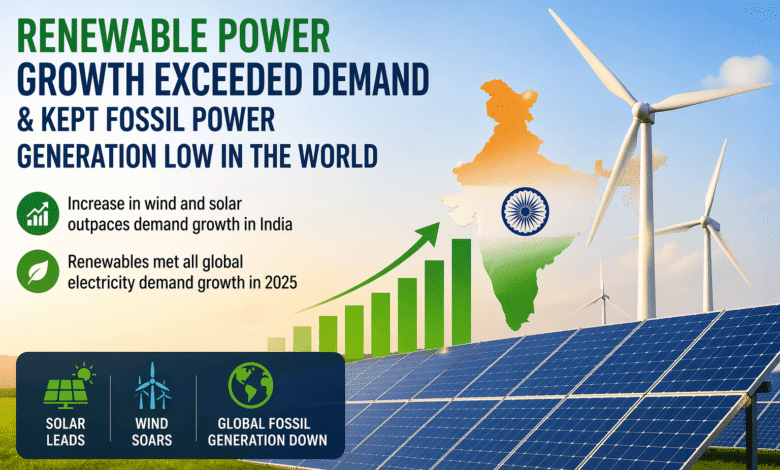
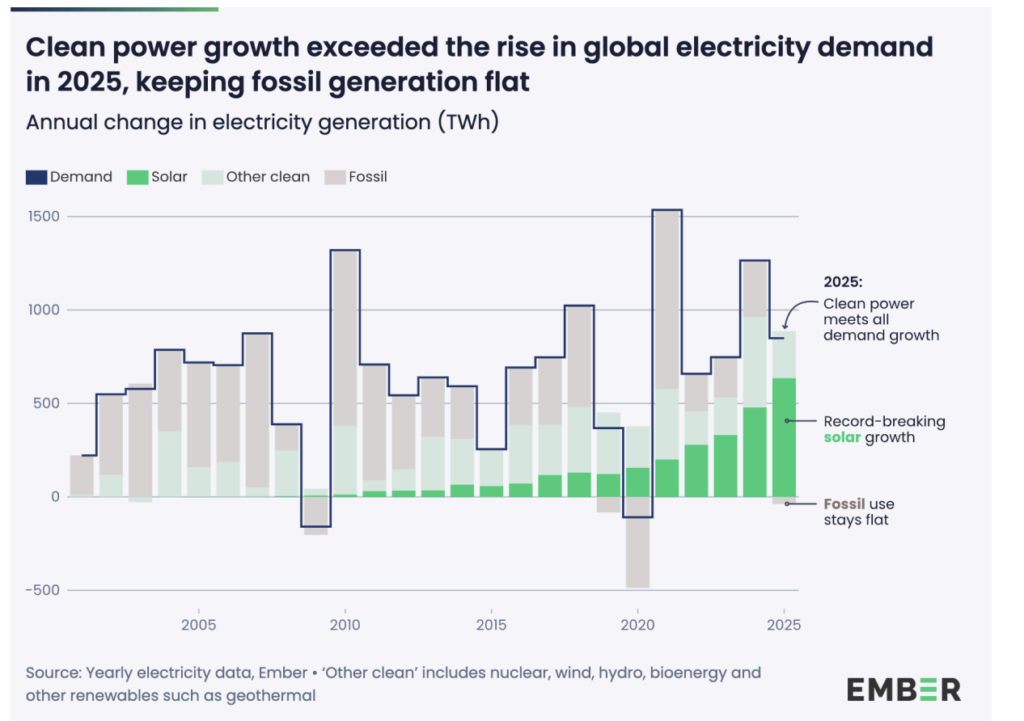
The global energy transition reached a decisive milestone in 2025, as the rapid expansion of renewable energy successfully met the entire growth in electricity demand, preventing any rise in fossil fuel-based power generation, according to a new report by Ember.
India Leads with Record Renewable Expansion
India emerged as a key driver of this transformation, recording a historic increase of 98 TWh (+24%) in renewable power generation—spanning solar, wind, hydro, and bioenergy. This surge was twice the country’s electricity demand growth of 49 TWh, which remained subdued due to milder weather conditions and slower industrial activity.
As a result, India’s fossil power generation declined by 3.3% (52 TWh)—marking only the third such drop since 2000. This trend aligned with a similar decline in China, where fossil generation fell by 0.9% (56 TWh).
Together, these reductions helped offset marginal increases in fossil power generation in the United States, European Union, and other economies—resulting in a 0.2% decline in global fossil electricity generation.
Despite this progress, India continues to be the second-largest coal power generator globally, behind China.
Wind & Solar Outpace Electricity Demand Growth
India mirrored global trends where wind and solar power are increasingly meeting new electricity demand.
- Wind and solar generation rose by 75 TWh in 2025
- This exceeded total demand growth in the country
- Globally, wind and solar met 99% of new electricity demand
However, India’s wind and solar share stands at 14%, still below the global average of 17%. Encouragingly, the share rose by 3 percentage points in 2025, signaling accelerating clean energy adoption.
Solar Power Emerges as India’s Dominant Energy Force
India is now firmly positioned at the forefront of global solar expansion:
- 53 TWh increase in solar generation (third-highest globally)
- 37% growth rate, surpassing the global average of 30%
- 38 GW (AC) capacity addition, exceeding the United States for the first time
Solar energy alone was sufficient to meet India’s entire electricity demand growth in 2025. On a global scale, solar contributed 75% of demand growth.
In a significant milestone, solar overtook hydro to become India’s largest source of clean electricity, reaching a 9.4% share.
Solar output has doubled since 2022, rising from 96 TWh to 196 TWh in 2025. This cements India’s position as the third-largest solar generator globally, producing nearly double the electricity of Japan, which ranks fourth.
“Solar power is the dominant driver of change in India’s power system,” said Aditya Lolla. “Along with battery storage, it enables fast-scaling, round-the-clock clean power while strengthening energy security.”
Wind Energy Sees Historic Surge
India’s wind energy sector also delivered a breakthrough year:
- Record annual increase of 22 TWh in 2025
- Generation has tripled over the past decade, from 33 TWh in 2015 to 104 TWh in 2025
- Nearly one-third of this growth occurred in 2025 alone
India has now overtaken the United Kingdom to become the world’s fifth-largest wind power generator.
According to Duttatreya Das, the next phase of growth will depend on strengthening grid infrastructure and integrating storage solutions: “India’s power system is entering a new phase driven by record renewable additions. Investments in grid flexibility and storage will be crucial to efficiently utilise low-cost clean power.”
Global Perspective: A Turning Point in Energy Transition
The seventh edition of Ember’s Global Electricity Review—covering 91 countries representing 93% of global demand—highlights a pivotal shift:
- Solar is emerging as the primary engine of global electricity expansion
- Clean energy is now fully meeting incremental demand
- Fossil generation is no longer structurally required for growth
The writer of this article is Dr. Seema Javed, an environmentalist & a communications professional in the field of climate and energy