South Asia Exposed to $107 Billion LNG Bet Amid Middle East War Risks
However, analysts warn that these large investments may face serious challenges if global LNG prices remain volatile
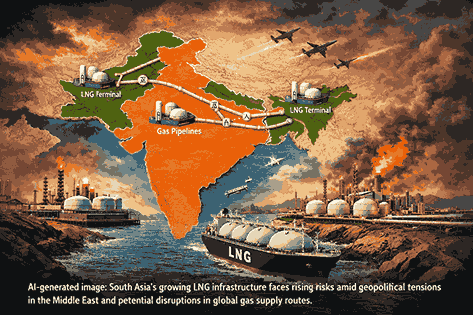
South Asia’s ambitious expansion of liquefied natural gas (LNG) infrastructure could expose the region to long-term economic and energy security risks as geopolitical tensions in the Middle East disrupt global energy markets.
According to a new report by the Global Energy Monitor (GEM), India, Bangladesh and Pakistan have $107 billion worth of LNG terminals and gas pipelines either announced or currently under construction.
The findings, based on data from the Asia Gas Tracker, come at a time when global energy markets are experiencing volatility following recent attacks by the United States and Israel on Iran and renewed shipping disruptions in the Strait of Hormuz, one of the world’s most critical energy shipping routes.
Major LNG Expansion Plans in South Asia
The report notes that Southern Asia accounts for 17% of global LNG import capacity under development, equivalent to about 110.7 million tonnes per annum, along with 17% of global gas pipelines by length, totaling 34,146 kilometres.
Among the region’s key developments:
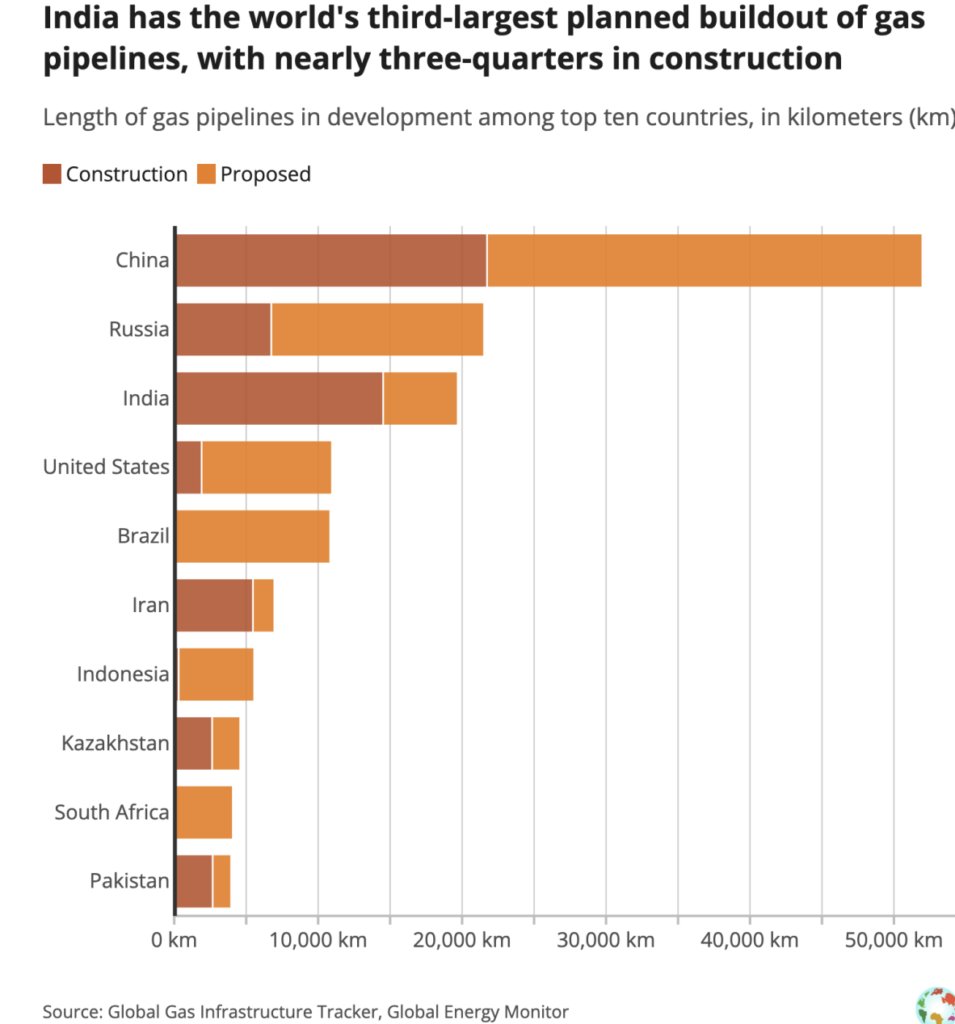
- India is pursuing the world’s second-largest LNG terminal capacity expansion and the third-largest gas pipeline build-out.
- Bangladesh and Pakistan each have enough LNG import infrastructure under development to roughly double their existing capacity.
However, analysts warn that these large investments may face serious challenges if global LNG prices remain volatile.
High Project Failure Rates
Despite expectations of a global LNG supply surplus later this decade, the report suggests that even a balanced market could face disruptions from shipping bottlenecks or supply interruptions, which can sharply raise delivered LNG prices.
South Asian economies are particularly vulnerable because they are highly price-sensitive LNG importers.
Over the past decade:
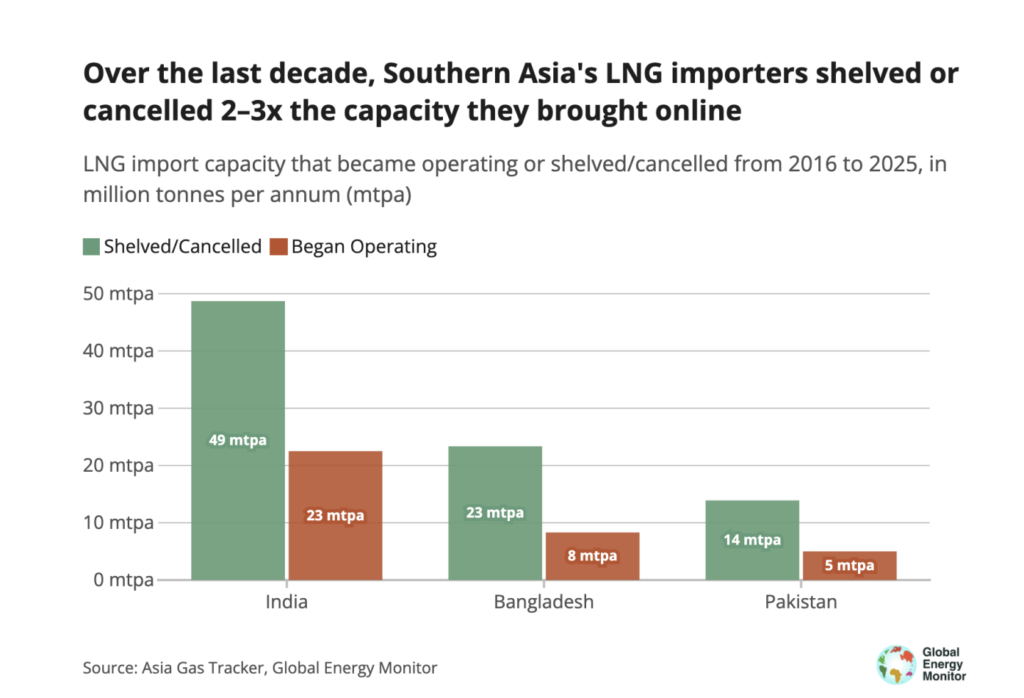
- India, Bangladesh and Pakistan have shelved or cancelled two to three times more LNG import capacity than they have completed.
- Proposed LNG terminals in South Asia have significantly higher failure rates than comparable projects in Europe.
The ongoing conflict in the Middle East highlights how quickly a promising energy market can shift into an affordability crisis, increasing the likelihood that planned projects could be delayed, stalled or cancelled.
Renewables Emerging as Strong Competitors
The GEM report also notes that renewable energy is increasingly outcompeting gas in the power sectors of India and Pakistan.
Recent developments include:
- Solar power generation in Pakistan has more than tripled in the last three years.
- India is expected to meet over 40% of its electricity demand through renewables by 2030.
- Advances in energy storage technologies are improving grid flexibility and reducing the need for gas-fired power plants used for balancing supply.
Additionally, emerging solutions such as green hydrogen could gradually reduce industrial dependence on imported gas.
Analyst View
Robert Rozansky, global LNG analyst at Global Energy Monitor, said the current geopolitical crisis underscores the risks of expanding LNG infrastructure.
“We’ve seen this story before, and South Asian economies that import LNG will struggle with these price shocks. It’s a reminder of the risks of building new gas infrastructure, and that domestic alternatives like renewable power are more affordable and reliable in the long run,” Rozansky said.
The writer of this article is Dr. Seema Javed, an environmentalist & a communications professional in the field of climate and energy