Sustainability Is No Longer an Option for India’s Heavy Industries: Deepak Mishra
ASSOCHAM India ESG Conclave charts pragmatic pathways for Net Zero in hard-to-abate sectors
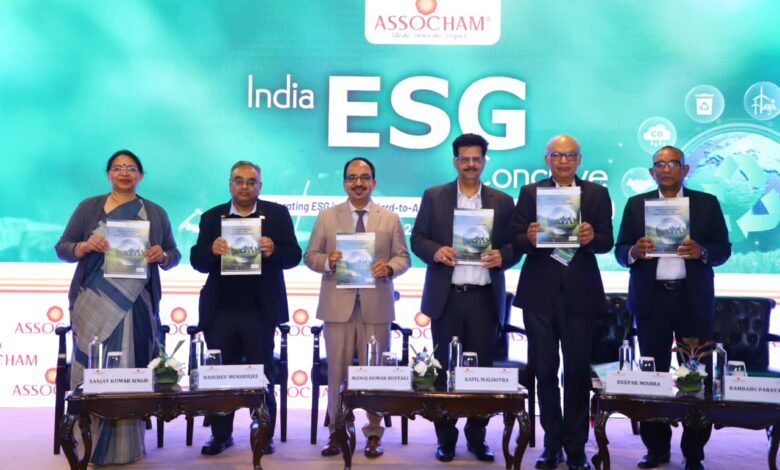
ASSOCHAM on Tuesday organised the India ESG Conclave – “Accelerating ESG in India’s Hard-to-Abate Industries: From Purpose to Impact” in New Delhi, bringing together policymakers, industry leaders and sustainability experts to deliberate on actionable strategies for India’s Net Zero transition.
The conclave focused on the integration of Environmental, Social and Governance (ESG) principles across critical sectors such as mining, metals, cement, chemicals, petrochemicals and hydrocarbons, with emphasis on technology deployment, policy support and industry collaboration for sustainable industrial growth.
Addressing the gathering, Deepak Mishra, Joint Secretary (Petrochemicals), Department of Chemicals & Petrochemicals, Government of India, said sustainability has moved beyond intent to implementation.
“While market conditions may fluctuate, India’s commitment to sustainability is firm and irreversible. The government has moved from intention to action, setting targets for reducing carbon intensity and driving a definitive transition to a circular economy,” Mishra said.
He emphasised that energy-intensive sectors such as petrochemicals and plastics must align competitiveness with sustainability, highlighting Extended Producer Responsibility (EPR) as a regulatory framework that delivers both financial and environmental benefits.
“In the future, sustainability will shift from compliance to innovation, technology and strategic initiatives. Organisations that make this transition will not only meet regulations but become key stakeholders in India’s low-carbon future,” he added.
Kapil Malhotra, Co-Chairman, ASSOCHAM National Council on Chemicals & Petrochemicals and Global Business Leader – Fluoropolymers, GFL, noted that decarbonisation has become a business imperative for hard-to-abate sectors.
“A systems-based approach combining energy efficiency, cleaner feedstocks, circularity, renewables and process innovation is essential. ESG must be viewed as a catalyst for transformation rather than a regulatory obligation,” Malhotra said.
Dr. Rambabu Paravastu, Advisor & Chief Sustainability Officer, Greenko Group, underlined the importance of green hydrogen, storage-based models and non-carbon solutions in decarbonising heavy industries such as steel, cement and chemicals.
“Platforms like the India ESG Conclave enable collective collaboration between industry, government and technology players, accelerating solutions with measurable ESG impact,” he said.
Highlighting the decade ahead, Manoj Kumar Rustagi, Chief Sustainability and Innovation Officer, JSW Cement Ltd., said:
“The next ten years will be critical for industrial decarbonisation, particularly in hard-to-abate sectors. There is a significant opportunity to develop local, home-grown technologies that make both environmental and economic sense.”
The conclave featured three thematic panel discussions focusing on:
- Low-carbon pathways in mining and metals
- Circularity in chemicals and petrochemicals
- Net Zero roadmap for the hydrocarbon sector
Senior representatives from ONGC, GAIL, Indian Oil, JSW Energy and Greenko, along with government officials, shared insights on green hydrogen, CCUS, clean fuels and ESG-aligned policy frameworks.
A key highlight of the event was the release of a Knowledge Report, outlining actionable recommendations to accelerate India’s transition towards a resilient, low-carbon industrial ecosystem.