
Green Economy to Drive ‘Green Jobs’ and Entrepreneurship; Youth Key to India’s Sustainable Growth: Dr. Jitendra Singh
Encouraging students and researchers, he said the future will be shaped by innovation, adaptability, and informed choices
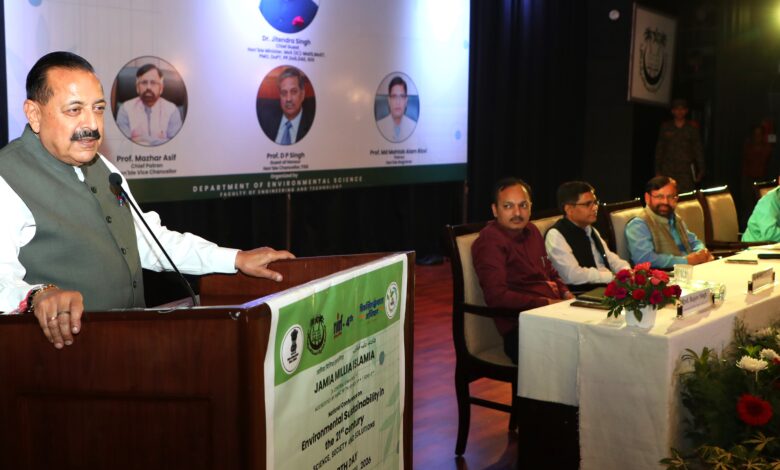
Union Minister of State (Independent Charge) for Science & Technology, Earth Sciences, and MoS PMO, Personnel, Public Grievances, Pensions, Atomic Energy and Space, Dr. Jitendra Singh said that India’s transition towards a green economy will unlock vast opportunities in “green jobs” and “green entrepreneurship,” positioning youth at the center of the country’s sustainability-driven growth.
Addressing the valedictory session of the National Conference on “Environmental Sustainability in the 21st Century: Science, Society and Solutions” at Jamia Millia Islamia on the occasion of Earth Day, the Minister emphasized that sectors such as renewable energy, electric mobility, green fuels, and the circular economy will generate large-scale employment in the coming years.
He noted that India’s development model is undergoing a paradigm shift towards green growth, adding that the clean energy push and green transition will not only create jobs but also accelerate the country’s move towards a low-carbon and sustainable economy.
Highlighting key initiatives, Dr. Singh pointed to the National Green Hydrogen Mission, backed by an outlay of over ₹19,000 crore, as a cornerstone of India’s clean industrial transformation. He said emerging technologies are enabling decarbonisation in critical sectors like steel and cement, strengthening India’s global leadership in the green transition.
The Minister underlined the rapid pace of technological change, stressing the need for continuous innovation. He cited grassroots innovations in electric mobility—such as converting conventional vehicles into electric ones—as examples of how sustainability can be made both affordable and scalable.
Dr. Singh also highlighted expanding opportunities across solar manufacturing, battery production, grid management, and biofuels, while identifying the circular economy—such as converting used cooking oil into biofuel—as a promising avenue for entrepreneurship.
Pointing to future energy frontiers, he said ocean energy remains largely untapped despite India’s vast coastline and will complement solar and wind energy going forward.
On energy security, the Minister noted that India is advancing towards higher nuclear power capacity while opening strategic sectors like space and nuclear energy to greater private participation, encouraging innovation and investment.
He also referred to the ₹1 lakh crore Research, Development and Innovation (RDI) Fund, aimed at supporting startups and innovators through collaborative funding between government and private stakeholders.
Emphasizing India’s global responsibility in climate action, Dr. Singh said the country—home to 1.4 billion people—is well positioned to lead the global green transition, guided by the vision of Lifestyle for Environment (LiFE) advocated by Prime Minister Narendra Modi.
Encouraging students and researchers, he said the future will be shaped by innovation, adaptability, and informed choices, with youth playing a decisive role in building a sustainable and resilient India.