
WCL’s Tough & Speedy Action Marks New Era of PSU Accountability, FIR and Blacklisting Move Against Coal Testing Firm!
Action against alleged coal testing discrepancies highlights growing accountability and tighter oversight in India’s PSU sector

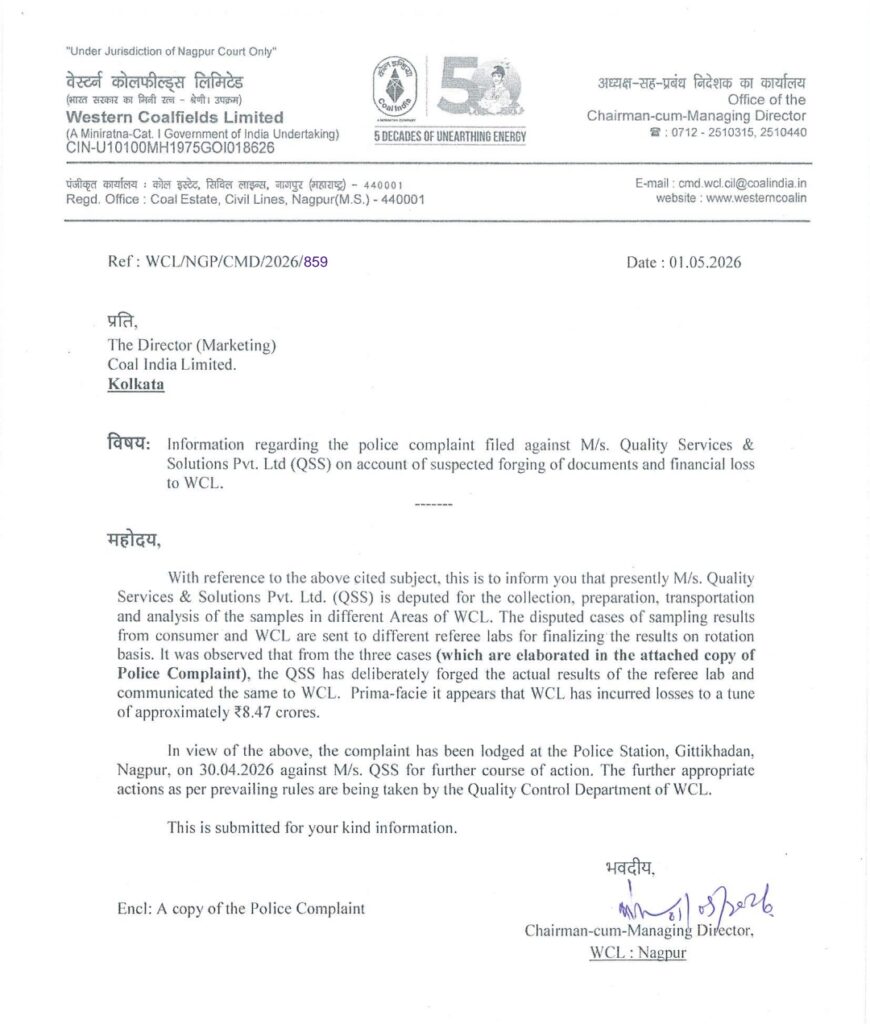
The transformation underway in India’s Public Sector Undertakings (PSUs) under the Modi government is increasingly visible not merely in policy documents, but in the way, institutions are responding to irregularities on the ground. The recent action initiated by Western Coalfields Limited (WCL) against third-party sampling agency Quality Services & Solutions Pvt. Ltd. (QSS) is a significant example of this changing governance ecosystem. This specific case pertains to financial implication of approximately ₹8.47 crore.
By moving towards blacklisting proceedings and seeking registration of an FIR over alleged manipulation of coal testing reports, WCL has demonstrated that the era of passive oversight in PSUs is rapidly giving way to a culture of strict accountability, transparency, and enforcement.
A Strong Message From the Public Sector
For decades, critics often accused PSUs of delayed decision-making and weak enforcement against contractual irregularities. However, the WCL case reflects a very different institutional mindset.
Upon detecting discrepancies in coal sampling and referee laboratory reports, WCL reportedly:
- Conducted detailed internal scrutiny
- Verified findings independently with referee laboratories
- Documented inconsistencies in submitted reports
- Initiated legal escalation through police complaint procedures
- Moved to initiate blacklisting action against the agency involved
This sequence reflects not hesitation, but administrative confidence backed by systems and evidence.
Governance Reforms Translating Into Action
The Modi government has consistently pushed PSUs towards:
- Greater financial discipline
- Vendor accountability
- Technology-backed monitoring
- Transparent procurement and audit systems
- Faster enforcement action in cases of suspected malpractice
The WCL episode illustrates how these reforms are now influencing operational behaviour.
Rather than limiting the matter to internal correspondence, the PSU escalated it formally—signaling that public institutions are increasingly unwilling to compromise on integrity issues involving public money.
Protecting Public Revenue
Coal quality assessment directly impacts commercial settlements, pricing, and billing. Any discrepancy in grading can potentially affect revenue realization.
WCL’s findings reportedly pointed to a prima facie financial implication of around ₹8.47 crore, prompting immediate intervention.
More importantly, the company’s response highlights a larger institutional principle: Public resources must be protected proactively, not reactively.
Third-Party Agencies No Longer Beyond Scrutiny
One of the most important takeaways from the case is the tightening oversight of outsourced agencies.
Historically, third-party technical agencies often functioned with limited real-time scrutiny. The current governance framework is clearly changing that paradigm.
By cross-verifying data directly with referee laboratories such as EPTRI and identifying mismatches, WCL reinforced an important reform message:
- Outsourcing does not dilute accountability
- External agencies remain fully answerable within PSU systems
- Contractual partnerships must withstand audit and legal scrutiny
Leadership-Driven Accountability
Another notable aspect is the apparent seriousness with which the issue was escalated within the institutional hierarchy.
The matter was formally communicated to Coal India Limited by WCL leadership, underlining that governance issues are now receiving attention at the highest operational levels.
This top-down approach reflects a broader shift in PSU functioning under ongoing reforms:
- Leadership accountability is increasing
- Compliance mechanisms are becoming stronger
- Governance failures are less likely to be ignored
A New PSU Culture Emerging
The broader significance of this development lies beyond one company or one dispute.
It reflects the emergence of a new PSU culture where:
- Vigilance systems are active
- Data validation matters
- Legal recourse is pursued promptly
- Institutional reputation is protected aggressively
This evolution is crucial for sectors like coal, where operational transparency directly affects national energy security and economic efficiency.
Conclusion: Reform With Enforcement
The WCL case demonstrates that PSU reforms are no longer confined to administrative language—they are increasingly visible in enforcement actions and institutional conduct.
By pursuing both blacklisting proceedings and FIR action, WCL has sent a strong message across the PSU ecosystem that irregularities, especially those impacting public revenue and system integrity, will invite serious consequences.

When contacted by www.indianpsu.com, CMD of Western Coalfields Limited, Hemant Sharad Pande said “WCL has once again shown its commitment to fair practices. By identifying the malpractices in 3rd party referee results, we not only mitigated risk but also strengthened trust in our systems”.
If this reform momentum continues, India’s PSUs may increasingly emerge not just as state-owned enterprises, but as professionally governed institutions operating with global standards of accountability and oversight.
Several email queries sent by www.indianpsu.com to Quality Services & Solutions Pvt. Ltd., did not elicit any response. The company, if working in any other subsidiary of Coal India Limited, is bound to be blacklisted there too due to the action taken against it by Western Coalfields Limited.
Editor's View: Strong governance is meaningful only when institutions act decisively—and WCL’s response reflects exactly that shift.