
Haryana Pushes Smart Meters While Uttar Pradesh Rolls Back Prepaid Model: Which State Has Got It Right?
As Haryana moves ahead and Uttar Pradesh changes course, the country's power sector may be witnessing the emergence of two competing models
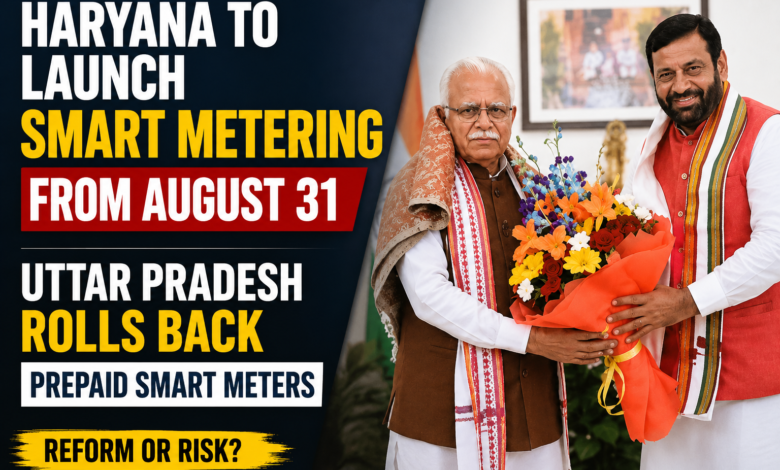
Can this be termed as a Reform or a Risk?
As Haryana prepares to launch smart metering works from August 31 following directions from Union Power Minister Manohar Lal, an uncomfortable question is emerging across India’s power sector: Is Haryana embracing a reform that Uttar Pradesh has already begun abandoning?
In a significant policy shift, the Uttar Pradesh government has directed its distribution companies to restore the postpaid billing system for nearly 84 lakh consumers, effectively rolling back the prepaid smart meter regime implemented under the Revamped Distribution Sector Scheme (RDSS). The decision follows sustained protests by consumers, traders and farmers who complained of compulsory prepaid recharges, abrupt disconnections and alleged billing anomalies.
The timing could not be more striking
While Uttar Pradesh is stepping back from prepaid smart metering amid public backlash, Haryana is preparing to move forward. During a recent review meeting in Chandigarh, Union Power Minister Manohar Lal emphasized the need for accelerated smart meter deployment and advocated a phased rollout of prepaid smart metering, starting with government consumers and employees before extending it to high-consumption users.
The question is not whether smart meters are technologically superior. Most experts agree they offer advantages such as real-time monitoring, accurate billing, theft reduction and improved energy management. The real issue is whether the prepaid model is suitable for Indian consumers, particularly households accustomed to postpaid electricity billing.
Supporters argue that prepaid smart meters are essential for improving the financial health of loss-making DISCOMs. India’s power distribution sector has struggled for decades with mounting dues, subsidy delays, power theft and billing inefficiencies. Smart meters are seen as a critical tool for reducing Aggregate Technical and Commercial (AT&C) losses and bringing greater accountability to electricity consumption.
Critics, however, contend that the burden of reform is being shifted disproportionately onto consumers. They question whether forcing consumers to recharge electricity like a mobile phone connection is appropriate for an essential service. Consumer groups also argue that sudden disconnections due to exhausted balances can disproportionately affect poorer households, senior citizens and rural consumers.
The Uttar Pradesh rollback has strengthened these concerns. If one of India’s largest states, after deploying millions of smart meters, has concluded that the prepaid model is politically and socially unsustainable, should other states pause and reassess before proceeding?
Another question is whether smart metering and prepaid billing are being unnecessarily conflated. Many experts believe smart meters can deliver operational benefits without requiring consumers to migrate to prepaid billing. Under this approach, utilities could retain postpaid billing while still leveraging the advantages of digital metering and real-time data.
For Haryana, the challenge will be to convince consumers that smart metering is not merely a revenue collection exercise but a genuine modernization initiative. Public trust, transparency in billing, effective grievance redressal and consumer choice may ultimately prove more important than technology itself.
As Haryana moves ahead and Uttar Pradesh changes course, the country’s power sector may be witnessing the emergence of two competing models. The outcome could shape the future of electricity reforms across India.
Editor's Take: As Haryana prepares to roll out smart meters, Uttar Pradesh's decision to roll back the prepaid model has reignited a national debate: are smart meters a power sector reform or a consumer risk?