

BMS Challenges UFBU Strike Notice: Legal Validity of September 11 Bank Strike Under Scanner
Interestingly, the BMS is not opposed to the underlying concerns of bank employees
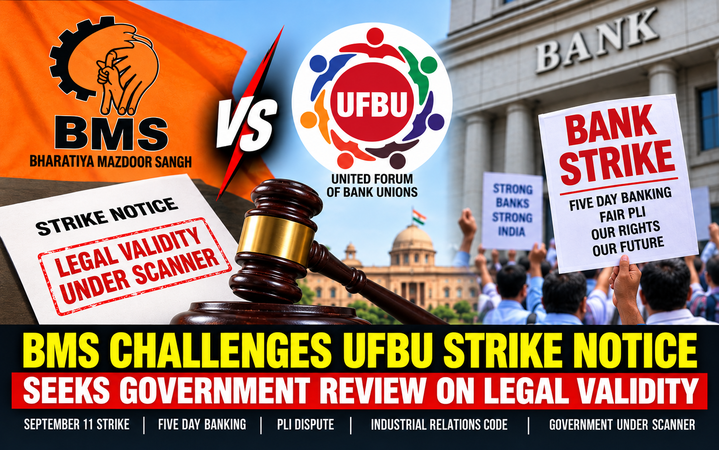
The escalating confrontation between bank unions and the government has taken a fresh turn, with the Bharatiya Mazdoor Sangh (BMS) challenging the legal validity of the United Forum of Bank Unions (UFBU) strike notice and asking the Department of Financial Services (DFS) to examine whether the proposed industrial action meets the requirements of the Industrial Relations Code, 2020.
In a letter dated September 4, the BMS has questioned the competence of UFBU to issue a statutory strike notice, pointing out that UFBU itself is an umbrella forum and not a registered trade union. It has also questioned whether the notice was properly served on the individual bank employers, rather than merely on the Indian Banks’ Association (IBA).
The intervention comes at a critical juncture. UFBU has announced an all-India bank strike on September 11, followed by a three-day strike from September 28 to 30, and an indefinite strike beginning October 26. The agitation centres on demands including five-day banking, the disputed performance-linked incentive (PLI) framework and other pending issues.
BMS Questions the Foundation of the Strike Notice
The BMS has asked the government to examine whether the UFBU notice satisfies the statutory requirements under Section 62 of the Industrial Relations Code.
The organisation has specifically sought scrutiny of the legal standing of UFBU to initiate statutory strike proceedings and questioned the manner in which the notice was served.
It has also asked the Department of Financial Services to reconsider the conciliation proceedings if those proceedings are based on a strike notice that is found to be legally defective.
The BMS wants the government to ensure that future strike proceedings are initiated only by legally competent bodies and in strict compliance with the applicable provisions of the Industrial Relations Code.
This puts the dispute on a different plane. Until now, the central confrontation has largely been about what bank employees want. The BMS intervention raises a second question: whether the mechanism being used to enforce those demands is legally sustainable.
September 11 Strike Now Faces an Additional Complication
The Chief Labour Commissioner (Central) has already initiated conciliation proceedings over the UFBU strike notice under Section 53(1) of the Industrial Relations Code.
The notice issued by UFBU was dated August 26 and was submitted by its seven constituent organisations – AIBEA, AIBOC, NCBE, AIBOA, BEFI, INBOC and INBEF. The proposed programme includes the September 11 strike, the September 28-30 strike and the indefinite action from October 26.
The conciliation process is therefore already underway, making the BMS demand for a review particularly significant.
The question before the authorities is no longer simply whether negotiations can avert the strike. It is also whether the statutory foundation of the strike notice itself requires examination.
BMS and UFBU: Same Broad Issues, Different Approach
Interestingly, the BMS is not opposed to the underlying concerns of bank employees.
The organisation has itself pressed the government for five-day banking and changes to the PLI system. It has sought a uniform PLI framework for bank employees and early implementation of five-day banking.
That makes the present confrontation particularly interesting.
The difference is in strategy.
While UFBU has chosen escalating industrial action, including a proposed indefinite strike, the BMS is seeking government intervention through the statutory and administrative route.
In other words, the fight is not necessarily over the demands themselves. It is increasingly about how those demands should be pursued and whether the UFBU’s chosen route complies with the law.
Government Has Already Blinked on PLI
The BMS intervention comes at a time when the government has already made a significant move on one of the principal flashpoints.
Following representations from bank employee representatives, the government has decided to keep the implementation of the PLI scheme for public sector bank employees for 2025-26 in abeyance. The issue is now to be taken up during the ongoing bipartite settlement and joint-note discussions.
This changes the negotiating landscape.
UFBU’s agitation had prominently targeted the PLI framework, which the unions have criticised as discriminatory. The government’s decision to put implementation on hold removes, at least temporarily, one of the immediate triggers for confrontation.
But five-day banking remains unresolved, and the broader list of residual demands continues to provide the basis for the UFBU agitation.
The Real Test Is Now September 11
The next few days could therefore prove decisive.
The UFBU-IBA meeting on September 4 failed to produce a breakthrough, and the unions maintained that there was no reason to defer the September 11 strike.
Meanwhile, major public sector banks have warned that operations could be affected if the strikes materialise, despite preparations to maintain normal functioning. SBI and Bank of Baroda have both disclosed the potential impact of the proposed strike programme.
Against this backdrop, the BMS challenge creates an additional pressure point for the authorities.
If the government accepts the BMS argument and finds deficiencies in the UFBU notice, the September 11 action could face a serious procedural challenge.
If the government allows the conciliation process to continue without accepting the objections, the dispute could move back to the negotiating table — but with the legal question still hanging over the strike programme.
A New Dimension to the Bank Strike Battle
The BMS intervention has therefore transformed what was essentially a wage-and-working-conditions confrontation into a three-way contest involving labour demands, government negotiations and statutory compliance.
The immediate question is whether the September 11 strike goes ahead.
The larger question is whether future industrial action in the banking sector will be shaped not merely by the strength of union mobilisation, but also by the legal status and statutory authority of the body issuing the strike notice.
For the government, this is an opportunity to establish a clear position on how the new Industrial Relations Code applies to collective action by umbrella organisations such as UFBU.
For the unions, it is a warning that the procedural route to a strike could become as important as the demands behind it.
And for bank customers, the outcome could determine whether the September strike calendar remains intact or undergoes another dramatic change.