

DGCA Orders Drug Tests for All Airline Pilots After Air India Incident
The move follows the serious incident involving Air India flight AI2379, which was flying from Phuket to Delhi on August 4, 2026
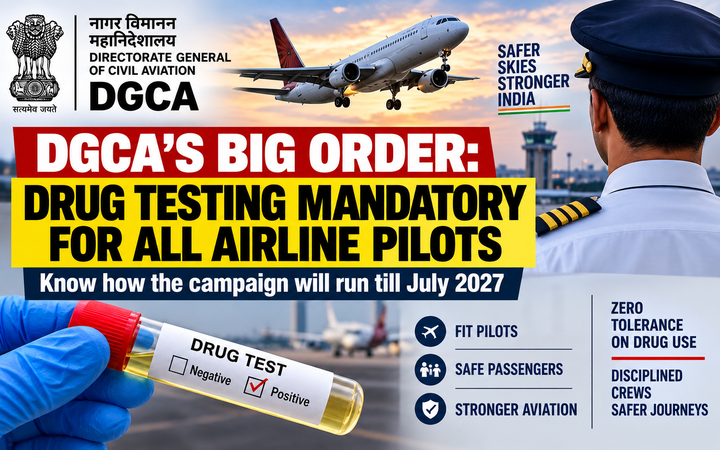
The Directorate General of Civil Aviation (DGCA) has directed airlines operating in India to conduct a one-time psychoactive-substance test of all their pilots, in a major tightening of aviation safety oversight following the Air India Phuket–Delhi flight incident.
The regulatory action comes after the pilot-in-command of an Air India Airbus A320 operating from Phuket to Delhi was found non-negative for a psychoactive substance, with the result subsequently confirmed through a laboratory test. The Aircraft Accident Investigation Bureau (AAIB), which investigated the August 4 incident, described the confirmed finding as a serious safety concern and recommended that the DGCA take appropriate action to prevent the abuse of psychoactive substances by aviation personnel.
The DGCA’s latest directive expands the scrutiny beyond individual airlines and places the entire commercial aviation sector under a coordinated testing exercise. The campaign is to be completed by July 2027, bringing pilots across Indian airlines within the regulator’s enhanced monitoring framework.
Air India Incident Triggers Regulatory Action
The DGCA’s move follows the serious incident involving Air India flight AI2379, which was flying from Phuket to Delhi on August 4, 2026.
The Airbus A320, registered as VT-EXO, experienced a sudden loss of altitude during cruise at around 36,000 feet. The aircraft’s three hydraulic systems temporarily lost pressure, the autopilot disengaged and the aircraft underwent a sudden altitude change. The incident resulted in injuries to 20 passengers and four crew members before the aircraft stabilised and landed safely in Delhi.
The subsequent investigation brought another serious issue to light.
The pilot-in-command was found non-negative for a psychoactive substance in an initial screening, and a confirmatory test subsequently established the presence of the substance. Air India later terminated the pilot’s employment, citing its zero-tolerance policy towards breaches of safety, fitness and regulatory requirements.
The AAIB has not established that the pilot’s substance use caused the aircraft’s hydraulic-system malfunction. The technical cause of the incident remains under investigation, with Airbus and France’s Bureau of Enquiry and Analysis for Civil Aviation Safety (BEA) assisting the probe.
However, the pilot’s confirmed test result has raised fundamental questions about the effectiveness of existing safeguards for detecting psychoactive-substance use among flight crew.
What Has Changed Under the DGCA Directive?
Under the existing DGCA framework, airlines are already required to conduct random testing for psychoactive substances among flight crew. The current framework has historically required testing of a proportion of pilots rather than testing every pilot each year.
The latest order represents a significant expansion of this surveillance mechanism.
Instead of relying only on the existing random-testing system, airlines have now been directed to ensure that all pilots undergo the specified psychoactive-substance test as part of the one-time exercise.
The development is particularly significant because the existing rules do not mandate a psychoactive-substance test before every flight. Pre-flight breathalyser testing applies to alcohol, while the broader psychoactive-substance testing regime operates through random and specified post-flight or duty-period testing.
Which Substances Are Covered?
The DGCA’s testing framework covers several categories of psychoactive substances, including:
- Cannabis/THC
- Amphetamines and amphetamine-type stimulants
- Opiates and their metabolites
- Cocaine
- Barbiturates
- Benzodiazepines
The testing process involves an initial screening followed, where required, by a confirmatory laboratory examination. A non-negative initial result does not by itself constitute a confirmed positive finding; the confirmatory process is used to establish the result.
A pilot returning a non-negative result is removed from safety-sensitive duties while the confirmatory testing process is completed.
Why the July 2027 Deadline Matters
The decision to conduct testing across the airline industry marks a major shift in the DGCA’s approach to crew fitness.
The exercise will require airlines to identify their pilot strength, organise testing through authorised facilities, maintain proper documentation and report the results to the regulator.
With the exercise continuing through July 2027, the DGCA will have an opportunity to obtain a much broader picture of psychoactive-substance use among India’s commercial flight crew.
The exercise could also provide the regulatory authorities with data to determine whether the existing random-testing regime needs to be permanently strengthened.
A Major Test for India’s Aviation Safety System
The DGCA’s latest order places pilot fitness firmly at the centre of India’s aviation-safety agenda.
A commercial pilot operates in an extremely safety-sensitive environment where impairment from psychoactive substances can potentially affect judgement, reaction time, coordination and decision-making.
The Air India case has demonstrated that the issue cannot be treated merely as an internal disciplinary matter for individual airlines.
The regulator’s nationwide testing exercise will therefore be closely watched by airlines, pilots and passengers alike. Its effectiveness will ultimately depend not only on the completion of the tests but also on strict laboratory procedures, reliable confirmation of results, proper chain of custody and consistent regulatory action.
The DGCA’s move sends a clear message: fitness to fly is a non-negotiable requirement, and India’s aviation regulator intends to subject the country’s commercial pilots to much closer scrutiny on psychoactive-substance use.