
BRICS New Delhi Declaration Links Climate Resilience With Trade, Industry, Energy and Finance
The significance of the New Delhi Declaration extends beyond its climate provisions
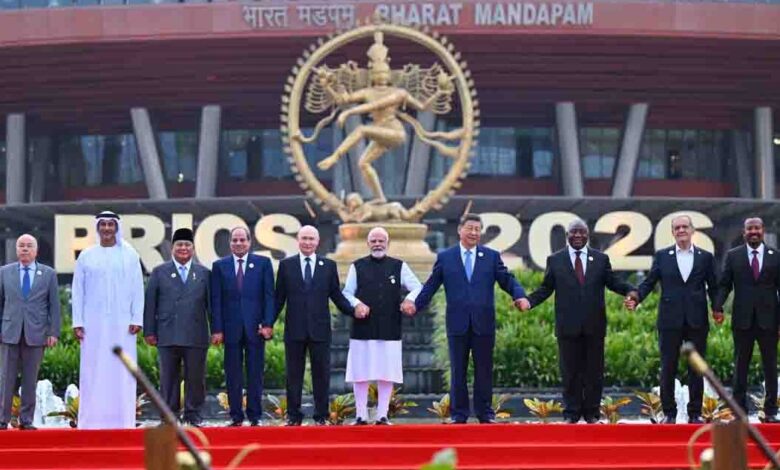
India’s presidency of the 18th BRICS Summit has placed climate resilience within a much broader economic and development framework, linking climate action with industrial capacity, trade, finance, energy security, infrastructure and the policy space available to developing economies.
The summit, held in New Delhi and concluded on September 13, 2026, brought together an expanded BRICS grouping of 11 members and 10 partner countries, representing 49.5 per cent of the world’s population, 40 per cent of global GDP and 26 per cent of global trade. The summit adopted the BRICS New Delhi Declaration under the theme, “Building for Resilience, Innovation, Cooperation and Sustainability.”
The declaration reflects the breadth of India’s BRICS chairship, placing resilience, sustainable development and practical cooperation at the centre of the bloc’s agenda. India’s presidency convened more than 400 meetings across the country as part of efforts to strengthen the institutional architecture of BRICS and advance cooperation across sectors.
Rathin Roy, Distinguished Professor, Kautilya School of Public Policy and Economic Advisor and Dean, GITAM School of Humanities and Social Sciences, said the declaration was notable for its strong multilateral character at a time when multilateralism itself was under pressure.
“What is interesting about the declaration, apart from its inordinate length, is that it is profoundly multilateral. In an age when multilateralism has been actively rubbished by all the major powers, it speaks about multinational initiatives, whether it speaks about sustainability, WTO reform, IMF reforms or the challenge of Gaza,” Roy said.
He said the declaration reflects a broader demand from emerging economies for greater influence within the multilateral system, commensurate with their growing economic importance.
“It looks to multilateral action to solve problems, within which, of course, it says that the emerging economies have to have a power commensurate with their economic salience within the multilateral system. The old post-war system is no longer valid,” he said.
On sustainable development, Roy pointed to what he described as an important distinction in the BRICS framing of climate change.
“All of them collectively are prioritising sustainable development. In most places in the declaration where climate change is mentioned, the word ‘including’ precedes climate change. So this is sustainable development, including climate. They are weaving in a broader lens,” he said.
Roy also noted the absence of the phrase “Net Zero” from the declaration, arguing that this reflects a fundamentally different way of framing the climate challenge. “What you also notice in the entire document is that the favourite Euro-American phrase — Net Zero — is absent. So the framing is profoundly different from the way the Europeans framed the climate change problem, or even the sustainable development problem,” he said.
“For BRICS, the sustainable development problem is not just about Net Zero. Net Zero is an outcome of a profoundly unsustainable development system. The drivers of sustainable development include environmental degradation, a consequence of which is climate change, but they also include inequality. The political economy nature of the problem is repeatedly highlighted.”
Roy also highlighted the wider acceptance of India’s Lifestyle for Environment (LiFE) approach within the BRICS framework. “I’m also impressed that India has managed to incorporate our own LiFE approach to sustainable development, emphasising that sustainable lifestyles should be associated with economic development. That finds a prominent position beyond the Indian position,” he said.
“This means it is gaining quite acceptance now beyond the Indian position, across emerging economies and hopefully the Global South.”
The New Delhi Declaration consequently places climate resilience within a much wider set of economic and development priorities. Rather than treating climate resilience as a stand-alone environmental issue, it connects it with economic resilience, industrial capacity, trade, finance and national policy space.
The approach links climate risks with industrial policy, critical minerals, energy systems, supply chains, infrastructure, small-business finance, insurance and food security. In doing so, it places climate risk within the broader question of how BRICS economies manage growth, investment and structural transformation.
According to Ulka Kelkar, Executive Director – Climate, Economics & Finance, WRI India, the declaration’s emphasis on disaster risk reduction and resilience is particularly significant as climate change increases the frequency and severity of extreme weather events.
“At a time when climate change is increasing the frequency and severity of extreme weather, the New Delhi Declaration introduces ideas on disaster risk reduction through international collaboration and community-led resilience building,” Kelkar said.
She noted that the declaration calls for climate risk assessment to be integrated into land-use planning, which could help prevent maladaptation.
“The BRICS Insurance Resilience Centre and BRICS Risk Lab can facilitate cross-country disaster risk pooling as an alternative to conventional insurance approaches, which have limited effectiveness in the face of climate change,” she said.
Kelkar also pointed to the role of finance and development institutions in strengthening resilience. “BRICS countries are already large donors of climate finance, not just recipients, and the New Development Bank can continue to support projects for sustainable development and climate adaptation,” she said.
She added that the economic vulnerability of micro, small and medium enterprises (MSMEs), particularly their role in global value chains, makes access to finance an important part of climate resilience.
“Financial access initiatives like the BRICS’ Guiding Principles for Credit Assessment Frameworks and the Jaipur Consensus can help make MSMEs more resilient to climate and economic shocks,” Kelkar said.
The declaration brings together priorities that are often addressed separately — climate action, development, energy security, resilience and finance. Against the backdrop of fiscal constraints faced by developing economies, rising losses from extreme weather events and strains on multilateral processes, the BRICS framework seeks to ground climate action in the principles of the Paris Agreement while placing greater emphasis on equity and the priorities of the Global South.
The declaration also advances cooperation in areas including carbon markets, climate research, community-based adaptation, smart grids, energy storage, hydrogen, critical minerals and transport decarbonisation. Its emphasis on early warning systems and climate-resilient infrastructure further reflects a move from broad commitments towards practical areas in which BRICS members can exchange expertise, build capacity and develop common approaches.
That emphasis on practical cooperation extends to trade and industrial policy. The declaration supports more resilient supply chains and greater participation by developing countries in higher-value manufacturing, alongside cooperation on critical minerals, hydrogen, solar manufacturing, smart grids and financing for export-oriented small firms.
At the same time, BRICS members have pushed back against trade measures they regard as protectionist or extraterritorial, particularly where environmental standards are developed without adequate representation of emerging and developing economies.
Aarti Khosla, Founder and Director, Climate Trends, said reaching consensus on such a framework was significant given the diversity and geopolitical complexity of the BRICS grouping.
“For a grouping as diverse and geopolitically complex as BRICS, achieving consensus on a forward-looking climate framework is no small feat,” Khosla said.
“In a year mired in energy volatility, BRICS has struck a pragmatic balance, recognising that climate action is about economics and infrastructure, not environmental policy alone.”
She said India had steered the discussion towards cooperation on smart grids, energy storage, adaptation and disaster resilience — areas she described as critical to a just transition.
“It demonstrates how BRICS can translate Global South priorities into collective action,” Khosla said.
“With the West backing out of climate commitments, BRICS solidarity sends a message for a new era of multilateralism to drive the Global South’s real priorities, along with the green agenda, more meaningfully.”
The significance of the New Delhi Declaration therefore extends beyond its climate provisions. At a time of geopolitical fragmentation, energy volatility and increasing climate-related economic risks, India’s BRICS chairship has sought to build consensus around a model in which resilience is not confined to environmental policy but becomes part of the broader architecture of economic development.
For BRICS, the emerging message is clear: climate resilience, economic resilience and development resilience are increasingly interconnected – and the Global South wants a greater role in determining the rules that govern all three.
The writer of this article is Dr. Seema Javed, an environmentalist & a communications professional in the field of climate and energy