
Geo-Cultural Conference Puts Waterman Dr. Rajendra Singh’s Water Wisdom at Centre of India’s Ecological Future
Prof. Bharat Raj, Prof. B.K. Singh, Prof. Rana Pratap, Sanjay Singh, Vikrant Sharma, Dr. Indira Khurana, Dr. Rambhuj, Narmada Singh, Anita Chauhan and Paras Pratap Singh contributed to the deliberations.
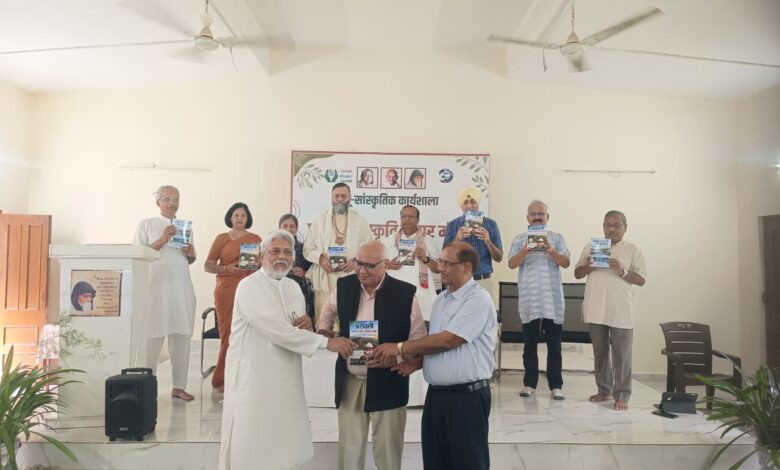
A three-day Geo-Cultural Conference at Harijan Sevak Sangh, New Delhi, has called for a fundamental rethink of India’s development model, placing water conservation, ecological regeneration, community participation and cultural wisdom at the heart of the country’s future.
Held from September 11 to 13, the conference brought together nearly 150 participants from across India, including grassroots environmental workers, farmers, scientists, academics, students, political activists and Gandhian-Sarvodaya workers.
The conference’s larger vision found particular resonance in the life and work of Dr. Rajendra Singh, the Waterman of India and Ramon Magsaysay Award winner, whose decades of grassroots work in water conservation and river revival have demonstrated the transformative power of community-led ecological action.
Rajendra Singh’s Water Revolution: A Model for India
Dr. Rajendra Singh’s work has long challenged the notion that India’s water crisis can be solved only through massive infrastructure.
His approach—rooted in rainwater harvesting, revival of traditional water systems, community participation and watershed regeneration—has shown how villages can reclaim their ecological security by taking responsibility for their own natural resources.
That philosophy closely reflected the central message of the New Delhi conference: India must learn to work with its ecological and cultural geography rather than impose a uniform development model upon it.
Participants argued that India’s 86-zone geo-cultural map could serve as an important tool for understanding the country’s diverse ecological, social and cultural conditions and developing locally appropriate solutions.
From Drought to Green Prosperity
The conference brought together dozens of people who have worked directly on the ground to reverse ecological degradation.
Participants narrated how rainwater was captured, degraded land regenerated and water bodies and rivers revived—bringing back greenery, agriculture and prosperity.
Women from Mewat, once severely affected by water scarcity, shared how community-led water work transformed their villages.
Representatives of the Arvari Parliament from Alwar spoke about their experience of decentralised democracy and community management of the Arvari River.
From the Chambal, participants who had abandoned the path of violence and guns described how they subsequently worked towards agriculture, greenery and rural prosperity.
Their experiences provided a powerful counterpoint to a development narrative driven primarily by consumption and resource extraction.
Farmers Raise Alarm Over Land, Water and Data Centres
The conference also heard strong concerns from farmers and activists over the growing pressure on agricultural land, forests, rivers and water resources.
Participants criticised the rapid expansion of resource-intensive infrastructure, including data centres, describing them metaphorically as “Bhasmasurs” that could consume enormous quantities of land, water and energy.
Farmers’ leaders and activists, including Dr. Sunilam, V.M. Singh and Major Dr. Hemanshu, shared their experiences of struggles involving farmers and natural resources.
The presence of scientists and professors from Central Universities and institutions from Lucknow, Visakhapatnam and other parts of India added a scientific dimension to the debate.
Nature, Culture and Science Must Come Together
One of the key conclusions emerging from the conference was that India’s development journey must bring together nature and culture, science and spirituality, and knowledge and lived experience.
Participants described the 86-zone geo-cultural map as a possible framework for a development model that recognises the country’s physical, ecological and cultural diversity.
The objective, they said, should be to build an India that is self-reliant, self-respecting and sustainable, rather than pursuing development at the cost of its natural foundations.
Documenting India’s Grassroots Ecological Heroes
The conference also unanimously called for systematic identification and documentation of people and communities working on the ground to protect nature.
Their experiences, participants said, need to be recorded, studied and shared so that successful models can be replicated elsewhere.
The geo-cultural map could subsequently become a practical tool for these grassroots practitioners, helping them understand their ecological zones and accelerate their work.
This is precisely where the legacy of Dr. Rajendra Singh assumes wider significance.
His work demonstrates that ecological transformation is possible when local knowledge, community institutions, water wisdom and sustained grassroots action come together.
A New Youth Movement for India
The conference also issued a call for a new youth movement centred on nature, culture and social responsibility.
Participants said India’s educated youth must move beyond using education merely for personal advancement and apply their knowledge to real-world challenges confronting land, water and communities.
The proposed youth movement would encourage young Indians to pursue education, creativity, construction and social action, while standing against injustice.
The objective is to create a generation that is modern and scientifically informed, yet deeply sensitive to nature and India’s cultural traditions.
A Broad Coalition of Voices
The gathering saw participation from political activists, Gandhian and Sarvodaya workers, academics, scientists, farmers and environmental practitioners.
Former Union Culture Minister Prahlad Patel, Karnataka’s Mahima Patel and Andhra Pradesh’s Satyanarayana Bullishetty were among the political participants.
Sarvodaya workers including Ramesh Sharma, Ramesh Bhaiya, Shankar Sanyal, Naresh Yadav and Sanjay Rai also participated.
Academics and experts including Prof. Bharat Raj, Prof. B.K. Singh, Prof. Rana Pratap, Sanjay Singh, Vikrant Sharma, Dr. Indira Khurana, Dr. Rambhuj, Narmada Singh, Anita Chauhan and Paras Pratap Singh, besides Maharashtra Jal Biradari representatives, contributed to the deliberations.
Tamil Nadu advocate Dr. Sangamaraja and legal expert Virag Gupta were also among the participants.
Two publications—“Bamaya and Kotwali River Rejuvenation” and “Aravalli: India’s Lifeline”—were released during the conference.
The Message: Extinguish the Fire Before It Is Too Late
The three-day deliberations ended with a larger national resolve: India’s ecological crisis must be addressed through a combination of community action, scientific knowledge, cultural wisdom and youth participation.
The experience of Dr. Rajendra Singh offers perhaps one of the clearest examples of this philosophy in action.
His journey from village-level water conservation to becoming internationally recognised as the Waterman of India and a Ramon Magsaysay Award winner demonstrates that profound ecological change can begin with something as fundamental as a community deciding to save its water.
The Geo-Cultural Conference carried that message forward.
India’s next development story, participants argued, cannot be written by separating people from nature. It must be written by restoring the relationship between the two.
And if India’s ecological “fire” is to be extinguished, the conference’s message was clear: the water, wisdom and sweat of its people may prove more powerful than the concrete and capital of its biggest projects.