
They Keep India Moving. But When They Need the Nation, Who Moves for Them?
They Keep India’s Petroleum Lifeline Running, Often at Their Own Risk
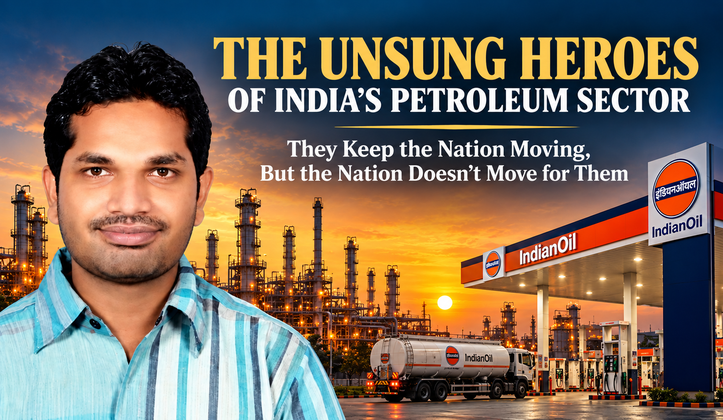
The spotlight in India’s petroleum industry usually falls on ministers, CMDs, directors, refinery expansions, record profits and major projects. But behind every litre of petrol, diesel, LPG or aviation fuel reaching the consumer is a vast workforce operating largely away from public attention – field officers, refinery workers, pipeline crews, terminal operators, tanker drivers, maintenance teams, safety personnel, retail outlet staff and emergency-response teams.
Their stories are rarely told. Their risks are rarely discussed. And their contribution is often noticed only when something goes terribly wrong.
It is beyond any doubt that providing security to personnel working with Oil Marketing Companies (OMCs) such as IndianOil, HPCL and BPCL, as well as employees of City Gas Distribution companies, primarily falls within the domain of the respective state governments and their police forces in the areas where these personnel are stationed across the country. Oil companies can certainly put internal safety and security protocols in place, but they cannot be expected to replace the state’s law-and-order machinery or provide a police officer to accompany every employee working in the field.
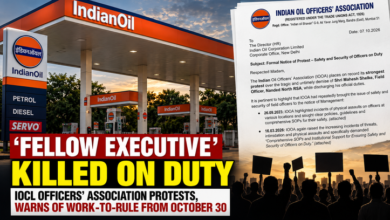
For God’s sake, we cannot expect the CMD of IndianOil, BPCL or HPCL to provide security cover to every employee of the organisation. The brutal killing of IndianOil Field Officer Mahesh Shelke in Maharashtra’s Hingoli district, therefore, raises a serious question about the law-and-order machinery at the local level. Shelke was carrying out an official assignment when he was brutally attacked. At the most basic level, preventing such an attack and maintaining law and order is the responsibility of the local police.
And when we talk about the local police, we are also talking about the intelligence-gathering mechanism available to the police establishment. In districts and cities across the country, specialised intelligence units are tasked with gathering information about developments, individuals and situations that could potentially create a law-and-order problem. The very purpose of such intelligence gathering is to identify potential threats before they turn into incidents. The question, therefore, is whether any information was available about a possible threat in the area where Shelke was carrying out his official duty and, if so, whether that information reached the concerned police authorities.
It would be hypothetical to say that the presence of a policeman could definitely have prevented Shelke’s murder. But one cannot ignore the possibility that even the presence of a single uniformed policeman at the location could have acted as a deterrent. An armed police officer would obviously have provided a greater level of protection, but even the visible presence of a police constable could potentially have made an attacker think twice before launching an assault on an officer performing an official duty.
This is not the first incident in which petroleum-sector officials have been killed while performing their professional responsibilities. In March 2026, two senior officials of Hindustan Petroleum Corporation Limited (HPCL) were shot dead at a compressed biogas plant in Sajni village under the Musajhag police station area of Badaun district in Uttar Pradesh. The deceased were identified as Sudhir Gupta, 55, Chief Project Manager of the HPCL Compressed Biogas Plant and a resident of Noida, and Harshit Mishra, 40, Deputy Manager from Bareilly.
What makes the Badaun incident particularly disturbing is the allegation that the danger had been brought to the attention of the local administration before the killings. Sudhir Gupta had reportedly submitted a written complaint to the local administration almost two months before the incident. If that complaint indeed contained specific concerns about a threat to his safety or the safety of the plant, the obvious question is why effective preventive action was not taken before the tragedy occurred.
The accused was subsequently arrested, but that alone does not answer the larger question of accountability. Arresting a suspect after a murder is an essential part of the criminal justice process. But the more important question for the families of the victims is whether the system did everything within its power to prevent the crime in the first place. If a written warning was available to the administration and no effective action followed, that aspect deserves equally serious scrutiny.
The same concern now arises following the killing of Mahesh Shelke. He was not a private individual involved in a personal dispute. He was a field officer of one of India’s largest public-sector oil companies and was carrying out an official assignment when he was attacked. Thousands of petroleum-sector employees perform similar duties every day, often at locations far removed from the security and visibility available in major corporate offices.
The tragedy is that after every such incident, the immediate response generally revolves around identifying and arresting the accused. Statements are issued, condolences are expressed and investigations begin. But for the family that has lost a husband, father or son, an arrest is not an answer to everything. They deserve to know whether the tragedy could have been prevented, whether warnings were ignored, whether adequate intelligence was available and whether the system failed somewhere before the fatal attack took place.
Where are the Candlelight March Teams?
There is also an uncomfortable social question. When a tragedy occurs in a major city, candle marches, protests and demands for justice often follow. Civil society organisations, political groups and activists come out on the streets. But when a petroleum-sector employee is killed while performing his duty in a relatively obscure location, the national attention is often fleeting. The victim may disappear from public memory within days.
Mahesh Shelke should not become another name that is remembered only until the accused is arrested. The question is not merely who killed him. The question is whether the system did enough to ensure that a professional carrying out an official assignment could return home safely.
India’s petroleum workforce keeps the country moving. The least that the system can ensure is that those who keep the nation moving are not left to face danger alone.
We Report – You Decide.