
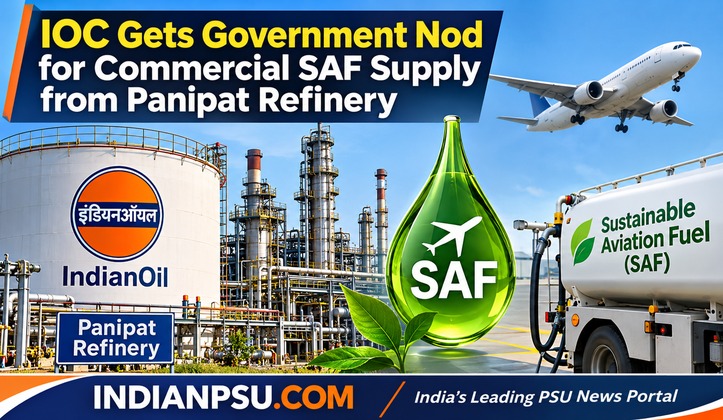
IOC Gets Government Nod for Commercial Supply of Sustainable Aviation Fuel from Panipat Refinery
The initiative is aligned with the International Civil Aviation Organization's (ICAO) efforts to reduce carbon emissions from international aviation
Read in your preferred Language :
Indian Oil Corporation Limited (IOC), India’s largest oil marketing company, has received the necessary government approvals to commence commercial supplies of Sustainable Aviation Fuel (SAF) from its Panipat refinery in Haryana.
IOC Chairman A.S. Sahney announced the development on November 17, 2026, stating that the facility has the capacity to meet India’s proposed 1% SAF blending requirement for international flights from 2027.
The approval clears the way for IndianOil to enter the commercial market for sustainable aviation fuel as India prepares to introduce blending requirements aimed at reducing carbon emissions from international aviation.
Panipat refinery to emerge as India’s SAF production hub
The SAF facility at IndianOil’s Panipat refinery uses used cooking oil as its primary feedstock. The company plans to produce approximately 30,000–35,000 tonnes of sustainable aviation fuel annually.
The feedstock will be sourced from used cooking oil collected from large hotels, restaurants and other commercial establishments.
The plant has already produced its first batch of SAF and secured the requisite regulatory clearances, including approval from the Directorate General of Civil Aviation (DGCA).
In August 2025, IndianOil’s Panipat refinery became the first facility in India to receive International Sustainability and Carbon Certification (ISCC) CORSIA certification for sustainable aviation fuel production. The certification establishes compliance with internationally recognised sustainability and carbon-accounting requirements for aviation fuel.
IOC to sign supply agreements with airlines
IndianOil Chairman A.S. Sahney indicated that the company would enter into supply agreements with airlines before committing investments to additional sustainable aviation fuel projects.
The company has already signed a Memorandum of Understanding with Air India for SAF supplies, although the agreement does not specify the commencement date or supply volumes.
The demand-led approach is intended to provide greater clarity on commercial requirements before IndianOil expands its SAF manufacturing capacity.
India sets ambitious SAF blending targets
India has announced indicative targets for blending sustainable aviation fuel with conventional Aviation Turbine Fuel (ATF), initially for international flights.
The targets are:
- 2027: 1% SAF blending
- 2028: 2% SAF blending
- 2030: 5% SAF blending
The initiative is aligned with the International Civil Aviation Organization’s (ICAO) efforts to reduce carbon emissions from international aviation under the Carbon Offsetting and Reduction Scheme for International Aviation (CORSIA).
IndianOil exploring another SAF production route
Apart from its Panipat facility using used cooking oil, IndianOil is also pursuing a separate sustainable aviation fuel project based on Alcohol-to-Jet (ATJ) technology.
The proposed facility, being developed in partnership with US-based LanzaJet, is planned to have an annual production capacity of approximately 86,800 tonnes. It will use ethanol as feedstock and is targeted for completion by March 2028.
The two projects reflect IndianOil’s strategy to diversify its alternative fuel portfolio and establish a stronger presence in the emerging sustainable aviation fuel market.
With commercial approval for its Panipat facility, IndianOil has taken an important step towards positioning India as a potential producer and supplier of sustainable aviation fuel. The development also opens up new opportunities for the domestic biofuel industry as the aviation sector increasingly looks for alternatives to conventional fossil-based jet fuel.