
E20 Controversy Escalates: Karnataka to Submit Ethanol Test Report to Centre
The three major public sector oil marketing companies - IOCL, BPCL and HPCL - have disputed Karnataka's reported findings
Read in your preferred Language :
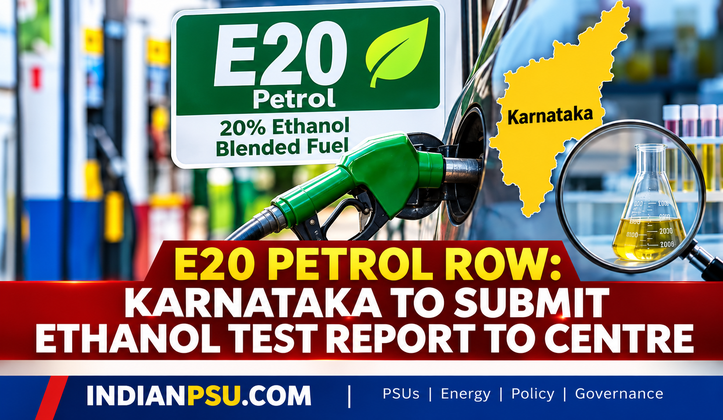
The controversy over alleged excessive ethanol blending in petrol has intensified, with the Karnataka government preparing to submit its investigation report to the Centre after detecting ethanol concentrations reportedly exceeding the prescribed 20% limit at several locations. The controversy has also triggered a sharp political exchange, with Union Minister of State for Petroleum and Natural Gas Suresh Gopi questioning the scientific understanding of those alleging irregularities in E20 petrol.
Karnataka Food and Civil Supplies Minister Rizwan Arshad has said that the state government will submit its official report to the Union Government, incorporating technical findings and laboratory test results relating to six petroleum terminals where excessive ethanol blending has allegedly been detected.
The report is expected to put pressure on the Centre and public sector oil marketing companies (OMCs), including Indian Oil Corporation Limited (IOCL), Bharat Petroleum Corporation Limited (BPCL) and Hindustan Petroleum Corporation Limited (HPCL), to address concerns over compliance with the prescribed E20 fuel standard.
Karnataka alleges ethanol blending beyond 20% limit
The Karnataka government has maintained that its investigation revealed ethanol concentrations significantly higher than the permitted 20% in certain petrol samples.
Earlier findings released by the state indicated ethanol concentrations of up to 31.2% in some samples. The state also claimed that 11 out of 14 samples tested during its October exercise exceeded the prescribed limit.
According to Rizwan Arshad, the alleged irregularities are not merely an issue involving individual petrol pumps. The state has pointed towards six petroleum terminals where ethanol is blended with petrol before distribution.
The government has said that its report will contain laboratory findings and technical details and will be submitted to the Centre. Karnataka has also indicated that it is examining legal options if the Union Government fails to take appropriate action.
Suresh Gopi hits back at critics
Amid the escalating controversy, Suresh Gopi has strongly defended the Centre’s ethanol-blending programme and questioned the scientific knowledge of those alleging that petrol contains more than 20% ethanol.
Speaking at a public event in Thrissur on November 17, the minister described critics making such allegations as people who lacked scientific understanding.
He maintained that India’s transition from E10 to E20 petrol followed extensive scientific research and evaluation, including approval from the Automotive Research Association of India (ARAI).
Gopi argued that the ethanol-blending infrastructure operated by oil marketing companies was automated and calibrated to ensure that the ethanol proportion did not exceed the prescribed limit.
According to him, the blending machinery has automatic shut-off mechanisms that stop the process once the ethanol concentration reaches 20%.
The minister also said that anyone was free to conduct independent tests of petrol samples. However, he suggested that allegations of systematic excess blending or adulteration would require a proper investigation, potentially involving the Central Bureau of Investigation (CBI).
He further claimed that there were no insurance claims establishing vehicle damage directly attributable to ethanol-blended petrol.
Oil marketing companies reject Karnataka’s findings
The three major public sector oil marketing companies – IOCL, BPCL and HPCL – have disputed Karnataka’s reported findings.
In its clarification, the Ministry of Petroleum and Natural Gas said that the OMCs had conducted tests on 893 petrol samples collected across 27 states and Union Territories. All the samples were found compliant with the prescribed quality specifications.
Significantly, all 56 samples tested in Karnataka during the separate exercise reportedly recorded ethanol concentrations between 19% and 20%, with an average of 19.30%.
The oil companies have questioned Karnataka’s sampling procedures and testing methodology, arguing that the exercise did not fully follow the prescribed statutory procedures.
They have sought complete sampling documentation, outlet-wise laboratory reports and access to retained samples for independent testing through authorised laboratories.
The companies have also called for a joint and transparent verification exercise involving state government representatives and OMC officials.
Kerala also enters the E20 controversy
Following Karnataka’s allegations, the Kerala government has also initiated an exercise to examine ethanol levels in petrol.
Kerala’s Food and Civil Supplies Department collected petrol samples from nine petrol pumps across Thiruvananthapuram, Ernakulam, Kozhikode and Kannur for laboratory testing.
The exercise was conducted using approved sampling procedures and in the presence of oil marketing company representatives, according to the state government.
The move has increased the possibility of a wider Centre-state confrontation over fuel quality, testing procedures and the implementation of the E20 programme.
What is the E20 controversy?
E20 refers to petrol containing 20% ethanol blended with 80% petrol. The programme is part of the Centre’s strategy to reduce dependence on imported crude oil, promote domestic ethanol production and provide an additional market for agricultural produce.
However, the programme has faced criticism from motorists who have complained about reduced mileage, higher effective fuel costs and concerns regarding the compatibility of older vehicles with higher ethanol blends.
The latest controversy has brought a more fundamental question into focus: whether petrol supplied through the country’s fuel distribution network consistently meets the prescribed ethanol-blending specifications.
While the Centre and OMCs insist that the E20 supply system is monitored and compliant, Karnataka’s reported laboratory findings have raised questions that cannot be settled merely through political statements.
Centre faces pressure for independent verification
The Karnataka government’s proposed submission of its report is likely to intensify demands for an independent and technically transparent investigation.
The key issue is no longer simply whether India should promote ethanol blending. It is whether every litre of petrol supplied to consumers meets the quality standards prescribed by the government.
With Karnataka standing by its findings, OMCs questioning the testing methodology and Kerala undertaking its own investigation, the E20 controversy is set to remain a major issue for the petroleum sector.
The Centre will now have to address the competing laboratory findings and establish whether the alleged excess blending represents a genuine fuel-quality violation, a sampling-related discrepancy or an isolated instance of adulteration.