

India’s Energy Demand to Surge 5 Times by 2047; NITI Aayog Flags Energy Security Challenge
Securing affordable energy supplies, critical minerals and clean energy technologies will be central to India's future energy strategy
Read in your preferred Language :
India’s rapidly expanding economy is expected to trigger an unprecedented surge in energy consumption over the next two decades, with electricity demand projected to increase four to five times and primary energy consumption 2–2.5 times by 2047.
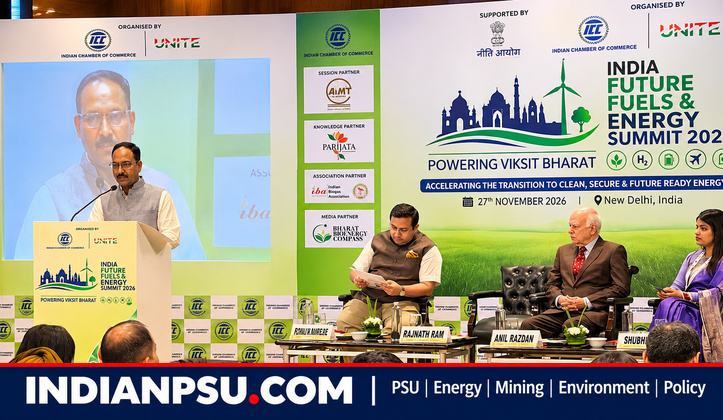
Rajnath Ram, Adviser (Energy), NITI Aayog, highlighted the scale of the challenge at the India Future Fuels & Energy Summit 2026, organised by the Indian Chamber of Commerce (ICC) on the theme “Accelerating the Transition to Clean, Secure & Future-Ready Energy.”
He said India’s biggest challenge would be to strengthen energy security while ensuring that energy remains affordable and environmentally sustainable.
“Energy security is no longer only about price and availability. It is also about choke points, shipping routes and supplier concentration, and every country is now treating energy as a strategic asset,” Ram said.
Geopolitical tensions put energy security in focus
Highlighting the changing global energy landscape, Ram said energy security was acquiring greater importance amid geopolitical uncertainties.
The 2026 West Asia crisis disrupted shipping routes and affected oil and energy supplies. Brent crude prices surged from approximately USD 71 per barrel to USD 117 in April before settling at around USD 96.
He said India managed the disruption through an inter-ministerial committee and daily monitoring. Consequently, domestic prices increased by approximately 8–10%, compared with increases of around 50% in several other parts of the world.
The government is also seriously considering the creation of at least 40 million tonnes of strategic crude oil storage capacity to strengthen the country’s ability to withstand future supply disruptions.
Renewable energy creates new import dependencies
Ram cautioned that India’s clean energy transition was also creating new strategic vulnerabilities.
Although India has installed nearly 170 GW of solar capacity, domestic manufacturing of critical components such as ingots and wafers remains limited. The country also imports approximately 95% of its magnets and 90% of its battery cells.
He pointed out that China’s recent decision to restrict exports of certain solar technologies underlines the urgency of developing domestic manufacturing capabilities.
“The challenge is not only about securing barrels and cargoes. It is equally about securing wafers, cells, magnets, minerals and the materials that support the grid,” he said.
NTPC highlights economics of coal and biomass co-firing
Ravi Prakash Agrawal, Mission Director, NTPC Ltd., underlined the economic considerations involved in India’s energy transition.
He said domestic coal reserves were sufficient to meet the country’s requirements for the next 100–150 years and that coal remained considerably cheaper than oil and natural gas.
“Business always comes down to economics. Using green fuel to replace oil and gas is much better than burning it in coal plants, because co-firing raises the cost of power, and that affects every individual in the country,” Agrawal said.
He informed the gathering that around 12 power plants in the National Capital Region were already undertaking biomass co-firing, with additional plants being brought into the initiative.
Biomass co-firing reached approximately 4.67% last year and is expected to cross the mandatory 5% level this year.
According to Agrawal, co-firing of around 10% is achievable using non-torrefied biomass, while the proportion can reach up to 20% with torrefied biomass. However, torrefied biomass can cost nearly twice as much, making cost-reduction technologies critical for wider adoption.
Industry urged to increase R&D investment
Anil Razdan, Chairman, ICC National Expert Committee on Energy, called upon Indian industry to invest across the entire technology value chain, from raw material extraction and processing to manufacturing and trade.
He said India must move beyond being a buyer of technology and emerge as a global technology developer and innovator.
“We have to be world leaders, not buyers of technology but owners and inventors of technology. Expenditure on research and development, by the government, the country and industry alike, must rise from under 1% to over 5% if we really want to be there on the global scene,” Razdan said.
He also observed that control over fossil fuel resources had been a major factor behind several geopolitical conflicts in the 21st century.
With carbon footprints increasingly becoming a factor in international trade barriers, he stressed the importance of developing cleaner technologies and ensuring a conducive investment environment.
Razdan said investors also needed assured returns and timely power evacuation facilities to ensure the commercial viability of energy projects.
Nuclear energy and hydrogen emerge as key options
Debmalya Banerjee, Regional Director, ICC North, stressed the need for India to embrace green energy across the entire value chain.
He pointed out that electric vehicles were not necessarily powered by clean energy, as a significant portion of their electricity still came from thermal power plants.
“Nuclear energy, used in the appropriate manner, can solve our energy problems to a great extent. Hydrogen has not picked up well in the country, and European countries are far ahead of us in this technology,” he said.
Banerjee also announced that ICC would organise its Green Energy Summit in February.
Energy transition requires domestic capabilities
The India Future Fuels & Energy Summit 2026 brought together representatives from government, the power sector and industry to deliberate on India’s future energy requirements and the evolving energy mix.
Discussions focused on energy security, domestic clean energy manufacturing, biomass co-firing, research and development, nuclear power and hydrogen.
The deliberations highlighted a critical policy challenge: India’s energy transition cannot depend solely on expanding renewable energy capacity. It must also build domestic manufacturing capabilities, secure critical minerals and components, invest in indigenous technologies and strengthen strategic energy reserves.
As India moves towards its 2047 developed-nation ambition, the ability to balance energy security, affordability and sustainability will increasingly determine the country’s economic and industrial competitiveness.