

Africa Overtakes Asia as World’s Hungriest Continent; 645 Million People Faced Hunger in 2025: UN Report
Healthy diets now unaffordable for 2.7 billion people as food costs surge 45% since 2017; UN warns global hunger remains far above 2030 Zero Hunger target
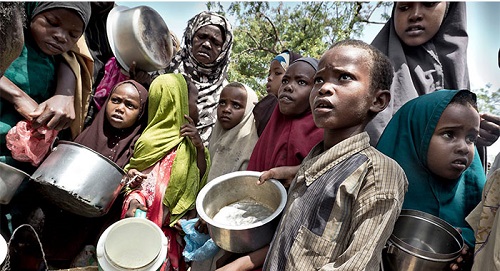
The United Nations has painted a sobering picture of global food security, revealing that Africa has overtaken Asia as the continent with the largest number of people facing hunger, even as overall global hunger showed modest improvement in 2025.
According to The State of Food Security and Nutrition in the World 2026 (SOFI 2026) report released this week, an estimated 645 million people—or 7.8% of the world’s population—experienced hunger in 2025. While this marks an improvement from 2024 and 2022, it is still 61 million higher than pre-pandemic levels in 2019, highlighting how far the world remains from achieving Sustainable Development Goal 2 (Zero Hunger) by 2030.
Africa Now Home to Largest Hungry Population
The report shows that Africa is now home to around 309 million hungry people, surpassing Asia’s 292 million, primarily due to rapid population growth despite a slight decline in the continent’s hunger rate from 20.3% in 2024 to 20.0% in 2025.
Meanwhile, Asia and Latin America & the Caribbean have continued to register gradual improvements in food security.
Healthy Diets Beyond Reach for Billions
The report highlights another alarming trend: healthy diets have become increasingly unaffordable worldwide.
The cost of healthy eating has increased by 45% since 2017, leaving approximately 2.7 billion people unable to afford nutritious food. As a result, one in every three people globally could not afford a healthy diet in 2025.
The UN stresses that ensuring food security is no longer merely about sufficient calories but also about access to safe, diverse and nutritious food.
Food Insecurity Remains Widespread
Although food insecurity has eased marginally, the numbers remain staggering.
In 2025, around 2.1 billion people (25.8% of the global population) experienced moderate or severe food insecurity, forcing them to reduce either the quality or quantity of food they consumed.
Regional disparities remain stark:
- Africa: 56.6% of the population faced moderate or severe food insecurity.
- Asia: 20.3%.
- Latin America & Caribbean: 22.9%.
- Northern America & Europe: 8.7%.
Food insecurity also remains significantly higher in rural communities than in urban areas.
Experts Warn 2026 Could Be Worse
Responding to the report, the International Panel of Experts on Sustainable Food Systems (IPES-Food) warned that global hunger could worsen again in 2026.
Jennifer Clapp, IPES-Food panel expert and Canada Research Chair at the University of Waterloo, cautioned that geopolitical tensions are increasingly shaping food security. “Global hunger remains stubbornly high. And the outlook for 2026 is deeply worrying. Geopolitics is increasingly shaping food security, with conflict, fertiliser disruptions, trade tensions, and El Niño-driven climate shocks threatening yet another surge in food prices.”
She argued that countries must build more resilient and self-reliant food systems instead of becoming increasingly dependent on volatile global markets.
Raj Patel, IPES-Food panel expert and Professor at the University of Texas at Austin, said the crisis reflects political choices rather than food shortages. “When 645 million people are hungry and one in three cannot afford a healthy diet, this is a failure of political choices. Healthy diets are becoming a luxury for billions, while farmers are paid less and consumers pay more.”
He blamed growing concentration of power among global food traders, processors and retailers for driving up prices while squeezing both farmers and consumers.
Smallholder Farmers Key to Ending Hunger
Elizabeth Nsimadala, President of the Eastern Africa Farmers Federation, described Africa’s position as the world’s hungriest continent as “a shock—but not a surprise.”
She noted that although smallholder farmers produce nearly 80% of Africa’s food, governments have failed to fulfil commitments to invest 10% of public expenditure in agriculture, while smallholder organisations receive less than 1% of the climate finance needed for adaptation.
She urged governments and international institutions to invest directly in small-scale farmers to build resilient food systems capable of withstanding climate shocks.
2030 Outlook Still Concerning
The report projects that between 510 million and 520 million people may still face hunger by 2030, depending on how long current geopolitical conflicts continue to influence energy, fertilizer and food prices.
The projections do not account for potential future shocks such as El Niño events in 2026 and 2027, which could further worsen global food security.
The UN concludes that achieving Zero Hunger by 2030 will require targeted, multisectoral policies, stronger investment in agriculture, resilient food systems, and improved access to affordable, nutritious diets worldwide.
The writer of this article is Dr. Seema Javed, an environmentalist & a communications professional in the field of climate and energy