
How Samsung Is Cheating Customers in India Through ‘Comprehensive Protection Insurance’
Korean Electronics Giant in India – The Great Customer Loot Starts!

On the lines of Make in India, Samsung got land and other support in Noida, Uttar Pradesh, courtesy of the Government of Uttar Pradesh in 1996.
Samsung rapidly captured the Indian market with its home appliances and mobile phones before taking on Apple in the premium smartphone segment. Its innovative flip and fold devices helped establish it as a formidable iPhone alternative, commanding premium prices comparable to those of Apple’s flagship handsets.
When Greed Overcomes Ethics
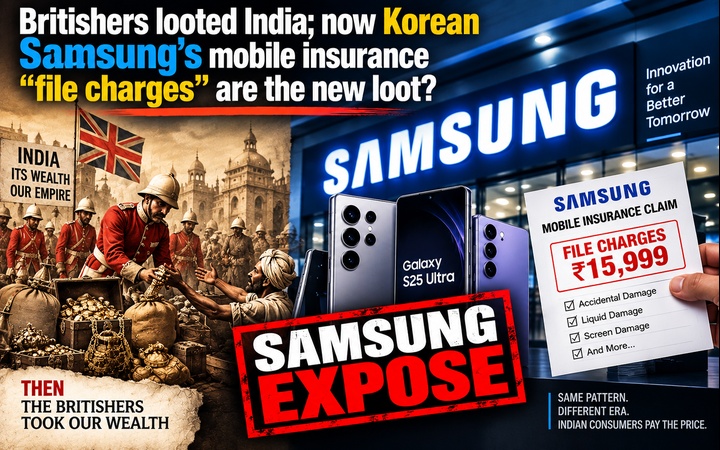
Samsung’s Comprehensive Protection Insurance makes a customer pay as much as ₹25,999 for the insurance for their most expensive mobile launched some time back. When the insured phone got damaged and a claim was lodged, the customer was rattled when asked to pay another ₹15,999 as file charges.
The obvious question is: what exactly is the customer paying ₹25,999 for if another ₹15,999 is demanded when the insurance is actually needed? The customer’s total outgo on the insurance and claim rises to ₹41,998, excluding the original cost of the phone.
The issue is not merely the existence of an additional charge. The critical question is whether the customer was clearly and prominently informed before purchase that a further ₹15,999 could be demanded when a claim was made. A consumer buying expensive insurance should know the real financial liability before paying the premium—not discover it after the phone is damaged.
The phrase “Comprehensive Protection Insurance” makes the issue even more striking. Samsung promotes protection against accidental, physical and liquid damage, but a customer who has already paid ₹25,999 can still face a substantial claim-time payment. What does “comprehensive” actually mean if the consumer must pay again to access the protection purchased?
The case is backed by the customer’s payment records, insurance documents and claim-related communication. The sequence is clear: ₹25,999 paid, phone damaged, claim lodged, ₹15,999 demanded as file charges.
Samsung needs to explain what these charges are, why they are imposed, whether they were prominently disclosed before purchase, and how many Indian consumers have faced similar demands.
For Indian consumers, the issue is simple: when you pay ₹25,999 for protection, you have a right to know exactly how much more you may have to pay when that protection is actually needed.
EDITOR’S NOTE
What does “Comprehensive Protection Insurance” actually mean when a consumer pays ₹25,999 for it and, when the insured handset is damaged, is forced to pay another ₹15,999 as “file charges”? This is not a trivial administrative fee; it goes to the heart of consumer transparency and the very purpose of insurance. A customer pays a substantial premium expecting protection when something goes wrong. If another ₹15,999 is demanded when that protection is actually invoked, the obvious question is whether this liability was clearly, prominently and unambiguously disclosed before the ₹25,999 was paid. How many Indian consumers have faced similar demands, and how many have simply paid because they believed they had no choice? Samsung may have its terms and conditions, but that does not erase the fundamental consumer question: was the real financial liability made clear at the point of sale, or does the customer discover the true cost only after the handset is damaged?
There is one crucial difference in this case: I am not writing about somebody else’s experience. I am the victim. I am Vivek Avasthi. I paid ₹25,999 for Samsung’s Comprehensive Protection Insurance; my handset was damaged; I invoked the insurance—and I was forced to pay another ₹15,999 as “file charges”. I have the payment records, insurance documents and claim-related communication. I pledge to my fellow Indians that I will take this matter to the highest level possible, through every legitimate avenue available. If necessary, legal action will be an open option. This is no longer merely about ₹15,999; it is about whether an Indian consumer who pays for protection is actually protected when that protection is needed—or is instead fleeced when he seeks to use it. Samsung must answer. Indian consumers deserve answers. JAI HIND.