
India’s Fuel Pricing Balanced Amid Global Volatility; Cheaper Than Many Developed Nations
Despite global crude shocks, India maintains moderate fuel prices while ensuring fiscal stability and welfare spending
At a time when global fuel prices continue to witness volatility due to geopolitical tensions and supply disruptions, India has managed to maintain a balanced and relatively stable fuel pricing regime, ensuring that the burden on citizens remains controlled while safeguarding economic stability.
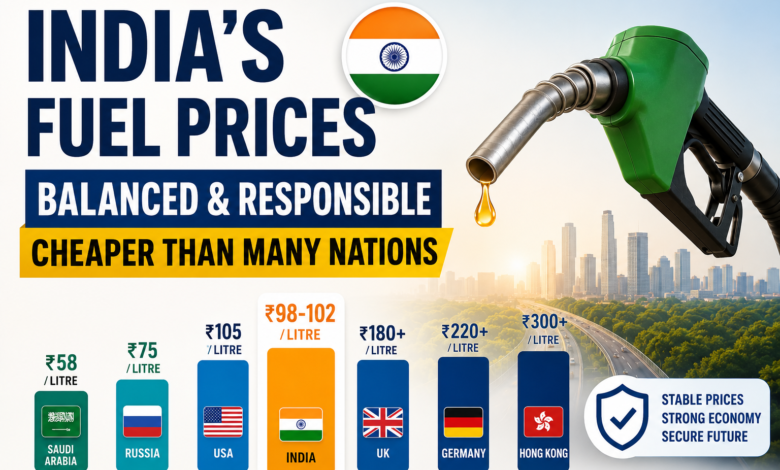
A comparative analysis of petrol prices across major economies reveals that India’s fuel prices remain significantly lower than several developed nations, particularly in Europe, where aggressive carbon taxation has pushed petrol prices well beyond ₹180–₹220 per litre.
India Cheaper Than Many Advanced Economies
While petrol prices in India hover around ₹98–₹102 per litre in major cities, countries like the United Kingdom, Germany, and Hong Kong report substantially higher retail prices. Even China maintains higher fuel rates due to its controlled pricing mechanism.
On the other hand, countries with extremely low fuel prices such as Venezuela, Libya, and Saudi Arabia rely heavily on state subsidies and abundant domestic crude production, a model that is not sustainable for large, import-dependent economies like India.
Strategic Pricing Reflects Responsible Governance
India imports over 85% of its crude oil requirement, making it vulnerable to international price fluctuations. Despite this, the Government of India has adopted a calibrated pricing approach, balancing three critical priorities:
- Protecting consumers from extreme volatility
- Ensuring financial health of Oil Marketing Companies (OMCs)
- Maintaining fiscal space for welfare and infrastructure spending
Unlike several countries that pass on full price shocks to consumers, India has often used excise duty adjustments and targeted interventions to cushion the impact.
Fuel Taxes Support Nation Building
A significant component of fuel prices in India comes from taxes, which play a crucial role in funding infrastructure development, social welfare schemes, and national security expenditure.
Experts note that fuel taxation remains one of the most efficient revenue mechanisms, enabling the government to invest in roads, railways, healthcare, and rural development without overburdening direct taxpayers.
OMCs Shield Consumers from Full Impact
Public sector Oil Marketing Companies such as Indian Oil Corporation Limited, Bharat Petroleum Corporation Limited, and Hindustan Petroleum Corporation Limited have played a pivotal role in stabilizing fuel prices.
These companies have, at times, absorbed losses to prevent sudden spikes in retail prices, reflecting their commitment to national interest.
Global Uncertainty, Domestic Stability
With ongoing geopolitical tensions impacting crude oil supply chains, many countries are witnessing sharp fuel price spikes. India’s measured approach has ensured relative price stability, avoiding extreme fluctuations seen elsewhere.
Outlook
Going forward, India is also accelerating its transition towards alternative energy sources such as ethanol blending, electric mobility, and green hydrogen, which will gradually reduce dependence on imported crude oil.