

PM Modi, Balendra Shah Strengthen India-Nepal Energy Corridor with Two Major Petroleum Projects
IndianOil spearheads cross-border energy infrastructure development with ₹442-crore Jhapa petroleum terminal and modernisation of Nepal's Amlekhgunj terminal under Pipeline Phase-II
Read in your preferred Language :
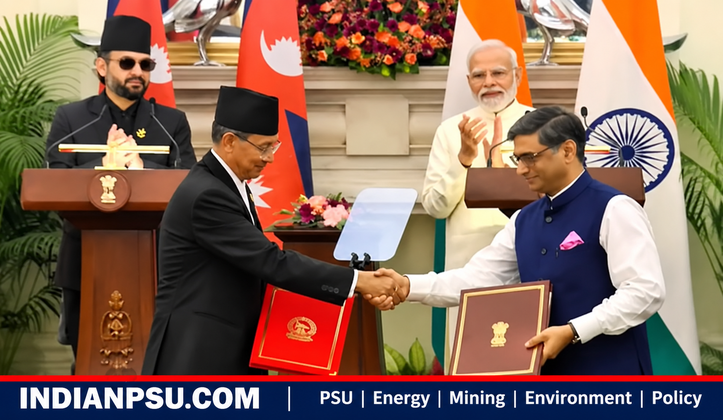
Prime Minister Narendra Modi and Nepal Prime Minister Balendra Shah jointly laid the foundation stone of a Greenfield Petroleum Storage and Distribution Terminal at Jhapa, Nepal, and dedicated the IndianOil Motihari–Amlekhgunj Petroleum Pipeline Phase-II to the people of Nepal, marking a significant milestone in India-Nepal energy cooperation.
The two projects are aimed at strengthening petroleum supply infrastructure, improving energy security and deepening bilateral cooperation under India’s Neighbourhood First policy.
₹442-Crore Jhapa Petroleum Terminal to Strengthen Energy Supply to Eastern Nepal
The Greenfield terminal will be developed over 35.63 acres and will receive petroleum products through the proposed Siliguri–Jhapa Product Pipeline (SJPL) from IndianOil’s Siliguri Terminal. It will subsequently distribute petroleum products across Eastern Nepal.
The terminal is being developed in view of the growing demand for petroleum products in Jhapa, which is projected to reach 552 thousand tonnes (TMT) by 2030. Demand is expected to grow at 7.1% for Motor Spirit (MS) and 7.8% for High-Speed Diesel (HSD).
The terminal will have a total storage capacity of 18.9 thousand kilolitres (TKL), comprising three MS tanks of 2.2 TKL each and three HSD tanks of 4.1 TKL each.
Major infrastructure at the terminal will include an eight-bay Tank Truck Loading (TLF) gantry with bottom and top loading facilities, TLF pumping systems, firefighting infrastructure, tank-truck decantation and calibration facilities, a control building, administration building, sub-station/PMCC building, quality control laboratory, amenity-cum-canteen, security facilities and other supporting infrastructure.
The project will be developed with an investment of ₹442 crore.
Once commissioned, the Jhapa terminal is expected to ensure safe, uninterrupted and environment-friendly supplies of petroleum products to Eastern Nepal, particularly Koshi Province. It will reduce dependence on road-based transportation, lower transportation costs, minimise handling losses, pilferage and adulteration, and reduce road congestion and carbon emissions.
The terminal will also strengthen Nepal’s energy security and improve emergency preparedness during natural disasters such as floods and landslides.
The project is being implemented by IndianOil in partnership with Nepal Oil Corporation, building upon the successful operation of the Motihari–Amlekhgunj Petroleum Pipeline, South Asia’s first transnational petroleum products pipeline.
Motihari–Amlekhgunj Pipeline Phase-II Dedicated
The two Prime Ministers also jointly dedicated the IndianOil Motihari–Amlekhgunj Petroleum Pipeline Phase-II, marking another major development in cross-border petroleum infrastructure between India and Nepal.
Under Phase-II, IndianOil has re-engineered Nepal Oil Corporation’s Amlekhgunj Terminal at a project cost of ₹164.97 crore, transforming it into Nepal’s first state-of-the-art, fully automated SMART terminal.
The upgraded terminal receives petroleum products through the 69-km Motihari–Amlekhgunj Pipeline, which was commissioned in July 2019 and jointly inaugurated by the Prime Ministers of India and Nepal in September 2019.
The Phase-II expansion has added two petrol tanks of 4,100 kilolitres each, a 24-bay automated tank-truck loading gantry capable of loading approximately 300 tank trucks per day, a Terminal Automation System and upgraded firefighting facilities.
The upgraded infrastructure enables the pipeline to supply diesel, petrol and kerosene to Nepal more efficiently.
The pipeline recorded its highest-ever throughput of 12.72 lakh tonnes during 2025-26, reflecting its growing importance in Nepal’s petroleum supply chain.
The project was completed in January 2025, recording more than one million safe man-hours without any Lost Time Injury (LTI). During construction, it generated approximately 1.5 lakh man-days of employment.
The terminal currently provides direct and indirect employment to approximately 135 people, including around 60 direct and 75 indirect employees, in its operation and maintenance.
By shifting the transportation of petrol and kerosene from road tankers to the pipeline, the project eliminates the movement of approximately 57 tank trucks daily and reduces carbon emissions by around 9,200 tonnes of CO₂ annually.
Strengthening India-Nepal Energy Partnership
The Jhapa Greenfield Terminal and the Motihari–Amlekhgunj Pipeline Phase-II represent India’s continued commitment to strengthening energy infrastructure in Nepal and enhancing regional connectivity.
The projects are expected to improve the efficiency, reliability and sustainability of petroleum product supplies while reducing logistics costs and environmental impact.
Together, they reinforce India and Nepal’s strategic energy partnership and underline the importance of cross-border infrastructure in ensuring energy security, economic cooperation and regional development.