
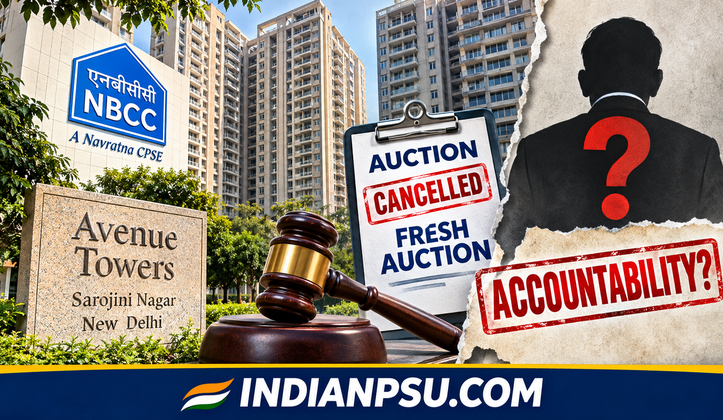
NBCC’s Avenue Towers Auction Mess: Who Is Accountable for Repeated Errors and What Action Has Been Taken?
The Delhi High Court is scheduled to hear the matter again on November 26, 2026
Read in your preferred Language :
The controversy surrounding the auction of 49 flats at NBCC’s Avenue Towers project in Sarojini Nagar has raised a more fundamental question than the cancellation of bids or the announcement of a fresh auction: Who is responsible for the repeated administrative and procedural mistakes, and what action has the public sector company taken against the officials responsible?
NBCC has issued a revised corrigendum acknowledging the legal proceedings concerning the cancelled bids and informing prospective buyers that petitions challenging the cancellation of 49 bids are pending before the Delhi High Court. The latest correction, however, does little to address the larger issue of accountability within the organisation.
The sequence of events has exposed a series of decisions that have repeatedly altered the auction process, leaving bidders confused and the corporation facing judicial scrutiny.
A Series of Decisions That Raise Questions
The auction process for the premium residential project has witnessed multiple cancellations and changes.
The original auction process was cancelled. Subsequently, NBCC invited fresh bids for the residential units, but certain units were again withdrawn from the auction. On October 28, 2026, the bids for 49 flats were cancelled, citing “administrative reasons”, even after successful bidders had been identified.
The affected bidders challenged the cancellation before the Delhi High Court, questioning the rationale behind the decision and alleging that their highest bids, which were above the reserve price, had been cancelled without any satisfactory explanation.
The controversy escalated further when NBCC invited fresh bids for the 49 units on November 6, even as the Delhi High Court had issued notice to the company on November 5 in connection with the petitions.
The initial fresh-auction notice also failed to adequately disclose the pending litigation, prompting NBCC to issue a revised corrigendum subsequently.
Who Took These Decisions?
The repeated changes in the auction process raise questions about the role of officials responsible for planning, approving and executing the e-auction.
Were the decisions to cancel the bids for 49 flats taken at the operational level? Who approved the cancellation? Was the decision vetted by the legal department? Did senior management examine the legal implications before issuing the fresh auction notice?
More importantly, was there any internal inquiry into the circumstances that led to the cancellation of the bids and the subsequent omission of information concerning the pending court proceedings?
The corporation’s latest corrigendum corrects the information available to prospective bidders. But a correction of a public notice cannot substitute for fixing responsibility for the errors that necessitated the correction in the first place.
Public Money and Institutional Credibility at Stake
The Avenue Towers project is part of the government’s redevelopment programme, with the proceeds from the sale of residential units being utilised to finance redevelopment projects.
NBCC had announced a sale value of approximately ₹5,191 crore from the Avenue Towers e-auction, making it one of the company’s largest residential auction transactions.
At such a scale, the auction process is expected to be transparent, legally sound and professionally managed.
Repeated cancellations, unexplained administrative decisions, litigation and subsequent corrections to auction notices inevitably raise questions about the quality of internal decision-making and the accountability mechanisms within the PSU.
What Action Has NBCC Taken Against the Erring Officials?
The crucial question now is whether NBCC has initiated any internal examination to determine how the auction process reached this stage.
Has the company identified the officials responsible for the cancellation of the 49 bids?
Has any explanation been sought from the officers who approved the decision?
Has an internal vigilance inquiry, fact-finding exercise or disciplinary proceeding been initiated?
Has the management examined why the fresh auction was launched while the matter was already before the Delhi High Court?
And has responsibility been fixed for the omission of information about the pending litigation in the earlier auction notice?
There is no publicly disclosed information, as of now, indicating that NBCC has initiated disciplinary action or fixed responsibility against any official in connection with the sequence of events.
The November 26 Hearing
The Delhi High Court is scheduled to hear the matter again on November 26, 2026. The court proceedings could determine the fate of the fresh auction and the claims of the bidders whose bids were cancelled.
But irrespective of the court’s eventual decision, NBCC owes an explanation to the public and the affected bidders.
Correcting a notice after an error has come to light is one thing. Ensuring that such errors do not recur—and holding those responsible accountable—is quite another.
The Avenue Towers controversy is now not merely about 49 flats or a fresh auction. It is about accountability in a government-owned corporation. The question is simple: Who made these mistakes, and what consequences have they faced?