
Politics Over Petrol: Karnataka & Keralam Cry Foul, OMCs Rubbish Charges as Baseless
While allegations continue to fly over E20 petrol, there is no verified national data showing that even a single vehicle has been rendered completely unusable due to ethanol-blended fuel
Read in your preferred Language :
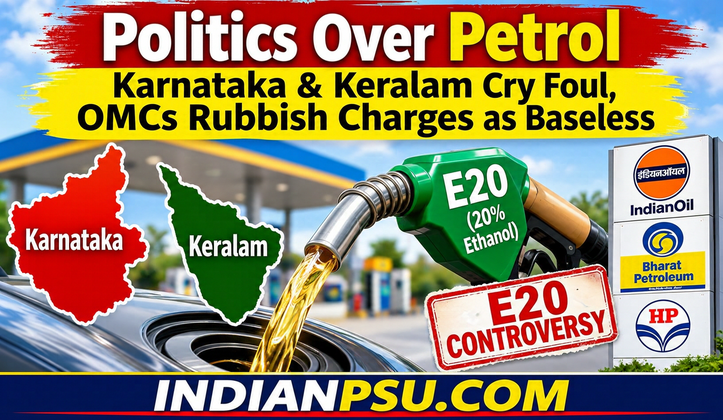
India’s E20 petrol programme has landed in a political controversy, with the Congress-ruled Karnataka government alleging excessive ethanol blending in petrol, neighbouring Keralam ordering its own fuel-quality tests and public sector oil marketing companies (OMCs) dismissing the charges as baseless.
What started as a dispute over ethanol percentages has quickly turned into a Centre-state confrontation, putting the government’s flagship ethanol-blending programme under scrutiny.
The controversy erupted after Karnataka Food and Civil Supplies Minister Rizwan Arshad announced that laboratory tests of 63 petrol samples collected from seven districts had revealed ethanol concentrations exceeding the prescribed E20 benchmark. Some samples reportedly contained ethanol as high as 31.2%, against the stipulated 20% limit.
The Karnataka government claimed that nearly four out of five samples had exceeded the prescribed level. The samples reportedly covered fuel supplied by Indian Oil Corporation (IOCL), Bharat Petroleum Corporation Limited (BPCL), Hindustan Petroleum Corporation Limited (HPCL), MRPL and private retailers.
The findings triggered questions over the quality-control mechanisms of oil marketing companies and the monitoring of ethanol blending across the country.
OMCs Counter Karnataka’s Claims
The three PSU oil marketing companies have strongly disputed Karnataka’s findings, questioning the sampling and testing methodology adopted by the state government.
In a clarification issued on November 7, the Ministry of Petroleum and Natural Gas cited a nationwide quality-monitoring exercise in which 893 petrol samples were tested across 27 states and Union Territories. All the samples were reportedly found compliant with prescribed specifications.
More significantly, IOCL, BPCL and HPCL said that all 56 samples tested in Karnataka recorded ethanol content between 19% and 20%, with an average of 19.30%.
The companies have questioned how Karnataka arrived at substantially different results and called for transparent, jointly supervised sampling and independent laboratory verification.
The Centre has maintained that E20 petrol supplied through the PSU oil marketing companies conforms to the applicable BIS specifications.
What does the automobile industry say?
The Automotive Research Association of India (ARAI) has reported that its testing of older and newer vehicles, including eight-to-ten-year-old BS-IV vehicles, did not establish significant adverse effects on critical engine components.
Maruti Suzuki has also reported that it serviced approximately 1.5 crore older, non-E20-certified vehicles during FY 2025-26 without reporting E20-related corrosion, abnormal wear or reduced component life.6
Keralam Joins the Testing Exercise
The controversy has now crossed Karnataka’s borders, with Keralam ordering random inspections and laboratory testing of petrol samples from retail outlets in Thiruvananthapuram, Ernakulam, Kozhikode and Kannur.
Food and Civil Supplies Minister Anoop Jacob has directed officials to collect samples and send them to accredited laboratories for examination.
The decision followed discussions with Chief Minister V.D. Satheesan. The state government has indicated that it has not established any instance of excessive ethanol blending but wants to independently verify fuel quality in view of the allegations emerging from Karnataka.
Keralam has warned of action against outlets if violations of prescribed fuel-quality standards are established.
E20 Programme Under Political Spotlight
The controversy has brought India’s ethanol-blending policy into the political spotlight.
The Centre has consistently defended the E20 programme, highlighting its potential to reduce crude oil imports, strengthen energy security, support domestic ethanol producers and lower carbon emissions.