

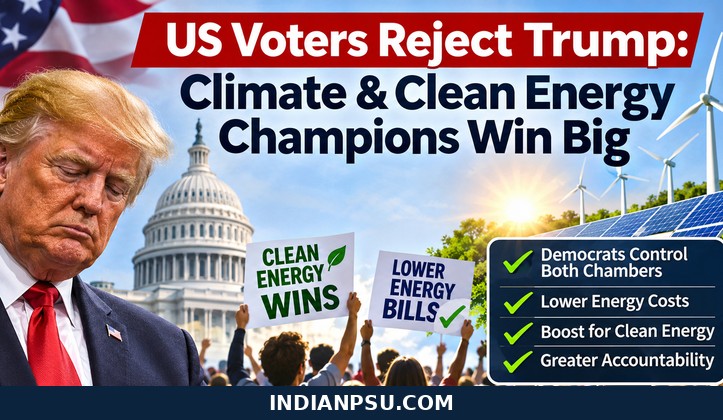
US Voters Reject Trump’s Energy Policies as Clean Energy Champions Score Big Wins
Soaring fuel prices, rising electricity bills and opposition to fossil fuel dependence emerge as major factors
Read in your preferred Language :
The 2026 US midterm elections have delivered a major political setback to President Donald Trump and the Republican Party, with Democrats securing control of both chambers of Congress. The results underline growing public dissatisfaction with the administration’s energy policies, particularly soaring fuel prices, rising household electricity bills and its continued reliance on fossil fuels.
Widely described as an “Energy Election”, the midterms demonstrated how energy affordability and climate action have become decisive political issues in the United States.
The election took place against the backdrop of the US-Israeli military conflict with Iran and the resulting disruption to global oil markets. Diesel prices reportedly surged from $3.75 per gallon before the conflict to $6.52 in September, placing considerable pressure on American households, truckers, farmers and businesses.
The global oil shock added substantially to fuel expenditure, with the United States bearing a particularly high cost despite being the world’s largest oil producer. Its continued dependence on petrol and diesel has left consumers exposed to international market volatility.
The results represent a significant rebuke to Trump’s fossil fuel-friendly policies, particularly as oil companies reported historic profits while consumers faced rising energy expenses.
Climate and energy affordability dominate political debate
Dr. Ife Kilimanjaro, Executive Director, US Climate Action Network, said: “Tuesday’s midterm elections results demonstrate a powerful rejection by people across the country of the Trump administration’s corrupt, pro-polluter agenda. Voters across the country have sent a powerful message and now elected leaders in Washington must get to work to deliver relief to the American people. One of the clearest ways to do that is to champion a transition off dirty, polluting fossil fuels to clean, renewable energy. We can only be successful in this necessary transition if we center the needs of communities most impacted by the climate crisis.”
Pre-election surveys had highlighted widespread frustration over immigration crackdowns, military involvement overseas, healthcare costs and government corruption. Energy affordability also became increasingly contentious as artificial intelligence and data centre expansion drove electricity demand and raised concerns about household power bills and water consumption.
Lori Lodes, President of Climate Power, said: “Two years ago, Trump and Republicans promised to slash energy costs and bring down the price of everything else. Instead, families paid more for gas, groceries and utilities while Republican donors’ profits skyrocketed. Their number one campaign promise became their number one failure. Tonight, voters held them accountable.
“Democrats went on offense with a clear answer: lower bills, cleaner and cheaper power. They put gas prices and utility bills at the center of their campaigns, challenged the corporate interests driving up costs, and demanded guardrails for energy-guzzling data centers. Americans rejected Trump’s corrupt policies that have jacked up the price of everything, especially energy — and elected Democrats to fight for lower bills and to hold his administration accountable.
“Energy affordability isn’t going anywhere. Now, it’s time for Democrats to get to work on what voters want: lower bills, reliable power, cleaner air, and corporate accountability. If Republicans stay wedded to Trump and his disastrous energy policies while Democrats push forward on the agenda they campaigned on, 2028 will look just like tonight.”
Clean energy candidates secure major victories
Democrats recorded significant victories in key Senate and House races, with several candidates explicitly connecting climate action and renewable energy with lower household expenses and economic security.
Among the major Senate victories were:
- Roy Cooper (North Carolina): Won the Senate seat after campaigning on clean energy development and climate resilience.
- Josh Turek (Iowa): Secured a historic Democratic Senate victory, linking climate-driven extreme weather to rising insurance costs.
- Sherrod Brown (Ohio): Made data centre expansion and rising utility bills central campaign issues while winning a Republican-held Senate seat.
- Troy Jackson (Maine): Defeated long-serving Republican Senator Susan Collins after campaigning on clean energy.
- Abdul El-Sayed (Michigan): Campaigned on a 100% renewable energy transition, reducing corporate influence and holding polluters accountable.
In the House of Representatives, Kathy Castor won comfortably in Florida, while Will Lawrence in Michigan and Rebecca Bennett in New Jersey secured significant victories by highlighting energy affordability and climate concerns. Zack Mullock also upset Republican incumbent Jeff Van Drew in New Jersey.
At the gubernatorial level, Jocelyn Benson won in Michigan, David Crowley secured victory in Wisconsin and Josh Shapiro was re-elected in Pennsylvania, with clean energy development featuring prominently in their political agendas.
Democrats also made historic breakthroughs in Texas, Kansas and South Carolina, challenging Republican dominance in traditionally conservative states.
Climate policy becomes an economic issue
Lisa Sachs, Associate Professor at Columbia Climate School, said: “While climate was rarely on the ballot by name, Trump’s anti-climate policies shaped the outcome. Energy security, affordability, quality jobs and resilient communities now form a single, coherent agenda, and yesterday’s vote rejected the policies that have made each of them worse.
The disastrous war with Iran exposed the costs of a fossil-dependent system, and the administration has senselessly doubled down on both the war and that dependence. At home, data centers are increasing emissions, driving up household power bills and competing with communities for water, often where it is already scarce, while the administration cancels the clean power projects that could meet growing energy demand fastest and rolls back protections for air and water.
This election showed that climate is part of what matters to voters every day, and that building better, cleaner, more affordable and more resilient systems is simply good policy.”
The election also produced historic gains in political representation, including the first Black woman elected governor, the first Native American governor, the first Muslim elected to the Senate and the first openly gay man elected to the Senate.
What the Democratic majority means for energy policy
Kelly Sims Gallagher, Dean at The Fletcher School at Tufts University, said: “The stunning defeat of the Republican Party in the U.S. midterms sends an unmistakable message that a majority of Americans do not support President Trump’s actions and policies. The flip of the Senate is consequential because President Trump will no longer be able to secure easy Senate confirmation for his nominations for the Supreme Court or senior positions in the government.
What this means for energy and climate policy:
- The Democrats will be able to appropriate funds for U.S. investments in clean energy technology innovation to better position the United States to compete with China.
- If a Supreme Court vacancy opens, the Democrats will have the power to block President Trump’s nominees.
- The Democrats can hold hearings on the war in Iran, energy policy, and much more to begin to restore a measure of accountability and balance.
- The Democrats might be able to pass new legislation if they can find common ground with President Trump in certain areas such as permitting reform.”
The new Democratic majority will have greater powers to investigate the administration’s energy policies, scrutinise oil-related agreements, examine the expansion of energy-intensive data centres and challenge efforts to roll back climate protections.
However, the White House will retain considerable executive authority, and Trump’s veto powers could complicate efforts to introduce new legislation.
A warning for fossil fuel-dependent economies
The 2026 US midterm elections carry implications well beyond American domestic politics. They demonstrate that being a major oil producer does not necessarily insulate a country from international energy price shocks.
The growing political importance of renewable energy reflects a broader understanding that energy security requires diversification, resilient electricity infrastructure and reduced dependence on volatile fossil fuel markets.
For governments worldwide, the message is clear: affordable energy, economic security and climate action are increasingly interconnected.
The American election has shown that voters are prepared to hold political leadership accountable when energy policies fail to deliver affordable and reliable power.
The writer of this article is Dr. Seema Javed, an environmentalist & a communications professional in the field of climate and energy