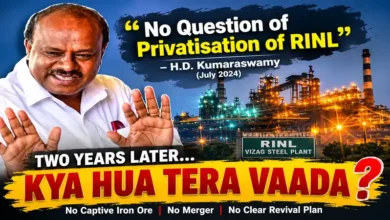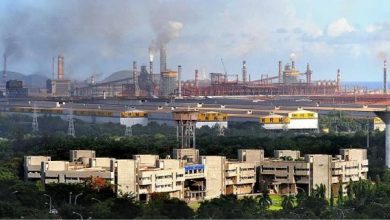

The ‘Aaya Ram, Gaya Ram’ Syndrome at RINL: Did the Steel Ministry Fail Vizag Steel?
Three stopgap CMDs, nearly 20 months without a full-time chief, and a PSU fighting for survival

Even as RINL grapples with the aftermath of the tragic fire accident that claimed eight lives, an uncomfortable question refuses to go away: Was the Ministry of Steel ever serious about ensuring professional management at the troubled steel PSU?
When Atul Bhatt proceeded on leave in September 2024 ahead of his retirement, RINL was already battling its worst crisis. Mounting losses, raw material shortages, declining production, bank defaults, salary concerns and growing liabilities had pushed the company to the brink.
This was precisely the moment when RINL needed a strong, full-time CMD. Instead, the Ministry chose a series of temporary arrangements.
First came A.K. Bagchi, Director (Projects), with additional charge. He was soon replaced by Ajit Kumar Saxena, CMD of MOIL, who headed RINL as an additional responsibility while continuing to run another PSU. After Saxena’s retirement in December 2025, the Ministry again opted for a stop-gap solution by handing additional charge to Manish Raj Gupta of SAIL.
For nearly 20 months, RINL functioned without a dedicated full-time CMD.
The issue is not about the competence of Saxena or Gupta. Both are respected professionals. The real question is why a strategic PSU employing thousands and carrying liabilities worth tens of thousands of crores was never considered important enough to warrant a full-time chief executive during its darkest phase.
What message did this send to employees, lenders and stakeholders?
If the government genuinely believed in RINL’s revival, why was there no urgency in appointing a regular CMD? Why was a company fighting for survival left to be managed through part-time leadership arrangements?
Corporate turnarounds require accountability, continuity and decisive leadership. Instead, RINL spent almost two years under executives whose primary responsibilities lay elsewhere.
The eventual appointment of M.N.V.S. Prabhakar as CMD in May 2026 was a welcome step. But it also highlighted a larger failure. The question is not why Prabhakar was appointed. The question is why it took nearly two years to do so.
As investigations continue into the recent fire tragedy, attention will understandably focus on safety systems and operational lapses. But governance failures must also be examined.
Because institutions do not decline overnight. They weaken when critical decisions are delayed, accountability becomes diffused and leadership is treated as an afterthought.
RINL's prolonged leadership vacuum remains one of the most telling examples of how the system failed a PSU when it needed professional management the most.