
JMM Temporarily Halts Coal Production and Dispatch at CCL’s Amrapali Project in Protest Against Mineral Bill
The disruption affected coal production and transportation activities at the project for a brief period

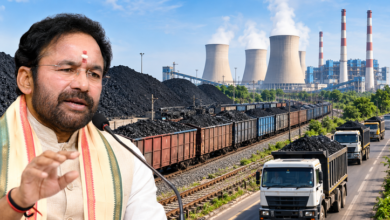
The Jharkhand Mukti Morcha (JMM) has intensified its opposition to the Mines and Minerals (Development and Regulation) Amendment Bill, 2026, with party workers, temporarily halting coal production and dispatch at Central Coalfields Limited (CCL)’s Amrapali Open Cast Project in Chatra district.
The protest marks the first phase of the party’s announced agitation against the proposed legislation. JMM workers gathered at the coal project and disrupted mining and coal dispatch operations, declaring that the stoppage would continue indefinitely.
Central Coalfields Limited (CCL), a subsidiary of Coal India Limited, operates the Amrapali coal project. The disruption has affected coal production and transportation activities at the project.
JMM Chatra district president Nilesh Gyasen said the party was opposed to what it described as attempts by the Central Government to weaken Jharkhand’s rights over its mineral resources.
He said the agitation was not merely about opposing a Bill but was linked to the larger issue of Jharkhand’s rights, identity and economic interests.
“Jharkhand’s mineral resources are closely linked to the rights and economic interests of its people. Any attempt to weaken these rights will not be tolerated,” Gyasen said.
He said JMM was a party born out of struggles and would continue to raise the issue on the streets as well as through democratic platforms. He warned that the agitation would be expanded if the Central Government did not withdraw the proposed legislation.
JMM district treasurer Nitesh Rana said the agitation had begun at the Amrapali project and would be expanded in accordance with directions from the party leadership.
He said the party would strongly oppose any move that, in its view, weakened the rights of Jharkhand over its mineral resources. Referring to the party’s long-standing political position on “Jal, Jungle, Zameen”, Rana said JMM would continue to fight for the rights of the state and its people.
He further said JMM workers would remain united on issues concerning Jharkhand’s mineral resources and would intensify the agitation against provisions of the proposed legislation that the party considers detrimental to the state’s interests.
The core committee of the JMM will meet on August 20 to chart out the further course of action.
Editor’s Note
With a significant share of Jharkhand’s coal mining operations falling under Central Coalfields Limited and other coal companies, the biggest concern is the possibility of prolonged disruption to coal production, dispatch and transportation in the state.
We fully recognise that the Mines and Minerals (Development and Regulation) Amendment Bill, 2026 has emerged as a serious point of contention between the Centre and the JMM-led government in Jharkhand. Differences over mineral rights, revenue and the interests of the state deserve to be debated and addressed through democratic and constitutional mechanisms.
However, there are other ways of settling such differences than disrupting mining, coal dispatch and transportation operations. Such disruptions can affect coal supplies, industrial activity, workers, transporters and, ultimately, the wider economy.
Dialogue is the need of the hour. The Centre and the Jharkhand Government must engage in meaningful discussions and find a mutually acceptable way forward.
Political differences and policy disagreements are part of a democracy. But causing avoidable losses to the national exchequer is an entirely different matter—one that cannot and should not be tolerated.
The interests of Jharkhand, its people and the nation are best served not through confrontation that disrupts economic activity, but through dialogue, negotiation and a balanced resolution.
The development comes amid growing political opposition in Jharkhand to the Mines and Minerals (Development and Regulation) Amendment Bill, 2026, with the issue emerging as a major point of contention between the state’s ruling political forces and the Central Government.