
Coal India Tweet Clarifies States’ 90% Mining Revenue Share Under MMDR Amendment Bill 2026
Coal India Limited steps in to explain and simplify the meaning of the MMDR framework
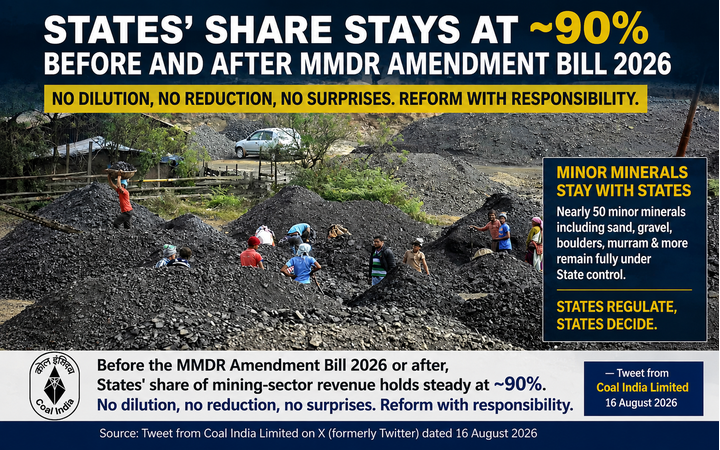
Coal India Limited, in a post on X on Sunday, clarified that states’ share of revenue from the mining sector will remain at around 90% even after the proposed MMDR Amendment Bill 2026.
In its tweet, Coal India said the states’ share remains unchanged before and after the proposed amendments, emphasising that there would be “no dilution, no reduction, no surprises.”
“Before the MMDR Amendment Bill 2026 or after, States’ share of mining-sector revenue holds steady at ~90%. No dilution, no reduction, no surprises. Reform with responsibility,” Coal India said in the tweet.
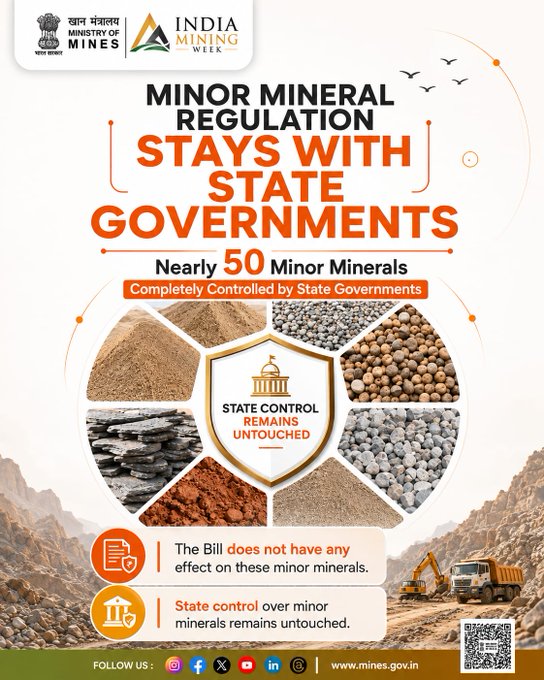
Minor Minerals to Remain Under State Control
Coal India also used its X post to clarify the position of minor minerals, stating that nearly 50 minor minerals, including sand, gravel, boulders and murram, will continue to remain fully under the control of state governments.
According to Coal India, the MMDR Amendment Bill 2026 makes no changes to this arrangement.
“States regulate, States decide,” the company said, underlining that state governments will continue to have regulatory authority over minor minerals.
The clarification is significant because minor minerals are closely linked with construction and infrastructure activity, while their extraction, regulation, permits and associated revenue mechanisms are largely administered at the state level.
No Dilution of States’ Revenue Share
Coal India’s tweet seeks to address concerns over whether the proposed amendments to the Mines and Minerals (Development and Regulation) Act could affect the financial interests of mineral-rich states.
The company stated that the approximately 90% share of states in mining-sector revenue remains intact, both before and after the proposed legislative changes.
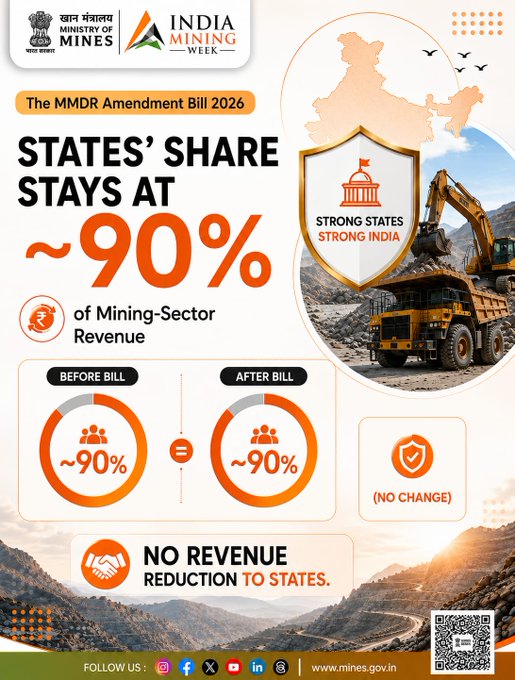
Coal India characterised the approach as “reform with responsibility”, stressing that changes in the mining regulatory framework would not result in a reduction of the states’ revenue share.
For mineral-rich states, mining remains an important contributor to government revenues, employment and regional economic activity. The assurance from Coal India is therefore likely to be relevant to ongoing discussions around the proposed amendments.
The company’s message also draws a clear distinction between broader reforms under the MMDR framework and the regulatory control of minor minerals.
With its latest tweet, Coal India Limited has sought to make two points clear: states will retain around 90% of mining-sector revenue, and nearly 50 minor minerals—including sand, gravel, boulders and murram—will remain under state control.
“States regulate, States decide,” Coal India said, while describing the proposed changes as “reform with responsibility.”