

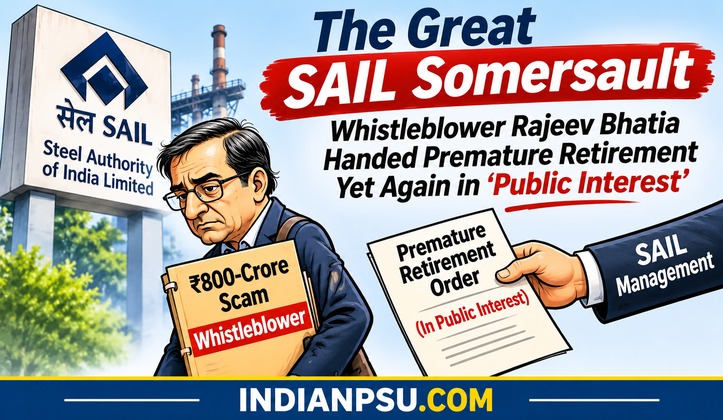
The Great SAIL Somersault: Whistleblower Rajeev Bhatia Handed Premature Retirement Yet Again in ‘Public Interest’
One fails to understand the "Public Interest" in this move!!!
Read in your preferred Language :
One step forward, two steps backward – and vice versa. Even the pawns on the chessboard of Steel Authority of India Limited (SAIL) appear bewildered by the erratic moves and shifting positions of the top management of the Maharatna steel PSU.
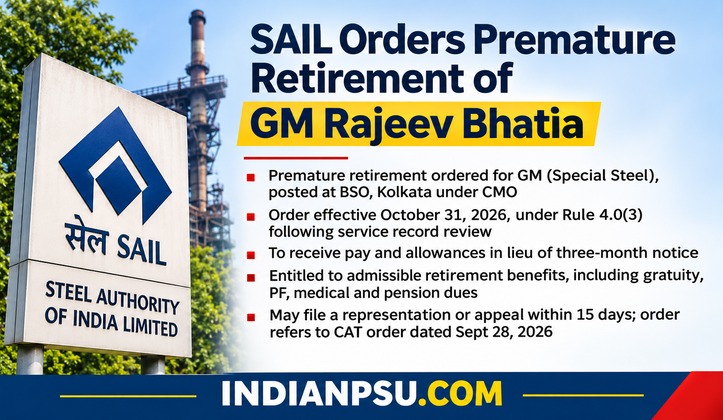
Rajeev Bhatia, the whistleblower who allegedly exposed an ₹800-crore scam within SAIL, has once again been ordered into premature retirement in the name of “public interest.”
A total of 29 SAIL officials were suspended in January 2024 in connection with investigations into alleged corruption in the steel PSU’s commercial dealings. These included two board-level officials and 27 other SAIL executives. Separately, one NMDC director, V. Suresh, was also suspended, taking the total across SAIL and NMDC to 30 officials.
The two SAIL directors were V.S. Chakravarthy (Director, Commercial) and A.K. Tulsiani (Director, Finance). The 27 other SAIL executives included 26 below-board-level officials suspended by SAIL and one additional senior executive cited in subsequent reporting. Most of the suspended officials were reinstated in June 2024 while the investigation was still pending.
The ₹800-Crore Question Cannot Simply Disappear
The allegations surrounding the reported ₹800-crore scam make this development particularly sensitive.
If Bhatia exposed financial irregularities on this scale, the obvious questions concern the substance of those disclosures, the action taken on them, and the findings of any inquiry conducted into the allegations.
Were the allegations investigated? What conclusions did the inquiry reach? Were any irregularities established? Were responsibility and accountability fixed wherever warranted?
Significantly, in Complaint No. 73/2023 pertaining to Venkatesh Infra Projects Pvt. Ltd., the Lokpal of India, in its order dated July 2, 2025, stated that the CBI, in its report submitted to the Lokpal on May 7, 2025, had depicted the culpability of SAIL officials.
Irrespective of whether any other agency is investigating the complaints, it is necessary to hold a departmental inquiry—a step that SAIL has not initiated even after the passage of three years, thereby allowing the officials allegedly involved to continue enjoying prime and lucrative postings.
These questions cannot be answered merely by examining the retirement order. The document neither establishes the alleged scam nor provides evidence that Bhatia was retired because of his whistleblowing.
Nevertheless, the coincidence of an executive’s reported whistleblower role and a fresh premature retirement order warrants a transparent explanation.
If the allegations were unfounded, the findings of the competent inquiry should provide clarity. If wrongdoing was established, accountability should follow the evidence, irrespective of rank or position.
What cannot inspire confidence is a situation in which serious allegations remain unanswered while the individual associated with exposing them finds himself facing another premature retirement order.
SAIL Management Must Answer
SAIL is a Maharatna public sector undertaking entrusted with an important role in India’s steel industry. Its management is expected to demonstrate institutional integrity, procedural fairness and accountability.
That expectation becomes even more important when allegations of substantial financial irregularities and questions about the treatment of a reported whistleblower arise together.
The immediate questions are straightforward:
- What specific findings led the Standing Committee to recommend Bhatia’s premature retirement?
- What is the current status of the allegations concerning the reported ₹800-crore scam?
- Were the allegations independently investigated, and what were the findings?
- Has SAIL examined whether Bhatia’s reported disclosures had any bearing on the circumstances of his retirement?
- Will management provide a transparent explanation of the decision and its procedural background?
Editor’s Take: SAIL management owes its stakeholders a convincing explanation. Public interest cannot be reduced to a phrase in an official order; it must be supported by a decision-making process that can withstand scrutiny.