

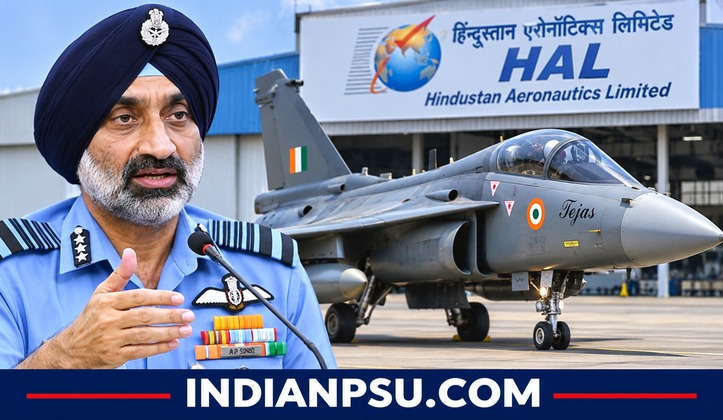
Outgoing Air Chief Marshal AP Singh Flags Defence Production Shortcomings; HAL Under Spotlight
His message is clear: India's defence manufacturing ambitions must translate into operational capabilities on the ground
Read in your preferred Language :
Outgoing Chief of the Air Staff Air Chief Marshal A.P. Singh has left behind an important message for India’s defence production industry, repeatedly questioning delays in the development and delivery of indigenous military equipment and calling for greater accountability among defence manufacturers.
During his tenure, Singh emerged as one of the most outspoken critics of delays in India’s defence manufacturing ecosystem, particularly those affecting Hindustan Aeronautics Limited (HAL), the country’s largest state-owned aerospace and defence manufacturer.
His criticism was not limited to one company. He also raised concerns about delays across indigenous defence development programmes, the functioning of multiple agencies and the gap between contractual commitments and actual delivery.
HAL faces direct criticism over Tejas delivery delays
Singh’s most direct public criticism of HAL came during Aero India in February 2025, when he questioned the company’s preparedness and approach towards delivering the Tejas Mk-1A fighter aircraft.
“I am just not confident of HAL,” Singh remarked while interacting with HAL officials. He also said that the company was not operating in a mission-oriented manner.
The remarks were significant because HAL had committed to delivering the first batch of Tejas Mk-1A aircraft to the IAF, but the programme had already encountered substantial delays.
The original delivery schedule envisaged the first aircraft in March 2024. However, engine supply constraints, weapons integration and other technical issues affected the programme. ThePrint+1
‘Delays are going to hurt us’
The outgoing Air Chief again highlighted the problem on October 3, 2026, when he said that delays in domestic fighter aircraft production would affect the operational capabilities of the Indian Air Force.
He pointed out that the Tejas Mk-1A programme was running approximately two years behind schedule.
The IAF requires additional fighter aircraft to address its declining squadron strength. Against an authorised strength of 42 fighter squadrons, the force had been operating with only 29.
Singh also called for prioritisation of indigenous fighter aircraft programmes rather than spreading limited resources across too many projects simultaneously.
He questioned whether organisations involved in multiple programmes had adequate resources to deliver them within the stipulated timelines.
Defence production cannot operate on promises
Singh had also raised the broader issue of delays in defence procurement and manufacturing in May 2025.
Questioning the practice of making commitments that cannot be fulfilled, he emphasised that delivery timelines must be realistic and contractual commitments should translate into actual delivery.
His position was that India could not achieve genuine self-reliance merely by assembling equipment domestically. The country needed to develop its own design, research, development and manufacturing capabilities.
The message was particularly relevant for defence PSUs and research organisations responsible for developing critical military platforms and equipment. India News – The Indian Express+1
Self-reliance cannot compromise operational readiness
In his final interview before retirement, published on November 1, 2026, Singh reiterated that imports could not become the long-term foundation of India’s air power.
However, he also made it clear that the immediate operational requirements of the armed forces could not be compromised while waiting for indigenous programmes to mature.
He advocated a combined approach in which imports could bridge critical capability gaps while domestic programmes strengthened India’s long-term technological and manufacturing capabilities.
His argument was that indigenous aircraft, weapons, sensors and electronic warfare systems were essential for strategic independence, but they needed to be delivered when the armed forces required them. The Week
A larger question for India’s defence PSUs
Singh’s observations raise important questions about the functioning of India’s defence production ecosystem.
Defence public sector undertakings have historically played a central role in building India’s military manufacturing capabilities. HAL, Bharat Electronics Limited (BEL), Bharat Dynamics Limited (BDL), Mazagon Dock Shipbuilders Limited (MDL) and other defence enterprises are entrusted with producing critical military platforms, equipment and systems.
However, the challenge is no longer merely expanding domestic manufacturing capacity. It is about ensuring timely delivery, technological advancement, quality, accountability and the ability to respond to the changing requirements of the armed forces.
The outgoing Air Chief Marshal’s repeated interventions have brought this issue into sharper focus.
His message is clear: India’s defence manufacturing ambitions must translate into operational capabilities on the ground. For defence PSUs, meeting delivery commitments is as important as securing new orders.