

India Plans ₹51,400 Crore Investment to Add 62 Ships by March 2027, Boost Maritime and Energy Security
Union Minister Hardeep Singh Puri has emphasised that India's rapid economic growth is closely linked to the development of its energy and shipping sectors
Read in your preferred Language :
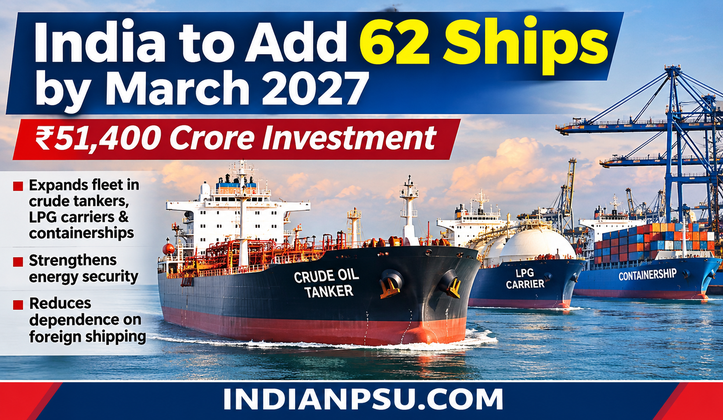
India is planning a major expansion of its national shipping fleet, with 62 vessels targeted for addition by March 2027 through an investment programme of ₹51,400 crore ($5.4 billion). The initiative aims to strengthen the country’s maritime capabilities, protect critical supply chains and reduce dependence on foreign shipping, particularly amid disruptions in the Strait of Hormuz.
The Ministry of Ports, Shipping and Waterways announced that it is advancing a roadmap to add 62 vessels with a combined capacity of 2.85 million gross tonnes during the financial year 2026-27.
Union Minister for Ports, Shipping and Waterways Sarbananda Sonowal said India urgently needs to expand its capacity in crude oil tankers, LPG carriers and container vessels. The expansion will also cover green tugs and dredging vessels to strengthen port infrastructure and maritime operations.
The roadmap was discussed at a high-level inter-ministerial meeting involving the Ministry of Ports, Shipping and Waterways, the Ministry of Petroleum and Natural Gas, the Ministry of Chemicals and Fertilisers, senior maritime and trade officials, and representatives of state-owned oil companies.
The meeting focused on addressing supply-chain disruptions arising from the Strait of Hormuz crisis and accelerating India’s efforts towards self-reliance in the maritime sector.
The disruption of shipping movements through the strategically important Strait of Hormuz has highlighted India’s vulnerability to external maritime developments. Despite diplomatic efforts by New Delhi to facilitate the movement of India-bound vessels, cargo flows from the Middle East have remained significantly affected.
Two Indian-flagged tankers, Sanmar Herald and Jag Arnav, were also reportedly attacked by Iranian forces while attempting to exit the Strait earlier this month.
Energy Security Driving India’s Shipping Expansion
Union Minister for Petroleum and Natural Gas Hardeep Singh Puri has emphasised that India’s rapid economic growth is closely linked to the development of its energy and shipping sectors.
Pointing to India’s economic expansion, Puri said the country’s GDP has reached approximately $4.3 trillion. Nearly half of the economic activity is linked to the external sector, including exports, imports and remittances, underlining the critical importance of international trade and maritime transportation.
India’s crude oil consumption has increased to approximately 5.6 million barrels per day from 5 million barrels per day four-and-a-half years ago. At the present growth rate, consumption is expected to touch 6 million barrels per day.
According to the International Energy Agency, India is projected to account for nearly 30% of the growth in global energy demand over the next two decades, compared with an earlier estimate of 25%.
This rising demand will significantly increase the requirement for vessels capable of transporting crude oil, natural gas, LPG and other energy products.
Oil and Gas Account for 28% of India’s Trade Volume
Highlighting the scale of India’s energy trade, Puri said the country imported approximately 300 million metric tonnes of crude oil and petroleum products during 2024-25, while exports stood at around 65 million metric tonnes.
The oil and gas sector accounts for nearly 28% of India’s total trade by volume, making it the largest single commodity segment handled by Indian ports.
India currently meets approximately 88% of its crude oil requirements and 51% of its natural gas requirements through imports. This dependence makes shipping infrastructure a critical component of the country’s energy security.
Indian Oil PSUs Spent $8 Billion on Chartering Ships
The financial implications of dependence on foreign shipping are equally significant.
Puri highlighted that freight costs constitute a substantial component of India’s energy import expenditure. Oil marketing companies pay approximately $5 per barrel to transport crude oil from the United States, compared with around $1.2 per barrel from the Middle East.
Over the past five years, Indian public sector oil companies, including Indian Oil Corporation Limited (IOCL), Bharat Petroleum Corporation Limited (BPCL) and Hindustan Petroleum Corporation Limited (HPCL), have collectively spent nearly $8 billion on chartering vessels.
The Minister observed that this expenditure could have supported the creation of a substantial fleet of Indian-owned tankers.
The proposed ₹51,400 crore investment programme therefore represents more than an expansion of shipping capacity. It is also an effort to retain a greater share of maritime freight expenditure within the country, strengthen domestic shipping ownership and reduce vulnerabilities arising from geopolitical disruptions.
With India’s energy consumption expected to rise sharply over the coming decades, developing an indigenous fleet of tankers, gas carriers and container vessels is emerging as an important strategic priority.