

One Dead, Two Injured as Rat-Hole Mining Continues Unabated in Jharkhand
State police seem to be in deep - deep slumber, as all raids and recoveries have been made by CISF
Read in your preferred Language :
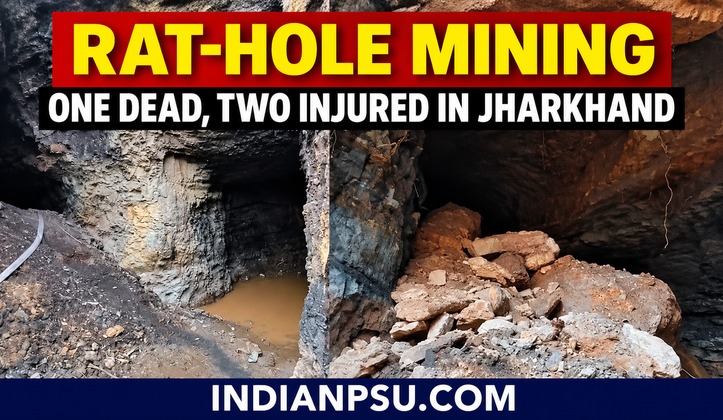
Illegal coal mining has once again claimed a worker’s life in Jharkhand. One worker died and two others reportedly suffered serious injuries after the roof of an illegal underground coal mine collapsed at Indra village in Barkagaon block of Hazaribagh district on Thursday morning.
The deceased has been identified as Kaleshwar Mahto (30), a resident of Simradiha Tola in Gondalpura village. He was the son of Bazo Mahto and is survived by a son and two daughters.
The incident has brought the continuing operations of dangerous underground coal mines in the Barkagaon region under scrutiny. Local sources claim that dozens of illegal coal mines are operating in the Indra and Lurunga areas, with workers extracting coal under hazardous conditions.
The precise mining method used at the site of Thursday’s collapse has not been officially established. However, the reported presence of narrow, tunnel-like illegal underground workings raises concerns about rat-hole-style mining and the safety of workers employed in these operations.
Allegations of evidence being concealed
Serious questions have also emerged over the handling of the worker’s death. There are reports that the body was cremated without a post-mortem examination, allegedly to avoid legal scrutiny. However, this claim has not been officially confirmed.
The absence of a clear official account of the incident has added to concerns over whether the circumstances surrounding the death will be properly investigated.
Dozens of illegal mines allegedly operating
According to local accounts, illegal coal extraction is continuing at several locations across the Indra-Lurunga belt. Some of the mining sites are reportedly situated on reserved forest land, raising additional concerns over violations of forest and mining regulations.
The alleged coal supply chain is also raising questions. Coal extracted from these unauthorised mines is reportedly transported by tractors to local stockyards. It is subsequently moved in heavy vehicles, including Hyvas and trailers, to other locations.
Sources further allege that illegally extracted coal is supplied to certain sponge iron plants in the Kuju area of Ramgarh district and the Giddi police station area of Hazaribagh district.
These allegations require an independent investigation to establish the operators, transporters, stockyard owners and industrial consumers involved in the alleged supply chain.
Rat-hole mining and the question of worker safety
Rat-hole mining involves extracting coal through narrow underground passages, often forcing workers to crawl through confined tunnels. Such operations can be extremely dangerous when conducted without proper roof support, ventilation, emergency exits and other mandatory safety arrangements.
Mine collapses, flooding and the accumulation of dangerous gases can turn these underground workings into death traps.
The National Green Tribunal prohibited rat-hole coal mining in Meghalaya in 2014. The legal position, however, must be distinguished from the broader issue of illegal mining in Jharkhand. Unauthorised coal extraction without the required statutory permissions is illegal under the applicable mining laws, irrespective of the method used.
The Barkagaon incident therefore raises a larger question: how are unauthorised underground coal mines allegedly continuing to operate in the region despite repeated accidents and the risks to workers?
Where are the enforcement agencies?
The continuing allegations of illegal mining raise serious questions for the district administration, mining authorities and forest department.
If dozens of mines are operating in the area, how are coal extraction, transportation and storage taking place without effective intervention? Who is responsible for monitoring the alleged mining activity on forest land? How is the extracted coal reaching stockyards and industrial consumers?
The authorities must investigate not just the site of the latest collapse but the entire alleged illegal coal supply network.
A comprehensive probe should establish the identities of those operating the mines, verify the reported injuries and circumstances of the death, examine the post-mortem allegations and trace the movement of coal from the extraction sites to stockyards and industrial units.
The deaths and injuries of workers cannot be reduced to routine incidents of illegal mining. Those who organise and profit from unauthorised extraction must be held accountable, while the agencies responsible for preventing such operations must explain how these mines continue to function.
The latest tragedy in Barkagaon is a grim reminder that illegal coal mining is not merely a question of mineral theft. It is also a question of human lives, administrative accountability and the enforcement of India’s mining laws.