
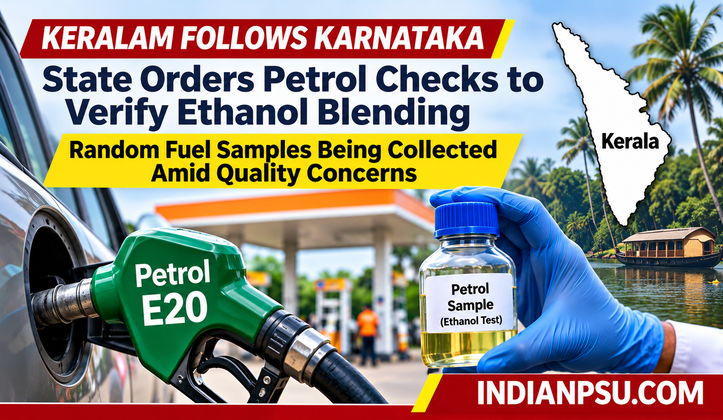
Keralam Follows Karnataka, Launches Random Petrol Checks to Detect Excess Ethanol Blending
The Centre and oil companies have already questioned the methodology adopted by Karnataka
Read in your preferred Language :
Following Karnataka’s allegations of excessive ethanol blending in petrol, the Keralam government has launched surprise inspections and random fuel sampling across the state to determine whether oil marketing companies (OMCs) are complying with the prescribed 20% ethanol blending limit.
The state’s Civil Supplies Department has begun collecting petrol samples from selected retail outlets for laboratory testing amid growing concerns over fuel quality, falling mileage and reports of vehicle engine problems.
Food and Civil Supplies Minister Anoop Jacob said the decision was taken after complaints from consumers and reports emerging from neighbouring Karnataka about petrol allegedly containing ethanol beyond the permissible E20 limit.
The inspection drive covers five districts — Thiruvananthapuram, Ernakulam, Kozhikode, Thrissur and Kannur.
Officials have been instructed to collect samples in the presence of representatives of oil marketing companies to ensure transparency in the process. The collected samples will be sent to government laboratories, including accredited facilities, for testing. The results are expected within approximately 10 days.
Jacob said consumers have the right to know the quality and composition of the fuel they purchase. He maintained that the exercise was intended to address public concerns and establish whether petrol sold in the state meets prescribed quality standards.
The minister also warned that strict action would follow if fuel samples were found to contain ethanol beyond permissible limits or were otherwise found to be adulterated. Authorities have the power to initiate legal proceedings against erring outlets under the applicable regulatory framework.
Karnataka’s findings trigger wider scrutiny
The Keralam government’s action follows a major controversy in Karnataka, where the state government claimed that laboratory testing had detected ethanol concentrations substantially higher than the prescribed 20% limit in petrol sold at several retail outlets.
Karnataka Food and Civil Supplies Minister Rizwan Arshad had claimed that testing of 63 petrol samples revealed instances of ethanol blending ranging between 26% and 31.2%.
The findings triggered a confrontation between the Karnataka government and public sector oil marketing companies, including Indian Oil Corporation (IOCL), Bharat Petroleum Corporation Limited (BPCL) and Hindustan Petroleum Corporation Limited (HPCL).
The three oil companies have rejected the allegations, questioning the testing methodology and maintaining that ethanol blending at refineries and depots is an automated process governed by stringent quality-control procedures.
Karnataka, however, has defended its sampling and testing procedures and reiterated its demand for greater transparency in fuel quality monitoring.
Centre and oil companies dispute excessive blending allegations
The Union Petroleum Ministry has also rejected Karnataka’s findings, maintaining that quality checks conducted on 893 E20 petrol samples collected from 27 states and Union Territories found the fuel compliant with prescribed standards.
The Centre and oil companies have questioned the methodology adopted by Karnataka, while the state government has stood by its findings.
E20 controversy puts oil companies under scrutiny
The controversy has brought the Centre’s ethanol blending programme under renewed public scrutiny.
India has been promoting ethanol blending to reduce dependence on imported crude oil, lower emissions and support the domestic agricultural sector. However, allegations of excessive blending have raised questions about fuel quality, transparency and the potential impact on vehicles.
With Keralam now joining Karnataka in independently examining petrol samples, the focus is shifting towards the actual ethanol content of fuel being sold to consumers.
The laboratory findings from Keralam could provide another important indicator in the ongoing debate over E20 petrol and compliance by oil marketing companies.
For millions of motorists, the immediate concern remains straightforward: whether the petrol they purchase meets prescribed specifications and whether they are getting the quality of fuel they are paying for.