

India Strengthens Energy Security as Global Refining Capacity Shrinks: Hardeep Singh Puri
The minister highlights India's expanding refining capacity, increased LPG production, diversified crude sourcing and ambitious petrochemical roadmap amid global energy uncertainties
Read in your preferred Language :
Union Petroleum and Natural Gas Minister Hardeep Singh Puri has said that India’s energy security remained resilient amid geopolitical conflicts in the Middle East and global supply-chain disruptions, attributing the country’s ability to navigate the crisis to advance planning, diversified crude oil sourcing and expansion of domestic energy production.
In a statement highlighting India’s preparedness to deal with global energy uncertainties, Puri said the country had successfully insulated energy consumers from the adverse impact of geopolitical conflicts and supply disruptions, even as several countries across the world faced serious energy emergencies and steep increases in fuel prices.
According to the minister, decisions taken well in advance under the leadership of Prime Minister Narendra Modi helped India anticipate potential challenges and prepare for disruptions in the global energy market.
SEE VIDEO:
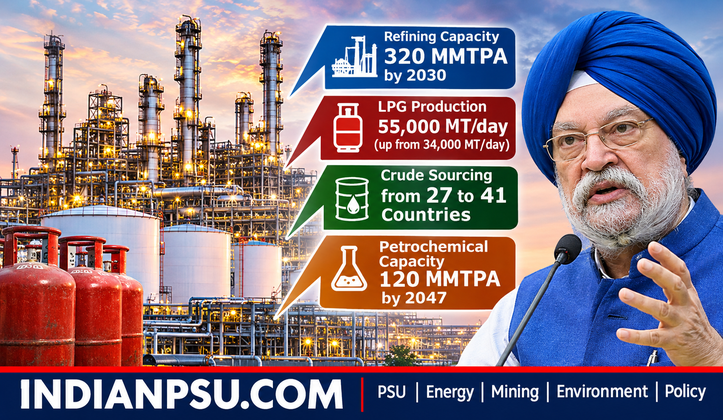
India expands crude oil sourcing from 27 to 41 countries
India has significantly diversified its crude oil procurement, expanding the number of sourcing countries from 27 to 41, Puri said.
The diversification strategy has strengthened India’s ability to navigate geopolitical uncertainties and disruptions affecting traditional energy supply routes.
India’s refining capacity currently stands at approximately 267 million tonnes per annum, while the country is targeting an expansion to 320 MMTPA by 2030 and eventually to 450 MMTPA.
Puri said India’s refining sector was strengthening its capacity even as several major global energy markets witnessed declining refining capacity and refinery closures.
From the upcoming refinery at Barmer to expansion of existing refining facilities, India is building a stronger foundation to meet its growing energy requirements.
LPG production increased to 55,000 tonnes daily
Highlighting the government’s response to concerns over LPG availability during the global energy crisis, Puri said domestic LPG production had been increased substantially.
Daily LPG bookings reportedly surged from approximately 52 lakh cylinders to more than 90 lakh cylinders amid concerns and rumours regarding potential shortages.
In response, LPG production was increased from approximately 34,000 metric tonnes per day to 55,000 metric tonnes per day.
The minister said the government’s coordinated efforts ensured that there was no shortage of LPG, no rationing and no disruption to economic activities.
He said the government ensured that the impact of the global crisis did not reach Indian kitchens.
Energy security through advance preparation
Puri said India’s resilience amid global uncertainties was the result of decisions taken in advance to strengthen energy security.
The country has expanded crude oil sourcing, strengthened domestic LPG production, maintained substantial refining capacity and continued investments in energy infrastructure.
According to the minister, India’s successful energy diplomacy under Prime Minister Narendra Modi helped ensure that domestic consumers remained insulated from the negative impact of geopolitical conflicts and global supply-chain disruptions.
Petrochemicals to drive the next phase of growth
The next phase of India’s refining story will not merely be about producing more fuel but extracting greater value from every barrel of crude oil, Puri said.
Petrochemicals are expected to play a central role in this transformation.
India’s current petrochemical capacity stands at approximately 36.4 MMTPA. Demand is projected to rise to around 55 MMTPA by 2030 and approximately 120 MMTPA by 2047.
The projected growth in demand presents substantial opportunities for investments, collaborations and expansion across the petrochemical value chain.
The minister said the scale of future demand demonstrated the enormous opportunity available to India’s energy and petrochemical sectors.
Samudra Manthan to unlock offshore hydrocarbon potential
India is also strengthening its exploration and production capabilities through initiatives aimed at unlocking domestic hydrocarbon resources.
Puri highlighted Samudra Manthan as a major push towards unlocking India’s offshore hydrocarbon potential, including opening nearly one million square kilometres of previously designated No-Go areas for exploration.
The initiative is expected to strengthen domestic exploration and production activities and contribute to reducing India’s dependence on imported hydrocarbons.
Renewables, green hydrogen and biofuels
India’s energy strategy is simultaneously advancing renewable energy, biofuels, green hydrogen, compressed biogas and natural gas.
Puri highlighted the USD 3 billion GOBARdhan programme, which aims to convert waste into clean energy while supporting rural incomes and accelerating India’s clean energy transition.
The government is seeking to build a diversified energy ecosystem combining conventional hydrocarbons with emerging clean energy technologies.
India’s energy sector attracting investments
The momentum in India’s energy sector is creating opportunities for collaborations and investments, particularly under the Make in India initiative.
Expansion of refining infrastructure, growing petrochemical demand, offshore exploration, LPG production and investments in alternative energy are expected to create opportunities across the energy value chain.
Puri said India’s expanding capabilities and capacities were strengthening its position in the global energy landscape.
The country’s energy strategy, he said, is not merely aimed at meeting domestic requirements but also at strengthening India’s role and capabilities in the global energy sector.
With expanding refining infrastructure, diversified crude oil sourcing, higher domestic LPG production and growing investments in petrochemicals and clean energy, India is positioning itself to navigate future global energy uncertainties while meeting the requirements of a rapidly growing economy.